
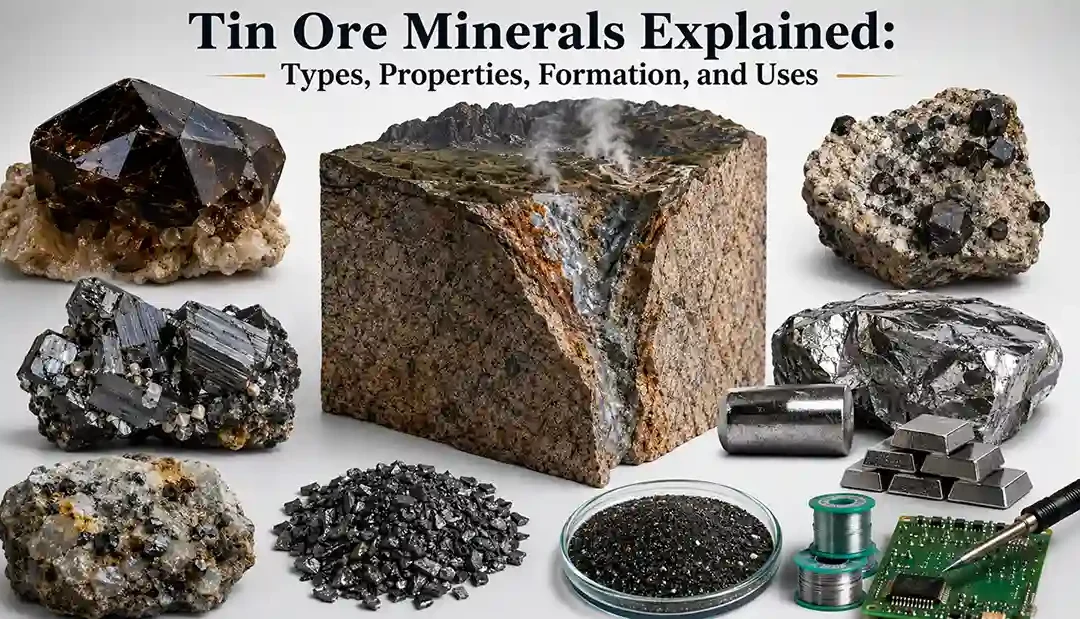
Tin has been an important metal for thousands of years. It was one of the key components of bronze, helping shape ancient civilizations and technological development.
Today, tin remains essential for:
- electronics manufacturing
- solder production
- tin plating
- renewable energy technologies
- industrial alloys
Most of the world's tin comes from a small number of specialized tin ore minerals, with cassiterite being the dominant source.
Learn more → mineral classification system
What Are Tin Ore Minerals?
Tin ore minerals are naturally occurring minerals that contain significant concentrations of tin.
These minerals commonly occur in:
- granite-related deposits
- hydrothermal veins
- pegmatites
- placer deposits
- greisen systems
Most commercial tin production comes from cassiterite-rich deposits.
Chemical Formula of Tin
Tin is a metallic element represented by:
Basic Properties
| Property | Value |
|---|---|
| Element Name | Tin |
| Symbol | Sn |
| Atomic Number | 50 |
| Atomic Weight | 118.71 |
| Classification | Post-Transition Metal |
| Density | 7.31 g/cm³ |
Major Tin Ore Minerals
Cassiterite – The Most Important Tin Ore
Cassiterite is the world's most important tin mineral.
Its formula is:
Characteristics include:
- brown to black color
- high density
- adamantine luster
- exceptional hardness
Nearly all major tin-producing regions mine cassiterite.
Stannite
Stannite is an important tin sulfide mineral.
Its formula is:
Features include:
- metallic luster
- steel-gray color
- copper association
- hydrothermal origin
It often occurs with copper and tin ores.
Teallite
Teallite is a lead-tin sulfide mineral.
Its formula is:
Characteristics include:
- metallic appearance
- lead-tin composition
- occurrence in hydrothermal veins
Cylindrite
Cylindrite is a rare tin-bearing sulfosalt.
Its formula is:
It is famous for:
- cylindrical crystal shapes
- complex chemistry
- collector interest
Canfieldite
Canfieldite is a silver-tin sulfide mineral.
Its formula is:
Features include:
- silver content
- metallic luster
- rarity
Formation of Tin Deposits
Granite Magmatism
Most tin deposits are associated with granitic intrusions.
Hydrothermal Activity
Tin-rich fluids deposit ore minerals.
Greisen Formation
Important environment for cassiterite concentration.
Placer Processes
Weathering concentrates cassiterite in sediments.
Granite-Hosted Tin Deposits
Many tin deposits occur in:
- granites
- pegmatites
- greisens
- hydrothermal veins
These environments concentrate tin during late-stage magmatic processes.
Cassiterite in Placer Deposits
Because cassiterite is:
- dense
- hard
- resistant to weathering
it commonly accumulates in:
- river gravels
- stream sediments
- alluvial deposits
Many historic tin mines exploited placer deposits rather than hard-rock mines.
Tin and Modern Technology
Electronics
Tin solder is essential for circuit boards.
Renewable Energy
Used in solar technologies and electronics.
Packaging
Tin coatings protect steel from corrosion.
Industrial Alloys
Important component of bronze and specialty alloys.
Major Uses of Tin
| Industry | Application |
|---|---|
| Electronics | Solder |
| Manufacturing | Alloys |
| Packaging | Tin-Plated Steel |
| Renewable Energy | Electronic Components |
| Construction | Specialty Materials |
Major Tin-Producing Countries
Important tin producers include:
- China
- Indonesia
- Myanmar
- Peru
- Bolivia
- Brazil
These countries host some of the world's largest cassiterite deposits.
How Geologists Identify Tin Ore Minerals
Cassiterite
- very high density
- brown-black color
- hardness of 6–7
- adamantine luster
Stannite
- metallic appearance
- sulfide composition
Teallite
- lead-tin association
- metallic luster
Cassiterite's high density is one of its most important identification features.
Learn more → mineral identification guide
Tin Ore Minerals Summary
| Mineral | Formula | Main Use |
|---|---|---|
| Cassiterite | SnO₂ | Tin Ore |
| Stannite | Cu₂FeSnS₄ | Tin Ore |
| Teallite | PbSnS₂ | Minor Ore |
| Cylindrite | Pb₃Sn₄FeSb₂S₁₄ | Collector Mineral |
| Canfieldite | Ag₈SnS₆ | Silver-Tin Mineral |
Cassiterite (SnO₂) is the world's primary tin ore mineral.
The chemical symbol for tin is Sn.
Most tin deposits form in granite-related hydrothermal systems and pegmatites.
Cassiterite contains high concentrations of tin and is the main source of global tin production.
Tin is widely used in solder, electronics, alloys, tin-plated steel, and renewable energy technologies.
Final Thoughts
Tin ore minerals have played a major role in human history, from the Bronze Age to modern electronics manufacturing. Minerals such as cassiterite and stannite provide the tin needed for solder, alloys, and advanced technologies.
As demand for electronics and renewable energy infrastructure continues to grow, tin ore minerals will remain economically important resources for the global economy.