
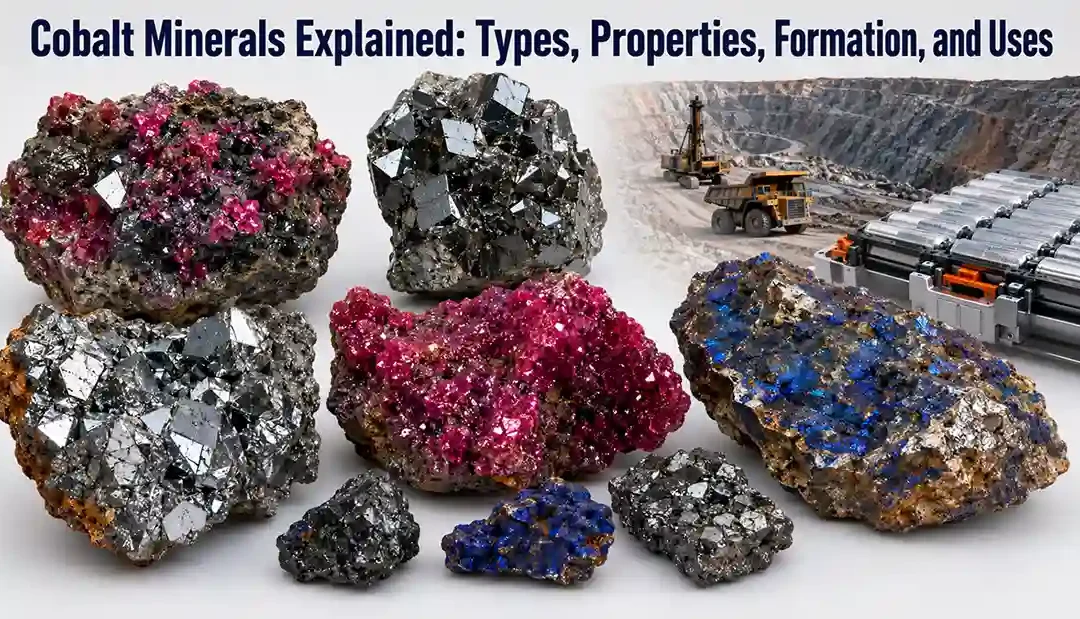
Cobalt is one of the most important critical minerals in the modern world. It is widely used in:
- rechargeable batteries
- electric vehicles
- aerospace alloys
- renewable energy systems
- electronics
Most cobalt is produced as a byproduct of copper and nickel mining rather than from dedicated cobalt mines.
Today, cobalt minerals are considered strategic resources because they support the global transition toward clean energy technologies.
Learn more → mineral classification system
What Are Cobalt Minerals?
Cobalt minerals are naturally occurring minerals that contain cobalt as a major component.
They occur in:
- hydrothermal veins
- magmatic sulfide deposits
- nickel-copper deposits
- sediment-hosted deposits
- oxidation zones
Although cobalt is relatively rare, it is concentrated in several economically important mineral species.
Chemical Formula of Cobalt
Cobalt is a metallic element represented by:
Basic Properties
| Property | Value |
|---|---|
| Element Name | Cobalt |
| Symbol | Co |
| Atomic Number | 27 |
| Atomic Weight | 58.93 |
| Classification | Transition Metal |
| Density | 8.90 g/cm³ |
Major Cobalt Minerals
Cobaltite – The Most Important Cobalt Mineral
Cobaltite is one of the most important cobalt-bearing minerals.
Its formula is: CoAsS
Characteristics include:
- metallic luster
- silver-gray color
- arsenic content
- hydrothermal origin
Cobaltite is an important source of cobalt in many mining districts.
Erythrite
Erythrite is one of the most recognizable cobalt minerals.
Its formula is: Co₃(AsO₄)₂·8H₂O
Characteristics include:
- bright pink color
- purple-red crystals
- secondary mineral origin
- weathering product
Because of its distinctive color, erythrite is often called "Cobalt Bloom."
Skutterudite
Skutterudite is an important cobalt arsenide mineral.
Its generalized formula is: (Co,Ni)As₃
Features include:
- metallic appearance
- silver-gray color
- cobalt and nickel content
It commonly occurs in hydrothermal ore deposits.
Linnaeite
Linnaeite is a cobalt sulfide mineral.
Its formula is: Co₃S₄
Characteristics include:
- metallic luster
- black color
- sulfide composition
It is an important source of cobalt in some deposits.
Carrollite
Carrollite is a copper-cobalt sulfide mineral.
Its formula is: Cu(Co,Ni)₂S₄
It commonly occurs in:
- copper-cobalt deposits
- African Copperbelt ores
- stratiform mineral systems
Formation of Cobalt Deposits
Hydrothermal Activity
Hot fluids concentrate cobalt minerals.
Magmatic Sulfide Deposits
Associated with nickel and copper.
Sedimentary Deposits
Some cobalt accumulates in basin environments.
Weathering Processes
Secondary minerals such as erythrite form through oxidation.
Cobalt and Copper-Nickel Deposits
Many cobalt deposits occur alongside:
- copper minerals
- nickel minerals
- iron sulfides
- arsenide minerals
This association explains why most cobalt is produced as a byproduct of copper and nickel mining.
Cobalt in Battery Technology
Cobalt plays an important role in:
Electric Vehicles
Lithium-ion battery cathodes.
Smartphones
Rechargeable battery systems.
Laptops
Portable energy storage.
Renewable Energy
Grid-scale battery storage.
Cobalt helps improve battery stability and performance.
Major Uses of Cobalt
| Industry | Application |
|---|---|
| Electric Vehicles | Batteries |
| Electronics | Rechargeable Batteries |
| Aerospace | Superalloys |
| Energy Storage | Battery Systems |
| Manufacturing | High-Performance Alloys |
Major Cobalt-Producing Countries
Important cobalt producers include:
- Democratic Republic of the Congo
- Indonesia
- Russia
- Australia
- Canada
- Philippines
The Democratic Republic of the Congo produces the majority of the world's cobalt supply.
How Geologists Identify Cobalt Minerals
Cobaltite
- metallic luster
- silver-gray color
- arsenide composition
Erythrite
- bright pink color
- weathering mineral
- cobalt indicator
Skutterudite
- metallic appearance
- arsenide mineral
Linnaeite
- black metallic crystals
Erythrite is often one of the best visual indicators of cobalt-rich deposits.
Learn more → mineral identification guide
Cobalt Minerals Summary
| Mineral | Formula | Main Use |
|---|---|---|
| Cobaltite | CoAsS | Cobalt Ore |
| Erythrite | Co₃(AsO₄)₂·8H₂O | Indicator Mineral |
| Skutterudite | (Co,Ni)As₃ | Cobalt Source |
| Linnaeite | Co₃S₄ | Cobalt Ore |
| Carrollite | Cu(Co,Ni)₂S₄ | Cobalt Ore |
Cobaltite (CoAsS) is one of the most important primary cobalt minerals.
The chemical symbol for cobalt is Co.
Erythrite is commonly called cobalt bloom because of its bright pink color.
Cobalt is essential for rechargeable batteries, electric vehicles, aerospace alloys, and energy storage systems.
Cobalt commonly occurs in copper and nickel deposits as well as hydrothermal vein systems.
Final Thoughts
Cobalt minerals are among the most strategically important mineral resources in the modern economy. Minerals such as cobaltite, erythrite, and carrollite provide the cobalt needed for batteries, renewable energy technologies, and advanced manufacturing.
As demand for electric vehicles and energy storage systems continues to increase, cobalt minerals will remain critical components of the global transition toward cleaner energy and sustainable technology.