
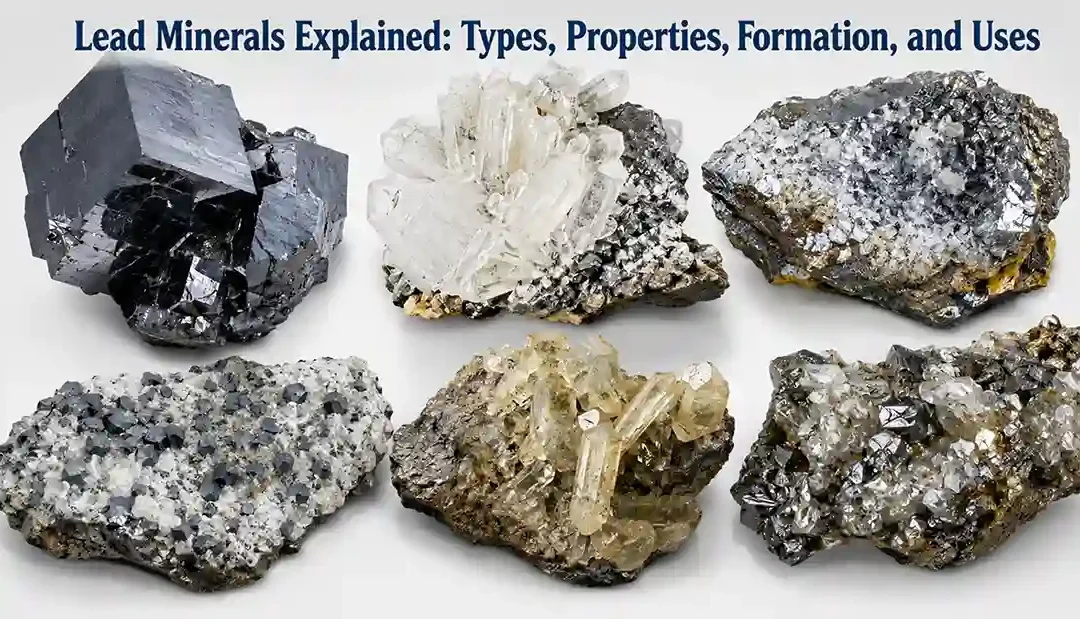
Lead is one of the oldest metals used by humans and has played an important role in construction, plumbing, batteries, and industrial manufacturing. Although native lead is extremely rare, numerous lead-bearing minerals occur throughout Earth's crust.
Lead minerals are important because they:
- provide the world's lead supply
- occur in valuable ore deposits
- often contain silver
- help geologists locate economic mineral resources
The most important lead mineral is galena, which has been mined for thousands of years.
Learn more → mineral classification system
What Are Lead Minerals?
Lead minerals are naturally occurring minerals that contain lead as a major chemical component.
Lead commonly occurs in:
- hydrothermal veins
- replacement deposits
- sedimentary deposits
- lead-zinc ore systems
Most commercial lead production comes from sulfide ore deposits.
Chemical Formula of Lead
Lead is a metallic element represented by:
Basic Information
| Property | Value |
|---|---|
| Element Name | Lead |
| Symbol | Pb |
| Atomic Number | 82 |
| Atomic Weight | 207.2 |
| Classification | Post-Transition Metal |
Major Lead Minerals
| Mineral | Formula | Importance |
|---|---|---|
| Galena | PbS | Primary Lead Ore |
| Cerussite | PbCO₃ | Secondary Ore |
| Anglesite | PbSO₄ | Secondary Ore |
| Pyromorphite | Pb₅(PO₄)₃Cl | Lead Mineral |
| Mimetite | Pb₅(AsO₄)₃Cl | Secondary Mineral |
Galena – The Most Important Lead Mineral
Galena is the world's most important lead mineral.
Characteristics include:
- metallic luster
- lead-gray color
- cubic crystals
- very high density
- perfect cubic cleavage
Galena is the source of most lead mined worldwide. It often contains valuable silver.
Cerussite
Cerussite is a secondary lead mineral formed by weathering of galena.
Its formula is: PbCO₃
Features include:
- transparent crystals
- high density
- brilliant luster
- carbonate composition
Cerussite is popular among mineral collectors.
Anglesite
Anglesite develops when galena undergoes oxidation.
Its formula is: PbSO₄
Characteristics include:
- white to gray color
- transparent crystals
- high specific gravity
- sulfate composition
It commonly occurs in oxidized lead deposits.
Pyromorphite
Pyromorphite is a colorful lead phosphate mineral.
Its formula is: Pb5(PO4)3Cl
Common colors:
- green
- yellow
- orange
- brown
It often forms attractive barrel-shaped crystals.
Mimetite
Mimetite is closely related to pyromorphite.
Its formula is: Pb₅(AsO₄)₃Cl
It commonly occurs in:
- oxidized lead deposits
- arid environments
- secondary mineral zones
Formation of Lead Deposits
Hydrothermal Activity
Most lead deposits form from hot mineral-rich fluids.
Replacement Deposits
Lead minerals replace existing rock material.
Sedimentary Deposits
Some lead ores accumulate in marine basins.
Oxidation Zones
Weathering produces secondary lead minerals.
Hydrothermal Lead-Zinc Deposits
Lead deposits commonly contain:
- galena
- sphalerite
- pyrite
- chalcopyrite
- fluorite
These minerals often occur together in hydrothermal veins.
Learn more → zinc minerals explained
Lead Minerals and Associated Ores
| Associated Mineral | Metal |
|---|---|
| Sphalerite | Zinc |
| Chalcopyrite | Copper |
| Pyrite | Iron |
| Silver Minerals | Silver |
| Fluorite | Fluorine |
Galena is frequently mined together with zinc and silver ores.
Industrial Uses of Lead
Lead-Acid Batteries
Largest modern use.
Radiation Shielding
Blocks X-rays and gamma rays.
Construction Materials
Used in specialized applications.
Electronics
Certain industrial components.
Alloys
Combined with other metals.
Major Uses of Lead
| Industry | Application |
|---|---|
| Energy Storage | Batteries |
| Medical | Radiation Shielding |
| Construction | Specialized Materials |
| Manufacturing | Metal Alloys |
| Electronics | Industrial Components |
Major Lead-Producing Countries
Important lead producers include:
- China
- Australia
- Peru
- Mexico
- Russia
- United States
These countries host many of the world's largest lead-zinc deposits.
How Geologists Identify Lead Minerals
Galena
- metallic luster
- cubic cleavage
- extreme density
Cerussite
- carbonate mineral
- high density
- transparent crystals
Anglesite
- sulfate composition
- bright luster
- heavy weight
Pyromorphite
- green barrel-shaped crystals
Learn more → mineral identification guide
Lead Minerals Summary
| Mineral | Formula | Main Use |
|---|---|---|
| Galena | PbS | Lead Ore |
| Cerussite | PbCO₃ | Secondary Ore |
| Anglesite | PbSO₄ | Secondary Ore |
| Pyromorphite | Pb₅(PO₄)₃Cl | Collector Mineral |
| Mimetite | Pb₅(AsO₄)₃Cl | Secondary Mineral |
Galena (PbS) is the world's primary lead ore mineral.
The chemical symbol for lead is Pb.
Major lead minerals include galena, cerussite, anglesite, pyromorphite, and mimetite.
Most lead deposits form through hydrothermal mineralization and later weathering processes.
Lead is primarily used in lead-acid batteries, radiation shielding, alloys, and industrial applications.
Final Thoughts
Lead minerals are among the most economically important metallic mineral resources on Earth. From galena-rich hydrothermal veins to colorful secondary minerals like cerussite and pyromorphite, these minerals provide valuable insights into ore-forming processes and economic geology.
Understanding lead minerals helps geologists discover mineral deposits while also revealing the complex geological processes that concentrate metals within Earth's crust.