
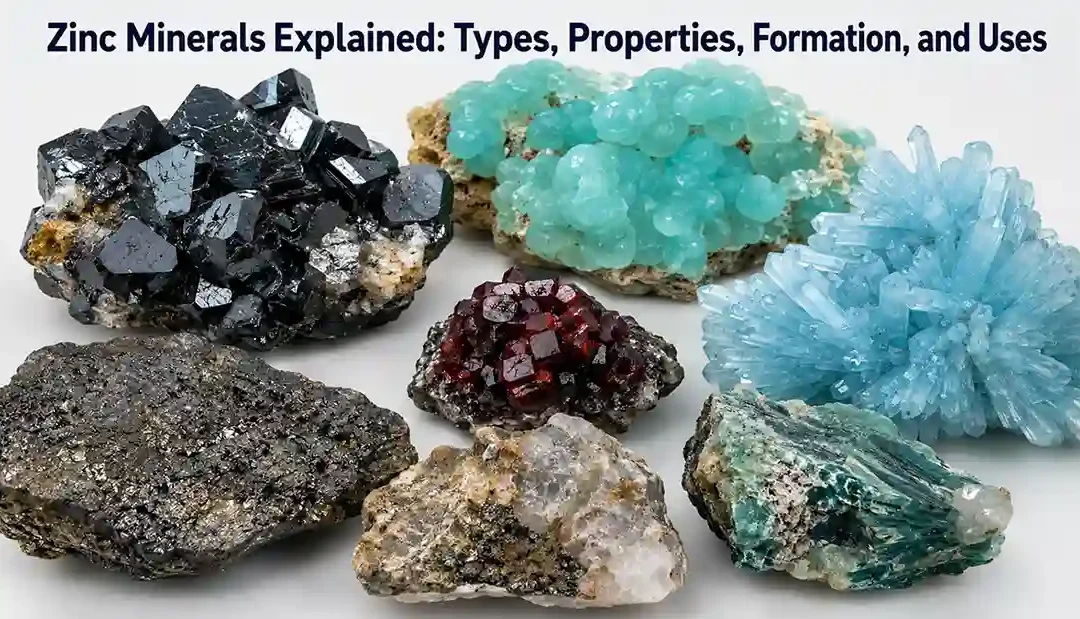
Zinc is one of the most important industrial metals in the world. It is widely used in:
- galvanizing steel
- batteries
- alloys
- construction materials
- chemical manufacturing
Unlike gold or silver, zinc rarely occurs as a native metal. Instead, it is found in various minerals that serve as important ore sources.
Among these minerals, sphalerite is by far the most important zinc ore mineral.
Learn more → mineral classification system
What Are Zinc Minerals?
Zinc minerals are naturally occurring minerals that contain zinc as a major component.
These minerals occur in:
- hydrothermal veins
- sedimentary deposits
- replacement deposits
- metamorphic rocks
Many zinc minerals are economically important because they provide the world's primary zinc supply.
Major Zinc Minerals
| Mineral | Formula | Importance |
|---|---|---|
| Sphalerite | ZnS | Primary Zinc Ore |
| Smithsonite | ZnCO₃ | Secondary Ore |
| Hemimorphite | Zn₄Si₂O₇(OH)₂·H₂O | Secondary Ore |
| Zincite | ZnO | Rare Ore |
| Willemite | Zn₂SiO₄ | Zinc Source |
Chemical Formula of Zinc
Zinc is a metallic chemical element with the symbol. It has an atomic number of 30 and commonly occurs in minerals such as sphalerite (ZnS), smithsonite (ZnCO₃), and hemimorphite (Zn₄Si₂O₇(OH)₂·H₂O). Pure metallic zinc is rarely found in nature and is usually extracted from zinc-bearing ore minerals.
Basic Information About Zinc
| Property | Value |
|---|---|
| Element Name | Zinc |
| Chemical Symbol | Zn |
| Atomic Number | 30 |
| Atomic Weight | 65.38 |
| Classification | Transition Metal |
| Crystal System | Hexagonal (metallic zinc) |
Common Zinc Mineral Formulas
| Mineral | Formula |
|---|---|
| Sphalerite | ZnS |
| Smithsonite | ZnCO₃ |
| Hemimorphite | Zn₄Si₂O₇(OH)₂·H₂O |
| Zincite | ZnO |
| Willemite | Zn₂SiO₄ |
Formation of Zinc Deposits
Hydrothermal Activity
The most important zinc deposits form from hot mineral-rich fluids.
Sedimentary Processes
Some deposits originate in marine basins.
Replacement Deposits
Minerals replace existing rock materials.
Oxidation Zones
Weathering produces secondary zinc minerals.
Hydrothermal Zinc Deposits
Many zinc ores form when:
- hot fluids move through fractures
- dissolved metals precipitate
- sulfide minerals crystallize
These environments commonly produce:
- sphalerite
- galena
- pyrite
- chalcopyrite
Learn more → pyrite mineral explained
Zinc Minerals and Associated Ores
Zinc minerals are frequently found with:
| Associated Mineral | Metal |
|---|---|
| Galena | Lead |
| Chalcopyrite | Copper |
| Pyrite | Iron |
| Barite | Barium |
| Fluorite | Fluorine |
These associations help geologists locate economic ore deposits.
Learn more → barite mineral explained
Industrial Uses of Zinc
Galvanized Steel
Protects steel from corrosion.
Batteries
Important battery component.
Brass Production
Combined with copper.
Chemical Industry
Used in zinc compounds.
Construction
Widely used in roofing and infrastructure.
Major Uses of Zinc
| Industry | Application |
|---|---|
| Construction | Galvanized steel |
| Electronics | Batteries |
| Manufacturing | Brass |
| Chemicals | Zinc compounds |
| Infrastructure | Corrosion protection |
Major Zinc-Producing Countries
Important zinc producers include:
- China
- Australia
- Peru
- Mexico
- India
- United States
These countries host many of the world's largest zinc deposits.
How Geologists Identify Zinc Minerals
Common identification features include:
Sphalerite
- resinous luster
- perfect cleavage
- brown streak
Smithsonite
- carbonate reaction
- smooth surfaces
- attractive colors
Hemimorphite
- botryoidal forms
- blue coloration
- fibrous crystals
Willemite
- strong fluorescence
Learn more → mineral identification guide
Zinc Minerals Summary
| Mineral | Formula | Main Use |
|---|---|---|
| Sphalerite | ZnS | Zinc Ore |
| Smithsonite | ZnCO₃ | Secondary Ore |
| Hemimorphite | Zn₄Si₂O₇(OH)₂·H₂O | Zinc Ore |
| Zincite | ZnO | Rare Ore |
| Willemite | Zn₂SiO₄ | Zinc Source |
Sphalerite (ZnS) is the world's primary zinc ore mineral.
Major zinc minerals include sphalerite, smithsonite, hemimorphite, zincite, and willemite.
Most zinc minerals form through hydrothermal processes and later weathering.
Zinc is primarily used for galvanizing steel, batteries, brass production, and corrosion protection.
No. Zinc usually occurs in minerals rather than as native metallic zinc.
Final Thoughts
Zinc minerals are among the world's most economically important mineral resources. From sphalerite-rich hydrothermal deposits to colorful secondary minerals like smithsonite and hemimorphite, these minerals provide the zinc needed for modern infrastructure, manufacturing, and technology.
Understanding zinc minerals helps geologists locate valuable ore deposits while also revealing the fascinating processes that concentrate metals within Earth's crust.