
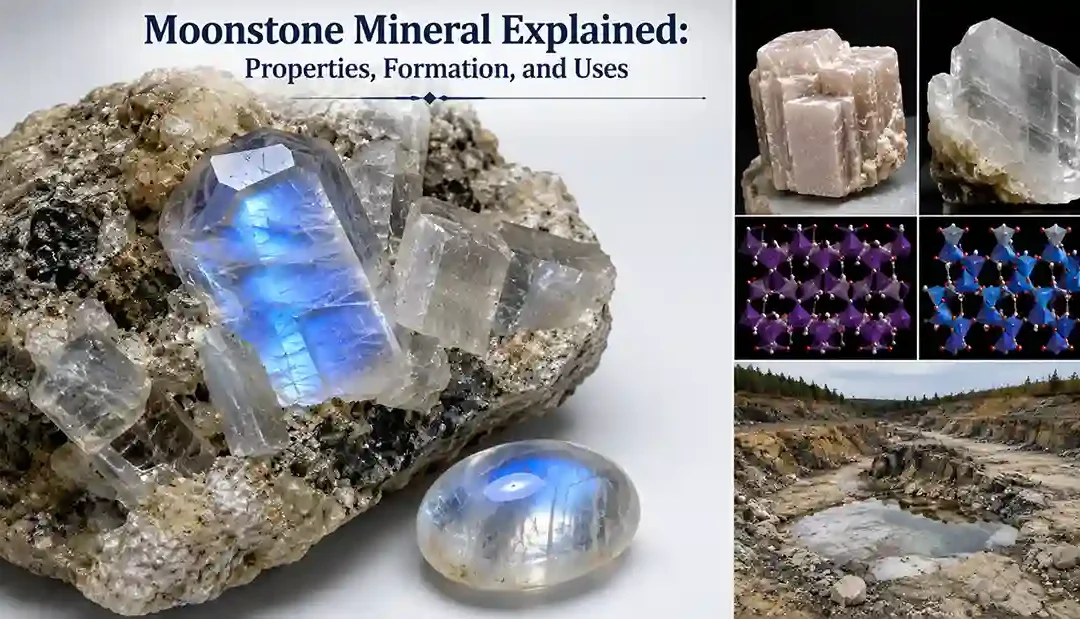
Moonstone is one of the most enchanting gemstones in the world, famous for its mysterious floating glow known as adularescence. This optical effect creates a soft blue or white light that appears to move beneath the surface of the stone.
Moonstone belongs to the feldspar mineral group and has been admired for centuries because of its:
- glowing appearance
- unique optical effects
- gemstone beauty
- historical significance
Its moon-like sheen gives the gemstone its name and makes it one of the most recognizable feldspar varieties.
Learn more → feldspar mineral explained
What Is Moonstone?
Moonstone is a gemstone variety of feldspar.
Most moonstones belong to the:
- orthoclase feldspar
- albite feldspar
Its chemical composition is commonly represented by Moonstone belongs to the feldspar mineral group. Which is the most abundant mineral group in Earth's crust.
Basic Properties of Moonstone
| Property | Value |
|---|---|
| Chemical Formula | KAlSi₃O₈ |
| Mineral Group | Feldspar |
| Crystal System | Monoclinic |
| Hardness | 6–6.5 |
| Streak | White |
| Luster | Vitreous to Pearly |
What Is Adularescence?
The most important feature of moonstone is adularescence. Adularescence is a soft floating glow that appears to move across the gemstone surface.
It occurs because:
- thin feldspar layers scatter light
- light reflects between microscopic crystal boundaries
- interference effects create a floating sheen
This optical phenomenon makes moonstone unique among gemstones.
Why Does Moonstone Glow?
The glow forms when orthoclase and albite intergrow. Tiny alternating layers of feldspar develop during cooling.
As light enters the gemstone:
- scattering occurs
- interference develops
- a floating glow becomes visible
The finest moonstones display vivid blue adularescence.
Crystal Structure of Moonstone
Moonstone belongs to the feldspar family.
Its structure contains:
- silicon tetrahedra
- aluminum atoms
- potassium ions
This arrangement produces:
- layered feldspar growth
- optical effects
- gemstone transparency
Learn more → crystal structure in minerals
Crystal System of Moonstone
Most moonstone varieties belong to the monoclinic crystal system. Its crystallographic relationship is. However, gem-quality moonstones are usually cut rather than displayed as crystals.
Learn more → monoclinic crystal system
Physical Properties of Moonstone
| Property | Description |
|---|---|
| Color | White, gray, peach, blue |
| Streak | White |
| Luster | Vitreous to pearly |
| Hardness | 6–6.5 |
| Cleavage | Perfect |
| Transparency | Transparent to translucent |
| Specific Gravity | 2.5–2.6 |
Types of Moonstone
Blue Moonstone
Most valuable variety.
Rainbow Moonstone
Displays colorful flashes.
Peach Moonstone
Soft peach coloration.
White Moonstone
Traditional gemstone variety.
Gray Moonstone
Less common but attractive.
Major Moonstone Varieties
| Variety | Characteristics |
|---|---|
| Blue Moonstone | Blue glow |
| Rainbow Moonstone | Multicolored flashes |
| Peach Moonstone | Peach coloration |
| White Moonstone | White sheen |
| Gray Moonstone | Gray body color |
How Moonstone Forms
Granite Pegmatites
Most important source.
Igneous Cooling
Feldspar minerals separate during cooling.
Hydrothermal Activity
Can contribute to crystal growth.
Slow Crystallization
Allows feldspar layering to develop.
Moonstone in Pegmatites
Moonstone commonly occurs with:
- quartz
- feldspar
- mica
- beryl
- tourmaline
Large pegmatites provide ideal conditions for gemstone formation.
Learn more → tourmaline mineral explained
Major Moonstone-Producing Countries
Important sources include:
- Sri Lanka
- India
- Myanmar
- Madagascar
- Tanzania
Sri Lanka is particularly famous for producing high-quality blue moonstones.
Moonstone in Jewelry
Moonstone is widely used in,
- rings
- necklaces
- earrings
- pendants
Cabochon cutting is preferred because it enhances adularescence.
Moonstone vs Labradorite
| Property | Moonstone | Labradorite |
|---|---|---|
| Optical Effect | Adularescence | Labradorescence |
| Mineral Group | Feldspar | Feldspar |
| Common Color | White-Blue | Gray-Multicolor |
| Structure | Orthoclase-Albite | Plagioclase |
Although both belong to the feldspar group, their optical effects are different.
Uses of Moonstone
Jewelry
Most important use.
Mineral Collections
Popular collector gemstone.
Museum Displays
Showcases optical mineral effects.
Geological Research
Studied for feldspar structures.
Major Uses of Moonstone
| Industry | Application |
|---|---|
| Jewelry | Gemstones |
| Collecting | Mineral specimens |
| Museums | Displays |
| Research | Optical mineral studies |
Moonstone in Mineral Identification
Geologists identify moonstone using:
- adularescence
- feldspar composition
- hardness of 6–6.5
- pearly luster
- translucent appearance
Its floating blue glow is the most distinctive identification feature.
Learn more → mineral identification guide
Moonstone Identification Summary
| Property | Moonstone |
|---|---|
| Formula | KAlSi₃O₈ |
| Hardness | 6–6.5 |
| Crystal System | Monoclinic |
| Optical Effect | Adularescence |
| Color | White, Blue, Peach |
| Mineral Group | Feldspar |
Moonstone's glow, called adularescence, is caused by light scattering between microscopic feldspar layers.
Moonstone is a gemstone variety of feldspar, primarily composed of orthoclase and albite.
Blue moonstone with strong adularescence is generally the most valuable variety.
Most moonstones belong to the monoclinic crystal system.
Moonstone commonly forms in granite pegmatites and related igneous environments.
Final Thoughts
Moonstone is one of the most fascinating feldspar gemstones because of its beautiful adularescence and mysterious moon-like glow. Its unique optical properties, geological formation, and long history in jewelry make it one of the most recognizable gemstones in the world.
From Sri Lanka's famous blue moonstones to rainbow moonstone varieties found in pegmatites worldwide, moonstone demonstrates how crystal structure can create extraordinary visual effects in nature.