
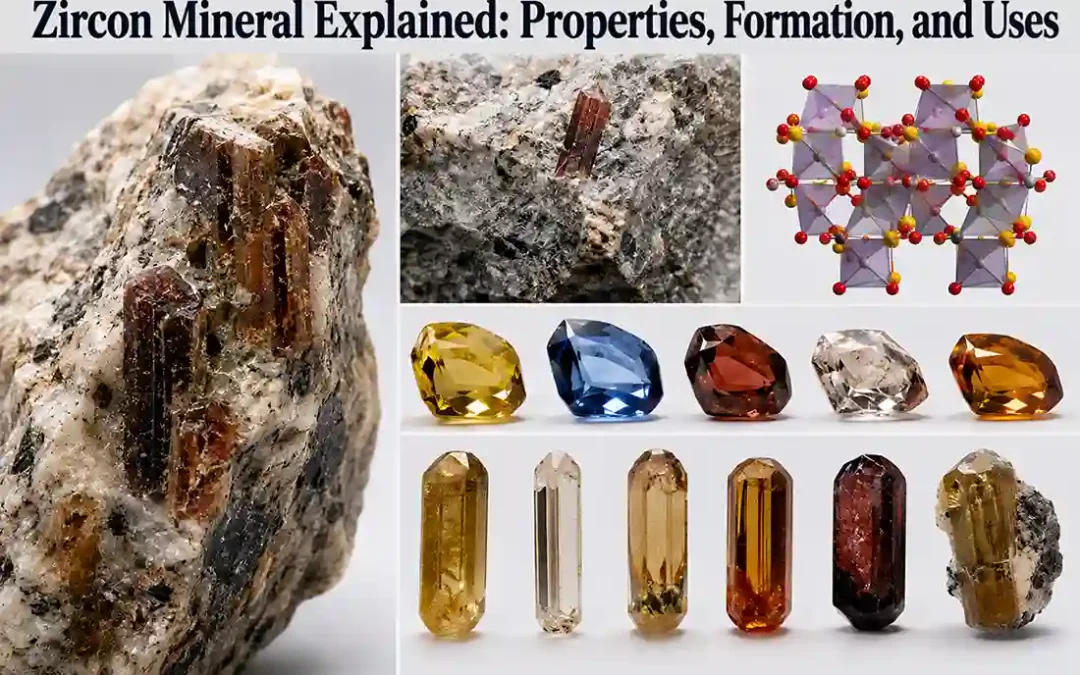
Zircon is one of the most important minerals in geology because it serves as a natural time capsule of Earth's history. While zircon is known as a beautiful gemstone, it is even more famous among geologists for its role in determining the age of rocks and understanding the evolution of Earth's crust.
Zircon is valued for its:
- exceptional durability
- gemstone quality
- resistance to weathering
- radiometric dating applications
Some zircon crystals are more than 4 billion years old, making them among the oldest known materials on Earth.
Learn more → what is a mineral
What Is Zircon?
Zircon is a zirconium silicate mineral. Its chemical formula is:
Zircon contains:
- zirconium
- silicon
- oxygen
It belongs to the nesosilicate mineral group and is the primary source of zirconium.
Basic Properties of Zircon
| Property | Value |
|---|---|
| Chemical Formula | ZrSiO₄ |
| Mineral Group | Nesosilicate |
| Crystal System | Tetragonal |
| Hardness | 6.5–7.5 |
| Streak | White |
| Luster | Adamantine to Vitreous |
Why Is Zircon Important?
Zircon crystals can contain trace amounts of uranium when they form.
Over time:
Uranium→Lead
This radioactive decay allows scientists to determine the age of rocks with remarkable accuracy.
Zircon is the foundation of:
- geochronology
- crustal evolution studies
- early Earth research
Crystal Structure of Zircon
Zircon contains:
- isolated silica tetrahedra
- zirconium ions
- oxygen atoms
Its strong crystal structure provides:
- exceptional durability
- chemical resistance
- survival through multiple geological cycles
This durability allows zircon crystals to persist for billions of years.
Learn more → crystal structure in minerals
Crystal System of Zircon
Zircon belongs to the tetragonal crystal system. Its crystallographic relationship is:
Common crystal habits include:
- tetragonal prisms
- bipyramidal crystals
- short columnar crystals
Learn more → tetragonal crystal system
Physical Properties of Zircon
| Property | Description |
|---|---|
| Color | Brown, yellow, red, blue, green, colorless |
| Streak | White |
| Luster | Adamantine to vitreous |
| Hardness | 6.5–7.5 |
| Cleavage | Poor |
| Transparency | Transparent to opaque |
| Specific Gravity | 4.6–4.7 |
Some of the Oldest Minerals on Earth
The oldest known zircon crystals are approximately 4.4 Billion Years old.
These ancient zircons provide evidence about:
- Earth's earliest crust
- early oceans
- planetary evolution
- conditions shortly after Earth formed
Few other minerals preserve such ancient geological information.
How Zircon Forms
Igneous Crystallization
Most zircon forms during magma cooling.
Granite Formation
Common accessory mineral in granitic rocks.
Metamorphism
May survive metamorphic events.
Sedimentary Recycling
Can be transported and redeposited many times.
Zircon in Granite and Pegmatites
Zircon commonly occurs with:
- quartz
- feldspar
- mica
- apatite
- tourmaline
Because of its durability, zircon often survives long after surrounding minerals weather away.
Learn more → apatite mineral explained
Zircon and Radiometric Dating
U-Pb Dating
One of the most important dating methods uses Uranium-Lead Dating. The decay relationships include:
238U→206Pb
and
235U→207Pb
These decay systems allow precise age determination for rocks billions of years old.
Gemstone Zircon
Natural Gemstone Variety
Zircon gemstones occur in:
- blue
- golden
- red
- brown
- colorless
High-quality zircon gemstones possess:
- exceptional brilliance
- strong dispersion
- diamond-like sparkle
Natural zircon should not be confused with cubic zirconia, which is a synthetic material.
Zircon vs Cubic Zirconia
| Property | Zircon | Cubic Zirconia |
|---|---|---|
| Natural Mineral | Yes | No |
| Formula | ZrSiO₄ | ZrO₂ |
| Crystal System | Tetragonal | Cubic |
| Geological Origin | Natural | Synthetic |
This is one of the most common misconceptions in gemology.
Major Zircon-Producing Countries
Important zircon sources include:
- Australia
- South Africa
- India
- Sri Lanka
- Brazil
- Madagascar
Australia is one of the world's largest zircon producers.
Industrial Uses of Zircon
Geochronology
Determining the ages of rocks.
Ceramics
Used in high-temperature materials.
Refractories
Heat-resistant industrial products.
Foundry Industry
Casting molds and coatings.
Gemstones
Jewelry applications.
Major Uses of Zircon
| Industry | Application |
|---|---|
| Geology | Radiometric dating |
| Ceramics | Heat-resistant products |
| Foundry | Casting materials |
| Refractories | High-temperature applications |
| Jewelry | Gemstones |
Zircon in Mineral Identification
Geologists identify zircon using:
- tetragonal crystals
- high density
- strong luster
- hardness of 6.5–7.5
- occurrence in igneous rocks
Its high density and crystal habit are often key diagnostic features.
Learn more → mineral identification guide
Zircon Identification Summary
| Property | Zircon |
|---|---|
| Formula | ZrSiO₄ |
| Hardness | 6.5–7.5 |
| Crystal System | Tetragonal |
| Color | Various |
| Luster | Adamantine |
| Mineral Group | Nesosilicate |
Zircon is a zirconium silicate mineral with the formula ZrSiO₄.
Zircon is used for uranium-lead radiometric dating and helps determine the ages of rocks.
No. Zircon is a natural mineral, while cubic zirconia is a synthetic gemstone material.
Zircon belongs to the tetragonal crystal system.
Some zircon crystals are approximately 4.4 billion years old, making them among the oldest known materials on Earth.
Final Thoughts
Zircon is one of the most scientifically important minerals on Earth. Beyond its beauty as a gemstone, zircon serves as a record keeper of geological time, preserving information about Earth's earliest history and crustal evolution.
From billion-year-old crystals that reveal the story of our planet to sparkling gemstones used in jewelry, zircon bridges the worlds of geology, geochronology, and gemology like few other minerals can.
Continue learning with → apatite mineral explained and tetragonal crystal system.