
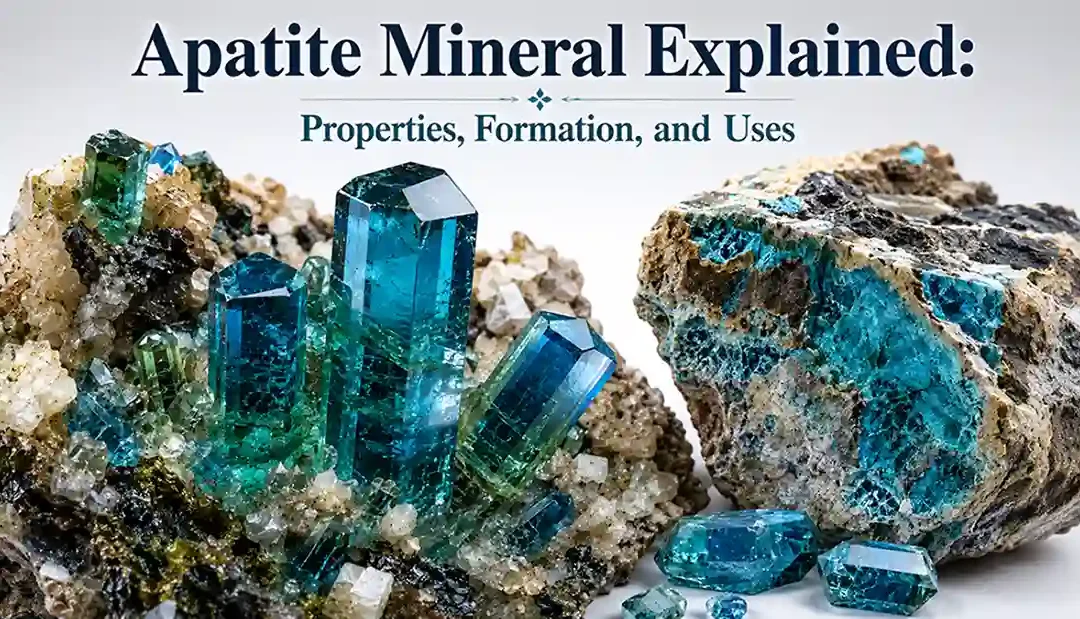
Apatite is one of the most important phosphate minerals on Earth and serves as the primary source of phosphorus used in fertilizers. Although it is relatively common, apatite is scientifically significant because phosphorus is essential for life, agriculture, and biological systems.
Apatite occurs in:
- igneous rocks
- metamorphic rocks
- sedimentary phosphate deposits
- biological tissues
In fact, the mineral structure of human bones and teeth closely resembles apatite, making it one of the most biologically important minerals on Earth.
Learn more → what is a mineral
What Is Apatite?
Apatite is a calcium phosphate mineral. Its generalized chemical formula is:
Depending on its composition, apatite may occur as:
- Fluorapatite
- Chlorapatite
- Hydroxyapatite
It belongs to the phosphate mineral group.
Basic Properties of Apatite
| Property | Value |
|---|---|
| Chemical Formula | Ca₅(PO₄)₃(F,Cl,OH) |
| Mineral Group | Phosphate |
| Crystal System | Hexagonal |
| Hardness | 5 |
| Streak | White |
| Luster | Vitreous |
Why Is Apatite Important?
Source of Phosphorus
Apatite contains phosphorus, one of the most important elements for life.
Phosphorus is essential for:
- DNA
- RNA
- cell energy transfer
- plant growth
- bones and teeth
Most commercial phosphorus comes from apatite-rich phosphate deposits.
Crystal Structure of Apatite
Apatite contains:
- calcium ions
- phosphate groups
- fluorine, chlorine, or hydroxyl ions
Its crystal structure produces:
- hexagonal crystals
- moderate hardness
- excellent crystal development
The same basic structure occurs naturally in vertebrate bones and teeth.
Learn more → crystal structure in minerals
Crystal System of Apatite
Apatite belongs to the hexagonal crystal system. Its crystallographic relationship is:
Common crystal habits include:
- hexagonal prisms
- tabular crystals
- granular masses
Learn more → hexagonal crystal system
Physical Properties of Apatite
| Property | Description |
|---|---|
| Color | Green, blue, yellow, brown, colorless |
| Streak | White |
| Luster | Vitreous |
| Hardness | 5 |
| Cleavage | Poor |
| Transparency | Transparent to opaque |
| Specific Gravity | 3.1–3.2 |
Apatite and the Mohs Hardness Scale
Apatite is significant because it defines hardness level 5 on the Mohs Hardness Scale.
Its hardness relationship is:
This means apatite can scratch:
- fluorite
- gypsum
- calcite
but can be scratched by:
- feldspar
- quartz
- topaz
Learn more → mohs hardness scale
How Apatite Forms
Igneous Crystallization
Common accessory mineral in many igneous rocks.
Sedimentary Processes
Forms large phosphate deposits.
Metamorphism
Occurs in some metamorphic environments.
Biological Processes
Develops naturally within bones and teeth.
Apatite in Igneous Rocks
Apatite commonly occurs in:
- granite
- syenite
- gabbro
- pegmatite
Although usually present in small quantities, it is widespread throughout Earth's crust.
Phosphate Rock Deposits
Large apatite-rich deposits form through:
- marine sedimentation
- biological activity
- chemical precipitation
These deposits are mined worldwide to produce phosphate fertilizers.
Apatite in Bones and Teeth
A variety called Hydroxyapatite forms the primary mineral component of:
- human bones
- teeth
- many vertebrate skeletons
Hydroxyapatite provides strength and rigidity to skeletal structures.
Industrial Uses of Apatite
Fertilizer Production
The most important use of apatite.
Animal Feed Supplements
Provides phosphorus.
Chemical Industry
Used in phosphorus compounds.
Water Treatment
Used in specialty filtration systems.
Gemstones
Transparent crystals are sometimes cut as gemstones.
Major Uses of Apatite
| Industry | Application |
|---|---|
| Agriculture | Fertilizers |
| Animal Nutrition | Feed supplements |
| Chemical Industry | Phosphorus production |
| Water Treatment | Filtration |
| Jewelry | Gemstones |
Gem-Quality Apatite
Although not as famous as sapphire or emerald, apatite can form attractive gemstones.
Common gem colors include:
- neon blue
- blue-green
- yellow
- violet
Because of its moderate hardness, apatite gemstones require careful handling.
Apatite in Mineral Identification
Geologists identify apatite using:
- hardness of 5
- hexagonal crystals
- vitreous luster
- white streak
- green or blue coloration
Its hardness often serves as an important diagnostic feature during field identification.
Learn more → mineral identification guide
Apatite Identification Summary
| Property | Apatite |
|---|---|
| Formula | Ca₅(PO₄)₃(F,Cl,OH) |
| Hardness | 5 |
| Crystal System | Hexagonal |
| Streak | White |
| Color | Green-Blue-Yellow |
| Mineral Group | Phosphate |
Apatite is a calcium phosphate mineral with the formula Ca₅(PO₄)₃(F,Cl,OH).
Apatite is the world's primary source of phosphorus used in fertilizers and agriculture.
Apatite belongs to the hexagonal crystal system.
Yes. Hydroxyapatite forms the main mineral component of bones and teeth.
Apatite is used in fertilizers, animal feed, chemicals, water treatment, and gemstones.
Final Thoughts
Apatite is one of the most important phosphate minerals on Earth and plays a vital role in both geology and biology. As the primary source of phosphorus for agriculture and the structural mineral of bones and teeth, apatite connects Earth's geological systems with life itself.
From phosphate mines and fertilizer production to human skeletal structures, apatite demonstrates the remarkable importance of minerals in sustaining modern civilization and biological processes.