
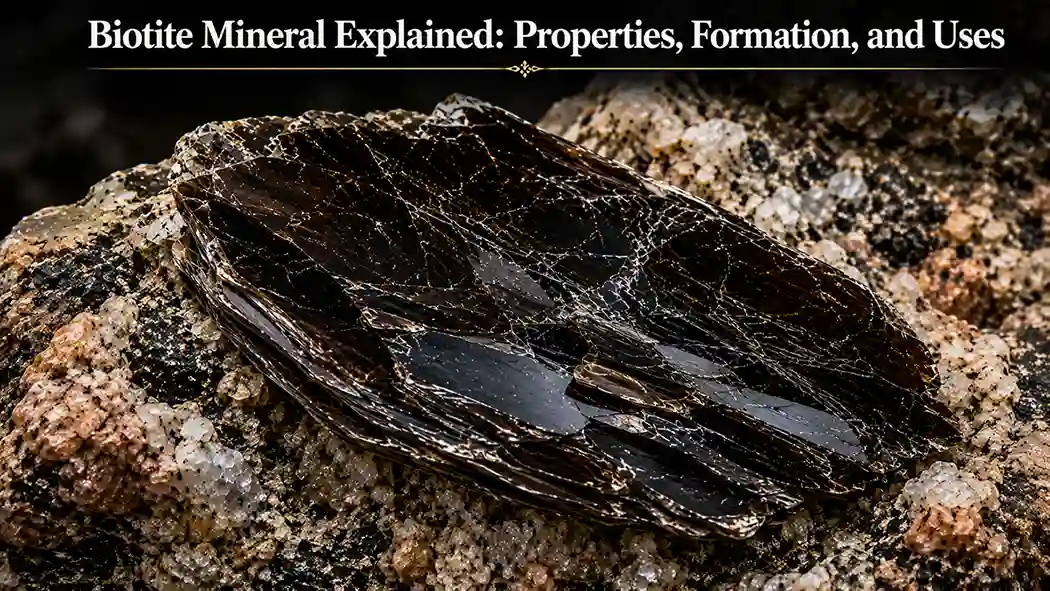
Biotite is a common dark-colored mica mineral found in a wide variety of igneous and metamorphic rocks. It is easily recognized by its black to dark brown color, sheet-like structure, and perfect basal cleavage.
As a member of the mica group, biotite splits into thin flexible sheets and plays an important role in understanding rock formation and metamorphism.
Biotite commonly occurs in:
- granite
- diorite
- schist
- gneiss
- pegmatite
Its abundance and distinctive appearance make it one of the most important rock-forming minerals in geology.
Learn more → mica mineral explained
What Is Biotite?
Biotite is a dark mica mineral rich in iron and magnesium. Its composition varies, but a common formula is:
Biotite belongs to the mica group and is classified as a phyllosilicate (sheet silicate)
Basic Properties of Biotite
| Property | Value |
|---|---|
| Chemical Formula | K(Mg,Fe)₃AlSi₃O₁₀(OH)₂ |
| Mineral Group | Mica |
| Crystal System | Monoclinic |
| Hardness | 2.5–3 |
| Streak | White to Gray |
| Luster | Vitreous to Pearly |
Why Is Biotite Dark?
Biotite's dark color comes from its iron and Magnesium Content.
Unlike muscovite, which is light-colored, biotite contains significant amounts of:
- iron (Fe)
- magnesium (Mg)
These elements give biotite its:
- black color
- dark brown color
- bronze appearance in thin sheets
Crystal Structure of Biotite
Biotite has a layered crystal structure consisting of:
- silica tetrahedral sheets
- aluminum-rich layers
- iron and magnesium ions
This structure produces:
- perfect cleavage
- flexibility
- sheet-like crystals
Learn more → crystal structure in minerals
Crystal System of Biotite
Biotite belongs to the monoclinic crystal system. Its crystallographic relationship is: . Although crystal faces are uncommon, the internal structure controls the sheet-like appearance.
Learn more → monoclinic crystal system
Physical Properties of Biotite
| Property | Description |
|---|---|
| Color | Black, dark brown |
| Streak | White to gray |
| Luster | Vitreous to pearly |
| Hardness | 2.5–3 |
| Cleavage | Perfect basal |
| Transparency | Transparent in thin sheets |
| Specific Gravity | 2.7–3.4 |
Perfect Basal Cleavage
One of biotite's most important properties is perfect basal cleavage.
Biotite can be separated into:
- thin sheets
- flexible flakes
- transparent layers
This property makes biotite easy to distinguish from many other dark minerals.
Learn more → mineral cleavage vs fracture
How Biotite Forms
Biotite forms through:
Igneous Crystallization
Common in granite, diorite, and other igneous rocks.
Metamorphism
Forms in schist, gneiss, and amphibolite.
Pegmatite Development
Large crystals occur in pegmatites.
Hydrothermal Alteration
May develop from mineral-rich fluids.
Biotite in Igneous Rocks
Biotite is a major component of:
Granite
One of the most common accessory minerals.
Diorite
Frequently occurs with amphibole and feldspar.
Pegmatite
May form large crystal books.
Volcanic Rocks
Present in some intermediate lavas.
Learn more → feldspar mineral explained
Biotite in Metamorphic Rocks
Biotite commonly occurs in:
- schist
- gneiss
- amphibolite
- hornfels
Aligned biotite flakes often create foliation, which is one of the most important metamorphic textures.
Learn more → mineral texture guide
Biotite vs Muscovite
| Property | Biotite | Muscovite |
|---|---|---|
| Color | Black-Brown | Colorless-Silver |
| Iron Content | High | Low |
| Transparency | Lower | Higher |
| Typical Appearance | Dark Sheets | Light Sheets |
These are the two most common mica minerals found in rocks.
Learn more → muscovite mineral explained
Industrial Uses of Biotite
Biotite is less important commercially than muscovite but still has several applications.
Geological Research
Used to study rock ages and metamorphism.
Educational Collections
Common teaching mineral.
Industrial Fillers
Limited use in specialized products.
Scientific Analysis
Important for geochronology and petrology.
Major Uses of Biotite
| Industry | Application |
|---|---|
| Education | Mineral collections |
| Geology | Petrologic studies |
| Research | Geochronology |
| Industry | Limited fillers |
Biotite and Radiometric Dating
Biotite contains potassium, allowing geologists to use:
Potassium-Argon Dating
and
Argon-Argon Dating
to determine the ages of rocks and geological events. This makes biotite highly valuable in geochronology.
Biotite in Mineral Identification
Geologists identify biotite using:
- black to dark brown color
- perfect sheet cleavage
- flexible flakes
- vitreous luster
- occurrence in igneous and metamorphic rocks
Its dark color immediately distinguishes it from muscovite.
Learn more → mineral identification guide
Biotite Identification Summary
| Property | Biotite |
|---|---|
| Formula | K(Mg,Fe)₃AlSi₃O₁₀(OH)₂ |
| Hardness | 2.5–3 |
| Crystal System | Monoclinic |
| Cleavage | Perfect Basal |
| Color | Black-Brown |
| Mineral Group | Mica |
Biotite is a potassium-rich mica mineral containing iron, magnesium, aluminum, silicon, oxygen, and hydroxyl groups.
Its dark color comes primarily from its iron and magnesium content.
Biotite belongs to the monoclinic crystal system.
Biotite occurs in granite, diorite, pegmatite, schist, gneiss, and other igneous and metamorphic rocks.
Biotite is mainly used in geological research, education, and radiometric dating studies.
Final Thoughts
Biotite is one of the most important rock-forming mica minerals and a key component of many igneous and metamorphic rocks. Its dark color, perfect cleavage, and geological significance make it invaluable for understanding rock formation, metamorphism, and Earth's history.
From granite plutons to metamorphic mountain belts, biotite provides geologists with important clues about the processes that shape our planet.