
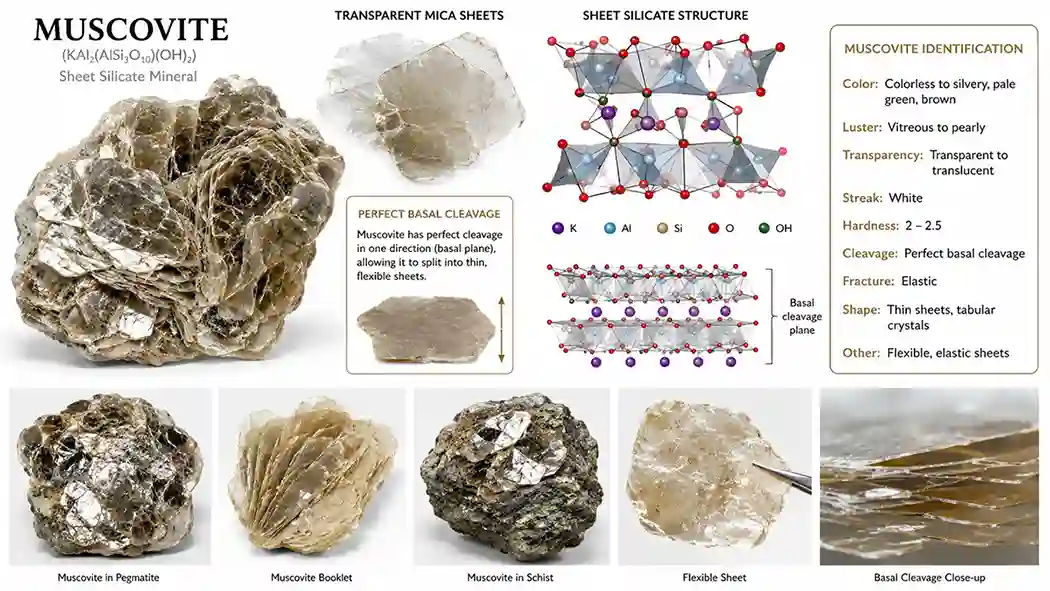
Muscovite is the most common mineral in the mica group and is easily recognized by its thin, transparent sheets and perfect cleavage. It is a potassium-rich aluminum silicate mineral that occurs in a wide variety of igneous, metamorphic, and sedimentary rocks.
Because muscovite splits into extremely thin flexible sheets, it has been used throughout history for insulation, windows, and industrial applications.
Muscovite is important because it:
- helps identify metamorphic conditions
- occurs in many rock types
- demonstrates sheet silicate structures
- has numerous industrial uses
Learn more → mica mineral explained
What Is Muscovite?
Muscovite is a potassium-aluminum silicate mineral. Its chemical formula is: . Muscovite belongs to the mica group and is classified as a Phyllosilicate (Sheet Silicate)
Basic Properties of Muscovite
| Property | Value |
|---|---|
| Chemical Formula | KAl₂(AlSi₃O₁₀)(OH)₂ |
| Mineral Group | Mica |
| Crystal System | Monoclinic |
| Hardness | 2–2.5 |
| Streak | White |
| Luster | Vitreous to Pearly |
Why Does Muscovite Split Into Thin Sheets?
Muscovite has perfect basal cleavage. Its crystal structure consists of stacked silicate sheets that are strongly bonded internally but weakly bonded between layers.
This allows muscovite to split into:
- thin sheets
- flexible flakes
- transparent layers
This property is one of the most important identification features of mica minerals.
Learn more → mineral cleavage vs fracture
Crystal Structure of Muscovite
Muscovite consists of:
- silica tetrahedral sheets
- aluminum-rich layers
- potassium ions between sheets
Its layered structure produces:
- flexibility
- perfect cleavage
- transparency
- low hardness
Learn more → crystal structure in minerals
Crystal System of Muscovite
Muscovite belongs to the monoclinic crystal system. Its crystallographic relationship is: . Although individual crystals are often difficult to observe, the internal crystal structure controls muscovite's sheet-like behavior.
Learn more → monoclinic crystal system
Physical Properties of Muscovite
| Property | Description |
|---|---|
| Color | Colorless, silver, pale brown |
| Streak | White |
| Luster | Vitreous to pearly |
| Hardness | 2–2.5 |
| Cleavage | Perfect basal |
| Transparency | Transparent to translucent |
| Specific Gravity | 2.7–2.9 |
How Muscovite Forms
Muscovite forms through several geological processes.
Igneous Crystallization
Common in granite and pegmatite.
Metamorphism
Forms in schist and gneiss.
Hydrothermal Alteration
Can develop from mineral-rich fluids.
Weathering Products
May persist in sediments because of its stability.
Muscovite in Igneous Rocks
Muscovite commonly occurs in:
Granite
One of the most common accessory minerals.
Pegmatite
Large muscovite crystals often form in pegmatites.
Felsic Igneous Rocks
Associated with silica-rich magmas.
Learn more → feldspar mineral explained
Muscovite in Metamorphic Rocks
Muscovite commonly occurs in:
- schist
- gneiss
- phyllite
- slate
Its alignment often creates foliation, which is a common metamorphic texture.
Learn more → mineral texture guide
Muscovite vs Biotite
| Property | Muscovite | Biotite |
|---|---|---|
| Color | Light | Dark |
| Iron Content | Low | High |
| Transparency | High | Low |
| Typical Appearance | Silver | Black |
These two minerals are the most common members of the mica group.
Industrial Uses of Muscovite
Muscovite has many commercial applications.
Electrical Insulation
Excellent heat and electrical resistance.
Paints and Coatings
Provides durability and sheen.
Plastics
Used as a filler material.
Cosmetics
Added to products for shimmer effects.
Construction Materials
Improves performance of specialty products.
Major Uses of Muscovite
| Industry | Application |
|---|---|
| Electronics | Insulation |
| Cosmetics | Shimmer additives |
| Paint | Fillers |
| Plastics | Reinforcement |
| Construction | Specialty materials |
Muscovite in Mineral Identification
Geologists identify muscovite using:
- perfect sheet cleavage
- transparent flakes
- pearly luster
- low hardness
- flexible sheets
Its ability to split into thin transparent layers makes it one of the easiest minerals to recognize.
Learn more → mineral identification guide
Muscovite Identification Summary
| Property | Muscovite |
|---|---|
| Formula | KAl₂(AlSi₃O₁₀)(OH)₂ |
| Hardness | 2–2.5 |
| Crystal System | Monoclinic |
| Cleavage | Perfect Basal |
| Color | Colorless to Silver |
| Mineral Group | Mica |
Muscovite is a potassium aluminum silicate mineral belonging to the mica group.
Its layered crystal structure creates perfect basal cleavage.
Muscovite belongs to the monoclinic crystal system.
It occurs in granite, pegmatite, schist, gneiss, and other metamorphic and igneous rocks.
Muscovite is used in electrical insulation, cosmetics, paints, plastics, and industrial products.
Final Thoughts
Muscovite is one of the most recognizable and important mica minerals in geology. Its transparent sheets, perfect cleavage, and widespread occurrence make it essential for understanding rock formation, metamorphism, and mineral structures.
From granite pegmatites to modern electronics and cosmetics, muscovite demonstrates how mineral properties can create both geological significance and industrial value.