
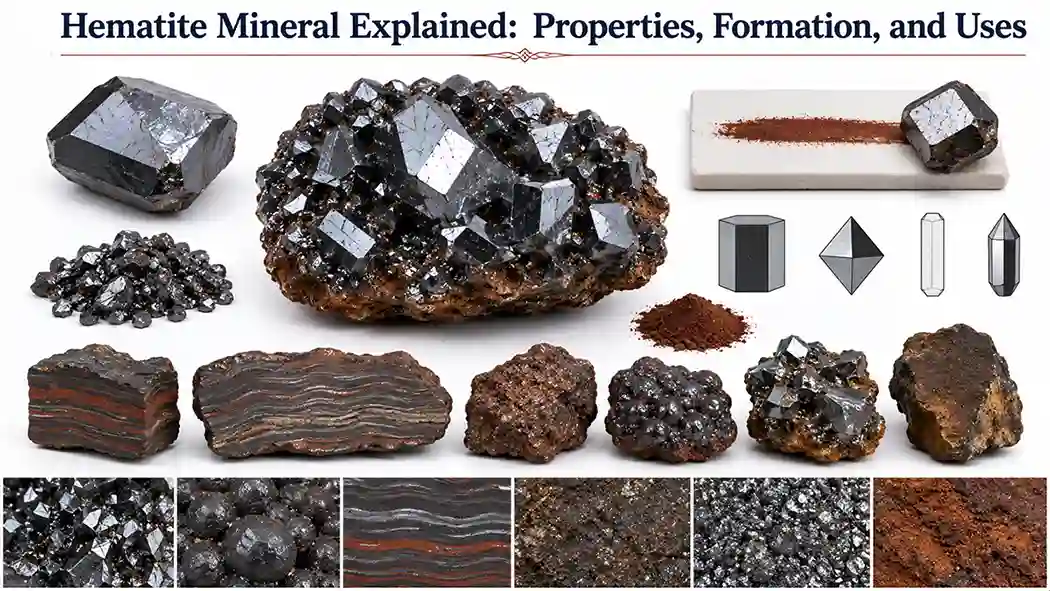
Hematite is one of the most important iron oxide minerals and a major source of iron worldwide. It is known for its metallic appearance, reddish-brown streak, and economic importance in steel production.
Although hematite can appear silver-gray or black externally, its distinctive red streak makes it one of the easiest minerals to identify.
Hematite is commonly found in:
- sedimentary rocks
- metamorphic rocks
- hydrothermal deposits
- banded iron formations
Its abundance and iron-rich composition make it one of the world's most valuable ore minerals.
Learn more → what is a mineral
What Is Hematite?
Hematite is an iron oxide mineral. Its chemical formula is
Hematite contains:
- iron (Fe)
- oxygen (O)
It belongs to the oxide mineral group and is one of the primary ores used for iron extraction.
Basic Properties of Hematite
| Property | Value |
|---|---|
| Chemical Formula | Fe₂O₃ |
| Mineral Group | Oxide |
| Crystal System | Trigonal |
| Hardness | 5–6.5 |
| Streak | Reddish-Brown |
| Luster | Metallic to Earthy |
Why Is Hematite Important?
Hematite is one of the most economically valuable minerals because it contains approximately 70% Iron.
Its high iron content makes it a major raw material for:
- steel production
- construction
- transportation
- manufacturing
Many of the world's largest iron mines extract hematite ore.
Crystal Structure of Hematite
The internal atomic arrangement of hematite creates:
- high density
- iron-rich composition
- trigonal crystal symmetry
Its crystal structure contributes to its physical and optical properties.
Learn more → crystal structure in minerals
Crystal System of Hematite
Hematite belongs to the trigonal crystal system. Its symmetry is characterized by,
Common crystal forms include:
- tabular crystals
- rhombohedral crystals
- massive forms
Learn more → trigonal crystal system
Physical Properties of Hematite
| Property | Description |
|---|---|
| Color | Steel gray to black |
| Streak | Reddish-brown |
| Luster | Metallic to earthy |
| Hardness | 5–6.5 |
| Cleavage | None |
| Fracture | Uneven |
| Specific Gravity | 5.0–5.3 |
The Famous Red Streak Test
The most important identification feature of hematite is its Reddish-Brown Streak. Even when the mineral appears black or silver, its powdered form is red.
This streak test quickly distinguishes hematite from:
- magnetite
- pyrite
- galena
Learn more → mineral color and streak
Common Forms of Hematite
Hematite occurs in several forms.
Specular Hematite
- Metallic appearance
- Reflective crystal surfaces
Massive Hematite
- Compact ore deposits
- Common mining form
Kidney Ore
- Rounded botryoidal structure
- Smooth surface
Earthy Hematite
- Soft red material
- Often used as pigment
Common Hematite Varieties
| Variety | Characteristics |
|---|---|
| Specular Hematite | Metallic crystals |
| Massive Hematite | Dense ore |
| Kidney Ore | Rounded surfaces |
| Earthy Hematite | Red powdery form |
How Hematite Forms
Hematite forms through several geological processes.
Sedimentary Deposition
Forms in iron-rich marine environments.
Metamorphism
Heat and pressure transform iron-bearing rocks.
Hydrothermal Activity
Mineral-rich fluids deposit hematite.
Weathering
Oxidation of iron minerals may produce hematite.
Hematite and Banded Iron Formations
Hematite is a major component of Banded Iron Formations (BIFs). These rocks formed billions of years ago when iron precipitated from ancient oceans. BIFs contain some of the largest iron ore reserves on Earth.
Hematite vs Magnetite
| Property | Hematite | Magnetite |
|---|---|---|
| Formula | Fe₂O₃ | Fe₃O₄ |
| Streak | Red-brown | Black |
| Magnetism | Weak | Strong |
| Crystal System | Trigonal | Isometric |
Magnetism is the easiest way to distinguish magnetite from hematite.
Learn more → magnetite mineral explained
Industrial Uses of Hematite
Steel Production
Primary source of iron.
Pigments
Produces red pigments and paints.
Jewelry
Polished hematite is used in decorative items.
Radiation Shielding
High-density varieties are used in specialized materials.
Major Uses of Hematite
| Industry | Application |
|---|---|
| Steel | Iron production |
| Pigments | Red coloring |
| Jewelry | Decorative stones |
| Construction | Heavy materials |
Hematite in Mineral Identification
Geologists identify hematite using:
- reddish-brown streak
- metallic luster
- high density
- hardness of 5–6.5
- iron-rich composition
The streak test is usually the most reliable method.
Learn more → mineral identification guide
Hematite Identification Summary
| Property | Hematite |
|---|---|
| Formula | Fe₂O₃ |
| Hardness | 5–6.5 |
| Crystal System | Trigonal |
| Streak | Red-Brown |
| Magnetism | Weak |
| Mineral Group | Oxide |
Hematite is an iron oxide mineral with the formula Fe₂O₃.
It is one of the world's most important iron ore minerals.
Hematite produces a distinctive reddish-brown streak.
Most hematite is weakly magnetic or non-magnetic, unlike magnetite.
Hematite belongs to the trigonal crystal system.
Final Thoughts
Hematite is one of Earth's most important ore minerals and has played a major role in human civilization through iron and steel production. Its red streak, iron-rich composition, and widespread occurrence make it a key mineral in geology and mineral identification.
From ancient banded iron formations to modern steel manufacturing, hematite continues to be one of the most economically and scientifically significant minerals on Earth.