
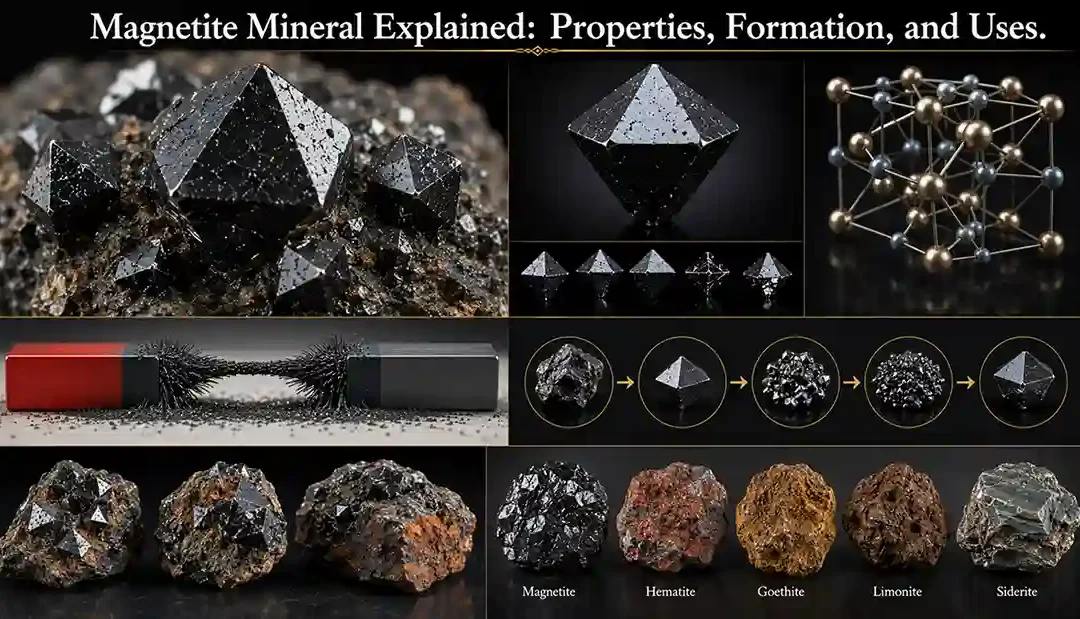
Magnetite is one of the most important iron minerals on Earth and is famous for its strong magnetic properties. It is the most magnetic naturally occurring mineral and serves as a major source of iron for steel production worldwide.
Magnetite occurs in a wide variety of geological environments and can be found in:
- igneous rocks
- metamorphic rocks
- sedimentary deposits
- iron ore formations
Because of its black color, high density, and strong magnetism, magnetite is one of the easiest minerals to identify.
Learn more → what is a mineral
What Is Magnetite?
Magnetite is an iron oxide mineral. Its chemical formula is
Magnetite contains:
- iron (Fe)
- oxygen (O)
It belongs to the oxide mineral group and is one of the world's most important iron ore minerals.
Basic Properties of Magnetite
| Property | Value |
|---|---|
| Chemical Formula | Fe₃O₄ |
| Mineral Group | Oxide |
| Crystal System | Isometric |
| Hardness | 5.5–6.5 |
| Streak | Black |
| Luster | Metallic to Submetallic |
Why Is Magnetite Magnetic?
Magnetite is famous because of its natural magnetism.The arrangement of iron atoms within its crystal structure creates a strong magnetic field.
Magnetite can:
- attract iron objects
- affect compasses
- retain magnetization
This property makes magnetite unique among common minerals.
Crystal Structure of Magnetite
Magnetite has a highly symmetrical crystal structure.
Its atomic arrangement produces:
- magnetic behavior
- high density
- isometric crystal forms
The crystal structure is responsible for many of magnetite's physical properties.
Learn more → crystal structure in minerals
Crystal System of Magnetite
Magnetite belongs to the isometric (Cubic) crystal system. Its crystallographic relationship is
Common crystal forms include:
- octahedrons
- dodecahedrons
- granular masses
Learn more → isometric crystal system
Physical Properties of Magnetite
| Property | Description |
|---|---|
| Color | Black |
| Streak | Black |
| Luster | Metallic to Submetallic |
| Hardness | 5.5–6.5 |
| Cleavage | None |
| Fracture | Uneven |
| Specific Gravity | 5.1–5.2 |
Common Crystal Forms of Magnetite
Magnetite commonly forms:
Octahedrons
The most recognizable crystal form.
Granular Masses
Common in many ore deposits.
Massive Aggregates
Large compact accumulations of magnetite.
Common Magnetite Crystal Forms
| Crystal Form | Appearance |
|---|---|
| Octahedron | Eight triangular faces |
| Granular | Small grain clusters |
| Massive | Dense compact masses |
How Magnetite Forms
Magnetite forms through several geological processes.
Igneous Crystallization
Forms directly from cooling magma.
Metamorphism
Develops under heat and pressure.
Hydrothermal Activity
Mineral-rich fluids deposit magnetite.
Sedimentary Processes
Can accumulate in iron-rich sedimentary rocks.
Magnetite as an Iron Ore
Magnetite is one of the most important iron ores because it contains approximately 72% Iron. This high iron content makes magnetite economically valuable.
It is widely mined for:
- steel production
- construction materials
- industrial manufacturing
Major Iron Ore Minerals
| Mineral | Formula |
|---|---|
| Magnetite | Fe₃O₄ |
| Hematite | Fe₂O₃ |
| Goethite | FeO(OH) |
| Limonite | Variable |
Magnetite vs Hematite
| Property | Magnetite | Hematite |
|---|---|---|
| Color | Black | Red to black |
| Streak | Black | Reddish-brown |
| Magnetism | Strong | Weak to none |
| Iron Content | Higher | Slightly lower |
The strong magnetic response is the easiest way to distinguish magnetite from hematite.
Magnetite and Earth's Magnetic Field
Magnetite plays an important role in Paleomagnetism. As magnetite crystals form, they can align with Earth's magnetic field.
Scientists use this information to study:
- plate tectonics
- continental drift
- Earth's magnetic history
Industrial Uses of Magnetite
Steel Production
Primary source of iron.
Heavy Concrete
Used in radiation shielding.
Water Filtration
Removes contaminants from water.
Coal Washing
Used in mineral processing.
Scientific Research
Important in magnetic studies.
Major Uses of Magnetite
| Industry | Application |
|---|---|
| Steel | Iron production |
| Construction | Heavy concrete |
| Water Treatment | Filtration |
| Mining | Coal processing |
| Research | Magnetic studies |
Magnetite in Mineral Identification
Geologists identify magnetite using:
- strong magnetism
- black streak
- metallic luster
- high density
- hardness of 5.5–6.5
Its magnetic properties make it one of the easiest minerals to recognize.
Learn more → mineral identification guide
Magnetite Identification Summary
| Property | Magnetite |
|---|---|
| Formula | Fe₃O₄ |
| Hardness | 5.5–6.5 |
| Crystal System | Isometric |
| Streak | Black |
| Magnetism | Strong |
| Mineral Group | Oxide |
Magnetite is an iron oxide mineral with the formula Fe₃O₄.
Its crystal structure allows iron atoms to produce a strong natural magnetic field.
Yes. Magnetite is one of the world's most valuable and widely mined iron ores.
Magnetite belongs to the isometric (cubic) crystal system.
Strong magnetism, black streak, metallic luster, and high density are key identification features.
Final Thoughts
Magnetite is one of Earth's most important minerals due to its magnetic properties and high iron content. As a major iron ore and a key mineral in paleomagnetic studies, magnetite provides valuable insights into both industrial resources and Earth's geological history.
From steel production to understanding plate tectonics, magnetite demonstrates how mineral properties can have both economic and scientific significance.