
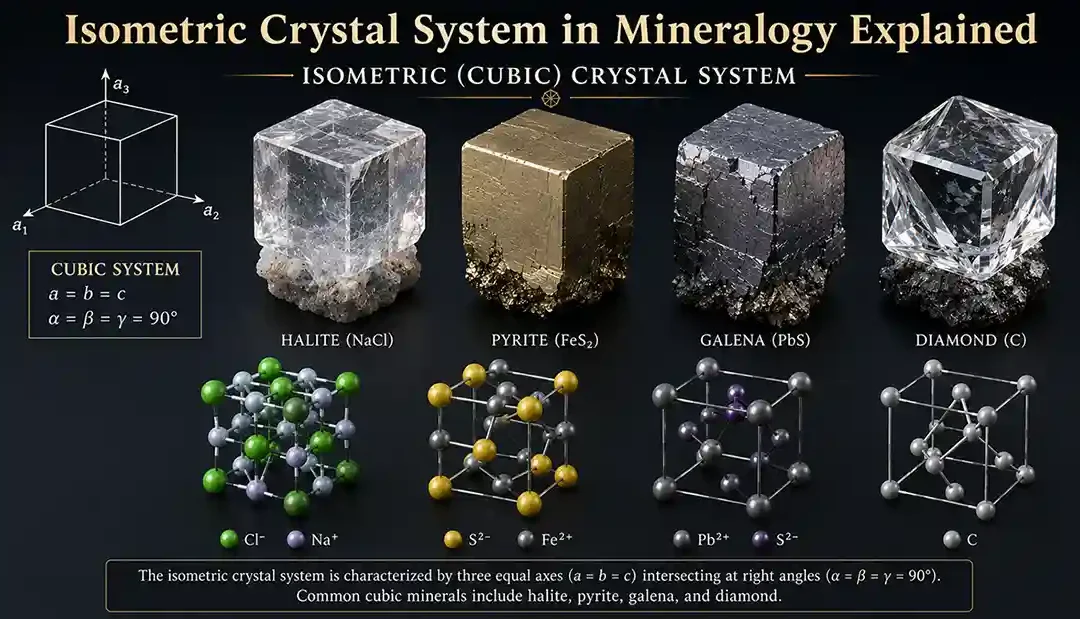
The Isometric Crystal System, also known as the Cubic Crystal System, is the most symmetrical of the seven crystal systems. Minerals in this system have three crystal axes of equal length that intersect at right angles.
Because of its high symmetry, the isometric system produces some of the most recognizable crystal shapes in mineralogy, including cubes, octahedrons, and dodecahedrons.
Many important minerals belong to this crystal system, including:
- Halite
- Pyrite
- Galena
- Diamond
- Magnetite
The isometric system is one of the easiest crystal systems to recognize in the field.
Learn more → crystal systems explained
What Is the Isometric Crystal System?
The isometric crystal system is a crystal system with three equal crystal axes intersecting at 90°
The axes can be visualized as:
a=b=c,α=β=γ=90∘
Key Characteristics
- Three equal axes
- All angles are 90°
- Highest crystal symmetry
- Produces cube-like crystal forms
Isometric Crystal System Properties
| Property | Value |
|---|---|
| Crystal Axes | 3 |
| Axis Lengths | Equal |
| Axis Angles | 90° |
| Symmetry | Highest |
| Common Crystal Form | Cube |
Why Isometric Crystals Are Highly Symmetrical
All three crystal axes are identical.
This means:
- crystal growth occurs equally in multiple directions
- crystals often develop balanced shapes
- external forms closely reflect internal atomic structure
Because of this symmetry, isometric crystals often appear very regular and geometric.
Common Crystal Forms in the Isometric System
Several crystal shapes occur in the isometric system.
Most Common Forms
Cube
Six square faces.
Examples:
- Halite
- Galena
Octahedron
Eight triangular faces.
Examples:
- Diamond
- Magnetite
Dodecahedron
Twelve rhombus-shaped faces.
Examples:
- Garnet (commonly)
Common Isometric Crystal Forms
| Crystal Form | Number of Faces |
|---|---|
| Cube | 6 |
| Octahedron | 8 |
| Dodecahedron | 12 |
Halite: A Classic Isometric Mineral
Halite is one of the easiest examples of the isometric crystal system.
Characteristics
- Perfect cubic crystals
- Three directions of cleavage at 90°
- Common evaporite mineral
Halite crystals often look like tiny cubes formed naturally.
Pyrite: The Famous Cubic Mineral
Pyrite commonly forms:
- cubes
- pyritohedrons
- combinations of crystal forms
Its metallic appearance and geometric shape make it one of the most recognizable minerals.
Learn more → mineral luster explained
Diamond and the Isometric System
Although polished diamonds appear different, natural diamond crystals often form octahedrons. Diamond belongs to the isometric system because its atomic structure follows cubic symmetry. Its strong crystal structure contributes to its extreme hardness.
Isometric Crystal Cleavage
Many isometric minerals display characteristic cleavage patterns.
Examples
| Mineral | Cleavage |
|---|---|
| Halite | Perfect cubic |
| Galena | Perfect cubic |
| Diamond | Octahedral cleavage |
| Pyrite | Poor cleavage |
Cleavage reflects the mineral's internal crystal structure.
Learn more → mineral cleavage vs fracture
Common Minerals of the Isometric System
| Mineral | Typical Crystal Form |
|---|---|
| Halite | Cube |
| Pyrite | Cube |
| Galena | Cube |
| Diamond | Octahedron |
| Magnetite | Octahedron |
| Garnet | Dodecahedron |
Isometric Crystal System and Mineral Identification
The isometric system helps geologists identify minerals by observing:
- crystal shape
- symmetry
- cleavage
- crystal faces
Perfect cubes often provide immediate clues that a mineral belongs to the isometric system.
Isometric System vs Other Crystal Systems
| Crystal System | Axis Lengths |
|---|---|
| Isometric | Equal |
| Tetragonal | Two equal |
| Orthorhombic | All unequal |
| Monoclinic | All unequal |
| Triclinic | All unequal |
The isometric system is unique because all three axes are identical.
Crystal Symmetry Comparison
SymmetryIsometric>SymmetryTetragonal>SymmetryOrthorhombic
The isometric system possesses the greatest symmetry among all crystal systems.
Importance of the Isometric Crystal System
The isometric system is important in:
- mineral identification
- crystallography
- gemstone studies
- materials science
- geology education
Many economically important minerals belong to this system.
Learn more → crystal structure in minerals
It is a crystal system with three equal crystal axes intersecting at 90 degrees.
Because many minerals in this system form cube-shaped crystals.
Halite, pyrite, galena, diamond, magnetite, and garnet.
The isometric crystal system has the highest symmetry.
Yes. Diamond crystallizes in the isometric (cubic) crystal system.
Final Thoughts
The Isometric Crystal System is the most symmetrical and recognizable crystal system in mineralogy. Its equal crystal axes and high symmetry create beautiful geometric forms such as cubes, octahedrons, and dodecahedrons.
Understanding the isometric system helps geologists identify minerals, interpret crystal structures, and appreciate the relationship between atomic arrangement and crystal shape.