
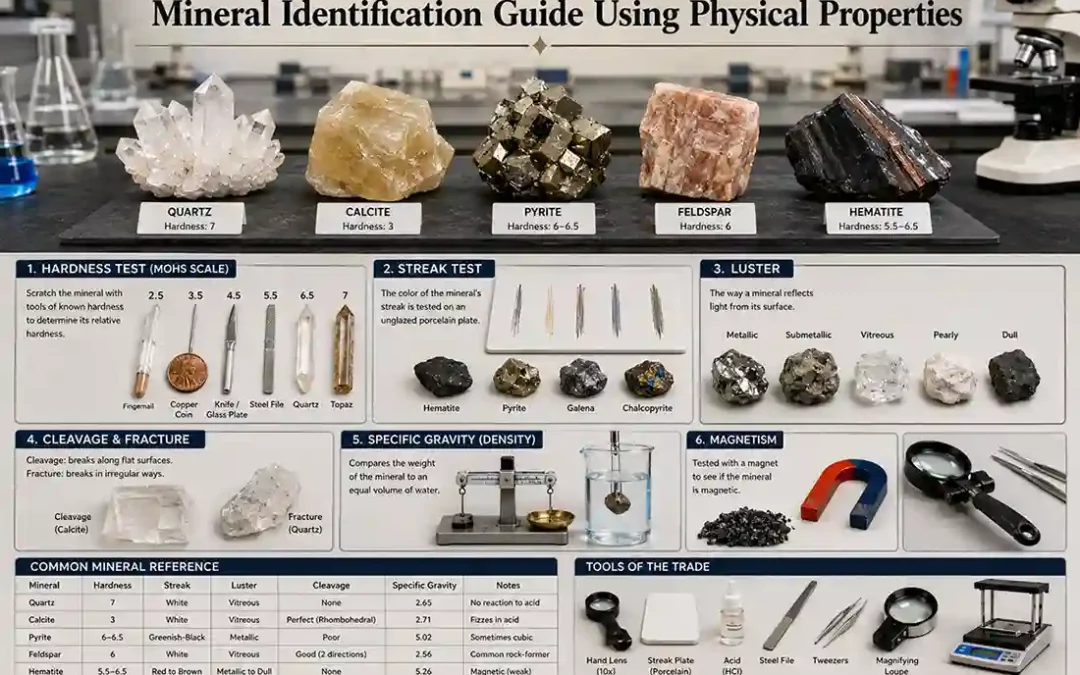
Mineral identification is one of the most important skills in geology and Earth science. Geologists identify minerals by studying their physical and chemical properties rather than relying only on appearance.
Because many minerals can look similar, scientists use several testing methods together to accurately identify unknown samples.
Common mineral identification methods include:
- hardness testing
- streak analysis
- luster observation
- cleavage examination
- crystal shape analysis
These techniques help geologists classify minerals, study rocks, locate ore deposits, and better understand Earth’s geological history.
Learn more → characteristics of minerals
Most Important Mineral Identification Tests
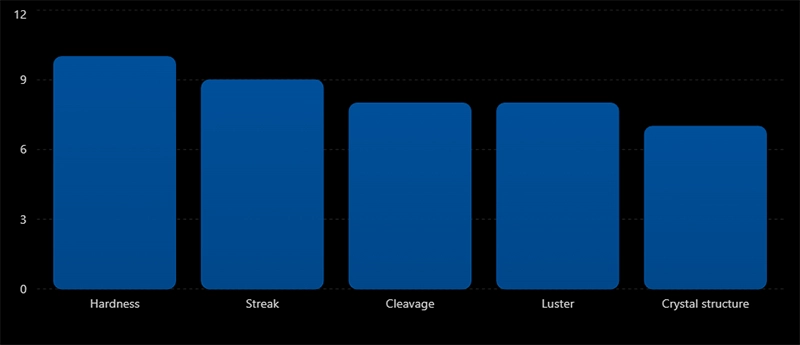
Most Important Mineral Identification Methods
Physical properties commonly used to identify minerals in geology.
Mineral Color Observation
Color is usually the first feature observed during mineral identification. However, color alone is not always reliable. Impurities can cause the same mineral to appear in different colors.
Example
Quartz may occur as:
- clear quartz
- rose quartz
- amethyst
- smoky quartz
Because of this, geologists use additional tests for accurate identification.
Crystal Shape and Habit
Minerals grow in specific crystal patterns called crystal habits
Common crystal forms include:
- cubic
- hexagonal
- prismatic
- fibrous
- tabular
Crystal structure often provides important identification clues.
Hardness Testing
Hardness measures resistance to scratching.
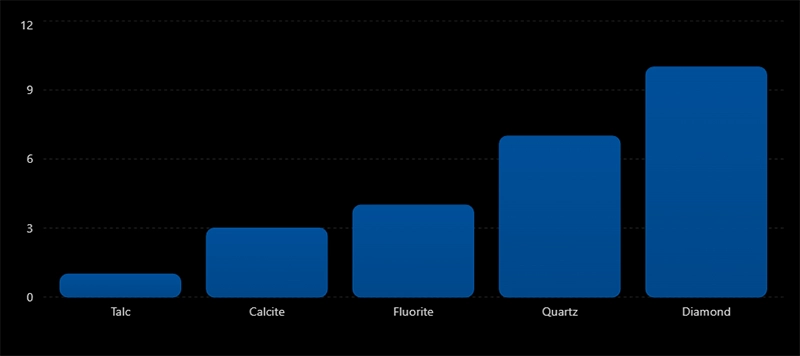
Scientists use the Mohs Hardness Scale, which ranges from:
- 1 (softest)
to - 10 (hardest)
Common Examples
- Talc = 1
- Calcite = 3
- Quartz = 7
- Diamond = 10
Mohs Hardness Scale Examples
Mohs Hardness Scale Examples
Common minerals arranged by scratch hardness.
Luster Identification
Luster describes how a mineral reflects light.
Main Luster Types
- metallic
- glassy
- pearly
- silky
- dull
Examples
- Pyrite = metallic
- Quartz = glassy
Luster is especially useful during visual examination.
Streak Testing
Streak is the color of a mineral in powdered form. Scientists perform this test using a streak plate
Example
- Hematite may appear silver
- but leaves a reddish-brown streak
Streak is often more reliable than surface color.
Cleavage and Fracture Analysis
Cleavage describes how minerals break along flat planes. Fracture describes irregular breakage.
Examples
- Mica shows excellent cleavage
- Quartz shows conchoidal fracture
Cleavage vs Fracture
| Property | Appearance |
|---|---|
| Cleavage | Flat smooth surfaces |
| Fracture | Curved or uneven breaks |
| Example Cleavage | Mica |
| Example Fracture | Quartz |
Specific Gravity Testing
Specific gravity measures relative mineral density. Some minerals feel unusually heavy because they contain:
- iron
- lead
- copper
Density testing helps identify many ore minerals.
Magnetism Testing
Some minerals respond to magnets.
Example
- Magnetite
It is naturally magnetic and easy to recognize. Magnetism can help distinguish certain iron-rich minerals.
Mineral Identification Tools
Geologists commonly use:
- streak plates
- hand lenses
- hardness kits
- magnets
- acid testing kits
- microscopes
These tools improve identification accuracy in:
- geology labs
- fieldwork
- mining exploration
Why Mineral Identification Matters
Mineral identification helps scientists:
- classify rocks
- study Earth history
- locate economic minerals
- understand geological environments
It is also important in:
- mining
- engineering
- environmental geology
- gemstone analysis
Geologists usually combine several tests such as hardness, streak, and cleavage.
Because impurities can change a mineral’s appearance.
A test that shows a mineral’s powder color using a streak plate.
It helps compare scratch resistance using the Mohs scale.
Final Thoughts
Mineral identification is a core skill in geology that combines observation, testing, and scientific analysis to classify Earth’s natural materials.
By studying properties such as hardness, streak, luster, cleavage, and crystal structure, geologists can accurately identify minerals and better understand geological processes.
Learning mineral identification methods provides a strong foundation for mineralogy, rock classification, and Earth science research.