
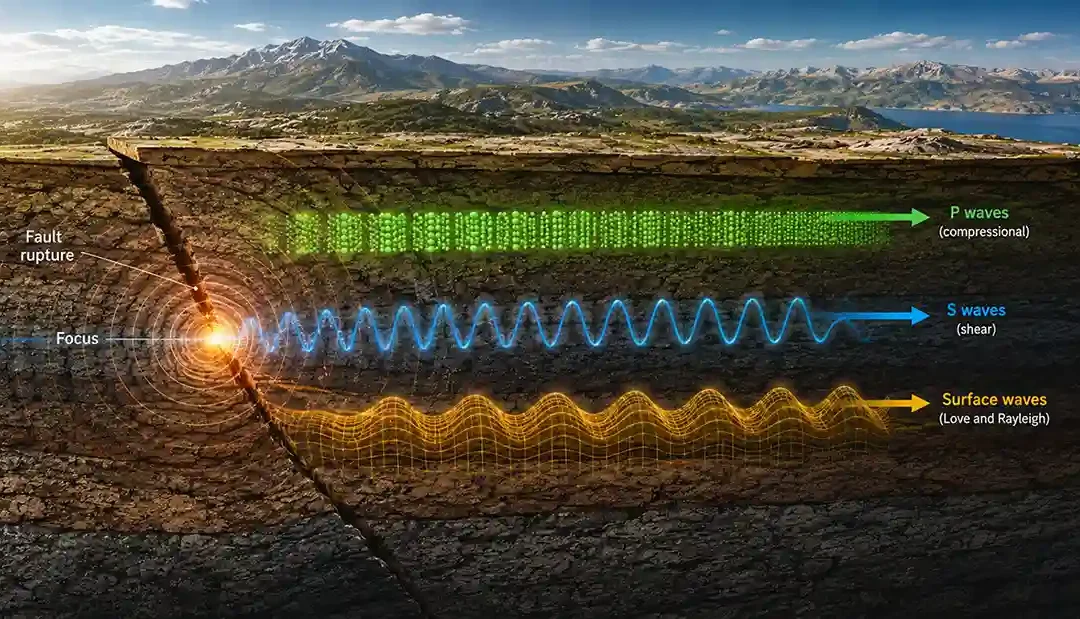
When an earthquake happens, energy travels through Earth in the form of seismic waves. These waves move outward from the earthquake source and create the shaking people feel on the surface.
Scientists study earthquake wave types to understand:
- how earthquakes spread
- why some areas shake more strongly
- how Earth’s interior is structured
There are three main earthquake wave types:
- P waves
- S waves
- Surface waves
Each wave moves differently and affects the ground in different ways. Some travel deep underground, while others move across Earth’s surface and cause the strongest shaking.
Learn more → what is an earthquake
Main Earthquake Wave Types
Main Earthquake Wave Types
Different seismic waves travel differently and produce different shaking effects.
| Wave | Impact |
|---|---|
| P Waves | 4 |
| S Waves | 7 |
| Surface Waves | 10 |
P Waves (Primary Waves)
P waves are the fastest earthquake waves.
Important Features
- first waves detected during earthquakes
- move through solids and liquids
- compress and expand material
P Wave Motion
P waves move similarly to a spring being pushed and pulled. Because they travel fastest, P waves arrive before stronger shaking begins.
S Waves (Secondary Waves)
S waves arrive after P waves.
Important Features
- slower than P waves
- move side to side
- travel only through solids
S waves usually create:
- stronger shaking
- more structural stress
Scientists discovered Earth’s outer core is liquid because S waves cannot travel through it.
Surface Waves Explained
Surface waves travel along Earth’s surface.
These are usually:
- the slowest waves
- the most destructive waves
Surface waves often cause:
- rolling ground motion
- strong side-to-side shaking
- severe building damage
Most visible earthquake destruction comes from surface waves.
P Waves vs S Waves vs Surface Waves
| Wave Type | Speed | Movement | Damage Level |
|---|---|---|---|
| P Waves | Fastest | Push-pull motion | Lower |
| S Waves | Medium | Side-to-side | Moderate |
| Surface Waves | Slowest | Rolling/shaking | Highest |
Different seismic waves create different types of ground motion.
How Earthquake Waves Travel Through Earth
As seismic waves move:
- some bend
- some reflect
- some slow down
Scientists use these wave behaviors to study:
- Earth’s crust
- mantle
- core structure
Seismic waves helped scientists discover Earth’s layered interior.
Why Surface Waves Cause More Damage
Surface waves stay close to buildings and infrastructure.
This creates:
- intense shaking
- long-duration movement
- structural collapse risk
Tall buildings are especially vulnerable to long surface-wave motion.
Learn more → earthquake intensity scale comparison
How Seismometers Detect Earthquake Waves
Scientists use Seismometers to detect seismic waves.
These instruments record:
- wave arrival times
- wave strength
- ground motion patterns
This helps scientists:
- locate earthquakes
- estimate magnitude
- study Earth’s interior
Learn more → earthquake monitoring technology
Real Earthquake Wave Examples
| Earthquake | Wave Effects |
|---|---|
| 2011 Japan | Massive surface-wave shaking |
| 1906 San Francisco | Strong strike-slip seismic waves |
| 1964 Alaska | Long-duration seismic waves |
| 2004 Indian Ocean | Tsunami-producing megathrust waves |
Different earthquakes create different wave patterns.
Why Understanding Wave Types Matters
Studying earthquake waves helps scientists:
- improve earthquake monitoring
- understand Earth’s interior
- develop early warning systems
- estimate seismic hazards
Seismic waves are one of the foundations of modern seismology.
P waves, S waves, and surface waves.
P waves travel the fastest and arrive first.
Surface waves usually create the strongest shaking and destruction.
Because liquid materials cannot support side-to-side shear motion.
Final Thoughts
Earthquake wave types help explain how seismic energy travels through Earth and why earthquakes create different kinds of shaking. P waves arrive first, S waves create stronger movement, and surface waves often cause the most destruction near Earth’s surface.
Understanding seismic waves is essential for earthquake science, monitoring systems, and improving disaster preparedness around the world.