
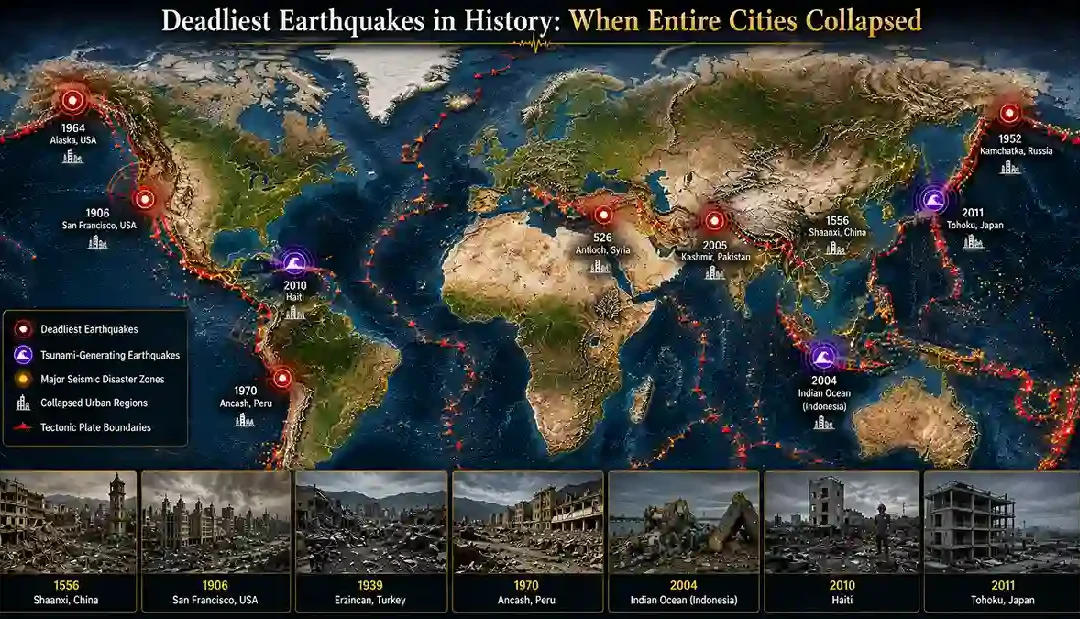
Not all earthquakes become disasters. Some occur in remote regions with limited damage. Others strike densely populated cities, trigger tsunamis, or collapse vulnerable infrastructure — turning seismic events into humanitarian catastrophes.
The deadliest earthquakes in history often involved:
- strong shallow shaking
- densely populated areas
- poor construction standards
- tsunamis or landslides
If you’re new to earthquakes, begin here → what is an earthquake
Why Some Earthquakes Become So Deadly
Earthquake deaths are influenced by more than magnitude.
| Factor | Effect |
|---|---|
| Population density | More people exposed |
| Building quality | Collapse risk |
| Shallow depth | Stronger surface shaking |
| Tsunamis | Coastal devastation |
| Landslides & fires | Secondary disasters |
A smaller shallow earthquake can sometimes be deadlier than a larger offshore one.
Learn more → magnitude vs intensity
10 Deadliest Earthquakes in History
1. 1556 Shaanxi Earthquake, China
The 1556 Shaanxi Earthquake is considered the deadliest earthquake in recorded history.
Estimated Impact
- Around 830,000 deaths
- Massive destruction across central China
- Widespread collapse of cave dwellings
Many homes were built into soft earth cliffs that collapsed during shaking.
2. 2010 Haiti Earthquake (M7.0)
The Haiti earthquake caused catastrophic urban destruction.
Why It Was So Deadly
- Very shallow earthquake
- Dense population exposure
- Weak building infrastructure
Hundreds of thousands of people were affected within seconds.
3. 2004 Indian Ocean Earthquake & Tsunami (M9.1)
This earthquake triggered one of the deadliest tsunamis in modern history.
Main Impacts
- Tsunami across multiple countries
- Massive coastal destruction
- Huge humanitarian crisis
Explore → earthquakes Indonesia
4. 1976 Tangshan Earthquake, China (M7.5)
The Tangshan earthquake struck a densely populated industrial city.
Key Facts
- Extremely destructive urban shaking
- Massive infrastructure collapse
- One of the deadliest modern earthquakes
5. 2023 Turkey–Syria Earthquakes
These earthquakes caused devastating destruction across southern Turkey and northern Syria.
Why It Was Severe
- Large shallow rupture
- Urban exposure
- Extensive building collapse
Explore → Istanbul fault zone
6. 1755 Lisbon Earthquake, Portugal
The Lisbon earthquake changed European history.
Main Effects
- Strong shaking
- Tsunami
- Massive city fires afterward
It became one of history’s most influential natural disasters.
7. 1923 Great Kanto Earthquake, Japan
The Great Kanto earthquake devastated Tokyo and Yokohama.
Why It Became So Deadly
- Strong urban shaking
- Massive fires after the earthquake
- Dense wooden construction
Learn more → earthquakes Tokyo region
8. 2003 Bam Earthquake, Iran (M6.6)
A relatively moderate earthquake became catastrophic because of vulnerable structures.
Main Factors
- Shallow depth
- Weak buildings
- Dense urban damage
Explore → earthquakes Tehran
9. 1970 Ancash Earthquake, Peru (M7.9)
This earthquake triggered one of the deadliest landslides in history.
Main Impacts
- Massive mountain collapse
- Entire towns buried
- Severe regional destruction
Explore → earthquakes Lima Peru
10. 1988 Armenia Earthquake (M6.8)
The Armenia earthquake caused widespread destruction despite moderate magnitude.
Why?
- Vulnerable infrastructure
- Winter conditions
- Strong shallow shaking
Deadliest vs Strongest Earthquakes
The strongest earthquake is not always the deadliest.
| Earthquake Type | Example |
|---|---|
| Strongest | 1960 Chile (M9.5) |
| Deadliest | 1556 Shaanxi Earthquake |
| Largest Tsunami Disaster | 2004 Indian Ocean |
| Most Urban Damage | Haiti 2010 |
Human factors strongly influence earthquake disasters.
Why Urban Earthquakes Are Especially Dangerous
Earthquakes near large cities often become catastrophic because of:
- building collapse
- fires
- transportation failure
- population density
Cities at high seismic risk include:
- Tokyo
- Istanbul
- Tehran
- Manila
- Mexico City
Learn more → earthquake risk zones worldwide
Can Deadly Earthquakes Be Prevented?
Earthquakes themselves cannot be stopped.
But deaths can be reduced through:
- stronger building codes
- earthquake-resistant engineering
- early warning systems
- public preparedness
Countries like Japan have greatly reduced fatalities through advanced preparedness.
Learn more → can earthquakes be predicted
The 1556 Shaanxi earthquake in China.
No — population density and building quality matter greatly.
Because they can devastate coastlines far from the earthquake itself.
The 2010 Haiti earthquake caused extremely high casualties.
Final Thoughts
The deadliest earthquakes in history show that seismic disasters are shaped not only by geology but also by human vulnerability. Strong shaking, weak infrastructure, tsunamis, and dense populations can transform earthquakes into catastrophic events affecting entire nations.
Understanding these disasters helps scientists and governments improve preparedness for future seismic risks.