
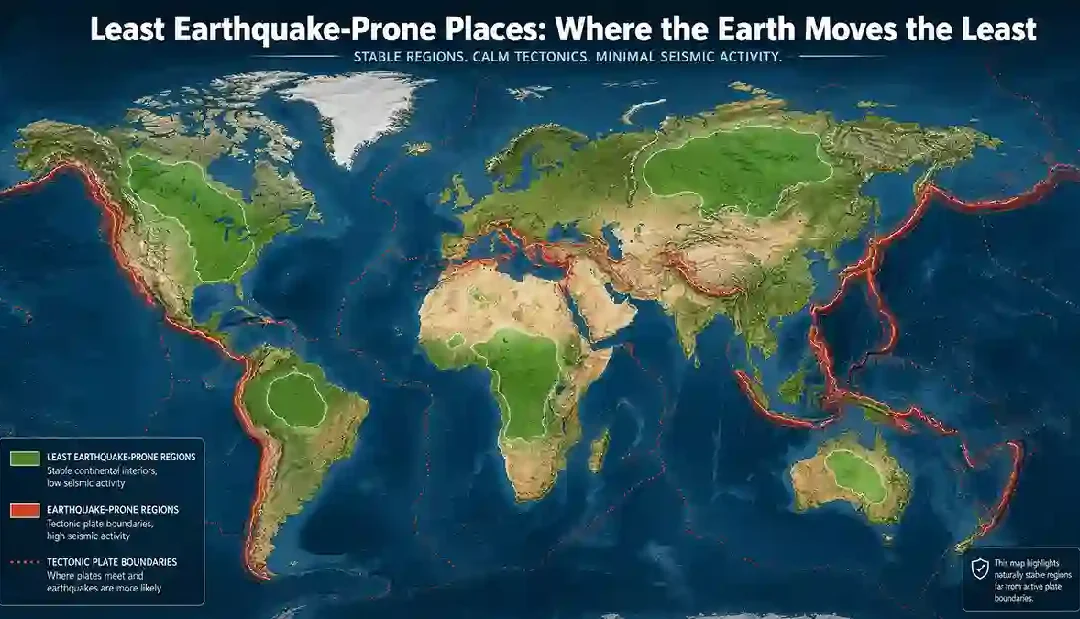
While some parts of the world experience constant seismic activity, others remain surprisingly stable for thousands — even millions — of years. These regions are often located far from tectonic plate boundaries.
Instead of sitting near active faults or subduction zones, they lie within ancient and stable parts of Earth’s crust called cratons.
That means:
- fewer earthquakes
- lower seismic energy
- reduced tectonic stress
If you’re new to earthquakes, begin here → what is an earthquake
Why Some Places Rarely Experience Earthquakes
Earthquakes happen most often where tectonic plates interact.
Low-risk regions are different because:
- they sit far from active plate boundaries
- crustal stress is lower
- major faults are absent or inactive
- tectonic movement is minimal
These regions are known as tectonically stable areas.
Learn more → causes of earthquakes
10 Least Earthquake-Prone Places in the World
1. Most of Australia — A Stable Continental Interior
Australia sits near the center of a tectonic plate.
Why It’s Stable
- Far from major plate boundaries
- Ancient continental crust
- Low tectonic stress
Australia does experience small earthquakes occasionally, but large destructive earthquakes are rare.
Explore → earthquakes Australia
2. Central Canada — Ancient Shield Stability
Much of central Canada lies on the ancient Canadian Shield.
Main Features
- Extremely old rock formations
- Minimal tectonic movement
- Very low seismic activity
Western Canada is more active, but the interior is relatively stable.
3. Brazil — One of South America’s Quietest Regions
Brazil is far from the Andes subduction zone.
Why?
- Located within the South American Plate interior
- Few active faults
- Rare strong earthquakes
4. Finland — Quiet Northern European Crust
Finland experiences very low earthquake activity.
Main Features
- Ancient stable crust
- Few active faults
- Rare noticeable earthquakes
5. Norway (Most Inland Areas)
Most inland areas of Norway have low seismic risk.
Why?
- Stable continental crust
- Far from active plate boundaries
- Minimal tectonic stress
Coastal offshore areas can still experience moderate seismic activity.
6. Sweden — One of Europe’s Calmest Seismic Regions
Sweden experiences very few earthquakes.
Main Features
- Ancient shield geology
- Very low tectonic movement
- Mostly minor seismic events
7. Qatar & Gulf Interior Regions
Parts of the Gulf region remain relatively stable.
Why?
- Located away from major active faults
- Lower tectonic activity compared to Iran or Turkey
- Rare significant earthquakes
8. Denmark — Low Seismic Activity Region
Denmark has very low earthquake frequency.
Main Features
- Stable Northern European crust
- Minimal fault activity
- Rare noticeable earthquakes
9. Much of South Africa
Large parts of South Africa are tectonically stable.
Why?
- Located far from major plate boundaries
- Ancient continental crust
- Low natural seismic activity
Some mining-related earthquakes can still occur.
10. Singapore — Low Regional Seismic Exposure
Singapore is relatively safe from strong earthquakes.
Main Features
- Located away from major active faults
- Mostly affected indirectly by distant earthquakes
- Low local seismic activity
What Makes a Region Geologically Stable?
| Stable Feature | Effect |
|---|---|
| Ancient continental crust | Less tectonic movement |
| Distance from plate boundaries | Lower seismic stress |
| Lack of active faults | Fewer earthquakes |
| Stable cratons | Long-term geological calm |
Stable regions usually lie deep inside tectonic plates.
Can Earthquakes Still Happen in Low-Risk Areas?
Yes — but they are usually:
- smaller
- less frequent
- less destructive
Even stable regions can occasionally experience intraplate earthquakes.
Learn more → types of earthquakes
Will These Places Always Stay Safe?
Geological stability changes very slowly over millions of years.
Most low-risk regions are expected to remain relatively stable for a very long time.
However:
- no place on Earth is completely earthquake-free
- rare unexpected earthquakes can still occur
Learn more → earthquake risk zones worldwide
There is no completely earthquake-free place, but stable continental interiors are the safest.
Because they are far from tectonic plate boundaries.
Yes — but usually weaker and less frequent.
Often yes, because volcanoes also form near active tectonic zones.
Final Thoughts
The least earthquake-prone places on Earth are usually located far from tectonic plate boundaries within stable continental interiors. These ancient geological regions experience far less tectonic stress than areas near subduction zones or transform faults.
Understanding why some regions remain stable helps reveal how Earth’s tectonic system controls where major earthquakes are most likely to occur.