
Not every earthquake causes noticeable shaking.
In fact, most earthquakes happen without people even realizing it.
The reason comes down to how energy travels through the Earth — and how strong that energy is by the time it reaches you.
To understand the basics, see our guide on what causes earthquakes
The Main Reason: Energy Weakens with Distance
When an earthquake starts:
- energy is released at the focus
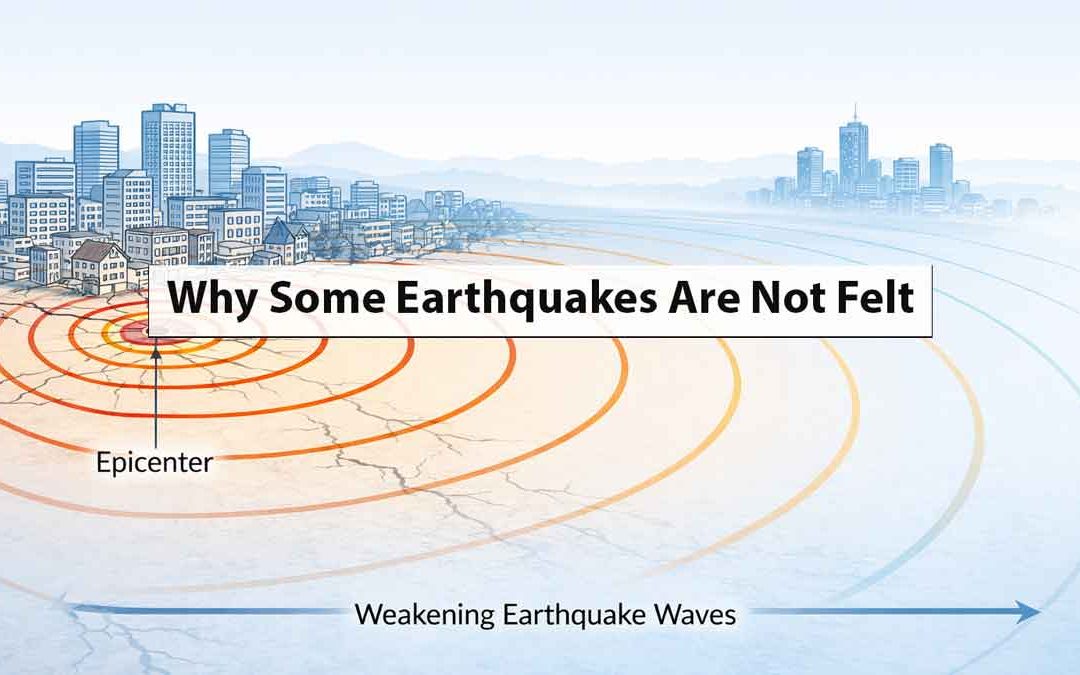
- waves spread outward in all directions
- energy becomes weaker over distance
By the time waves reach far locations, they may be too weak to feel.
Learn more in our seismic waves guide
1. Magnitude Matters
Small earthquakes release very little energy.
- Magnitude below 3.0 → usually not felt
- Magnitude 3–4 → sometimes felt
- Higher magnitudes → more noticeable
But magnitude alone doesn’t tell the whole story.
Learn the difference in our magnitude vs intensity guide
2. Distance from the Epicenter
The closer you are to the epicenter: the stronger the shaking
The farther away: the weaker it feels
Example:
A moderate earthquake may be strongly felt near the epicenter but completely unnoticed just a few hundred kilometers away.
3. Depth of the Earthquake
Depth plays a major role.
- Shallow earthquakes → strong surface shaking
- Deep earthquakes → energy spreads out and weakens
This is why some large earthquakes are barely felt at the surface.
4. Ground Type and Local Conditions
Where you are standing matters.
Areas built on:
- soft soil
- sediment
- landfill
amplify shaking
While areas on:
- solid bedrock
reduce shaking
Learn more about this effect in our guide on earthquakes in San Francisco
5. Human Awareness
Sometimes earthquakes are simply too weak to notice.
Factors include:
- background noise
- movement (walking, driving)
- attention level
Small earthquakes may go completely unnoticed during the day.
This is similar to why earthquakes can feel stronger at night
How Common Are Unfelt Earthquakes?
Very common.
- Thousands of earthquakes occur every day worldwide
- Most are too small to feel
The Earth is constantly moving — even when we don’t notice it.
What Happens During These Small Earthquakes
The process is the same:
- stress builds along faults
- rocks break
- energy releases
Learn more in our guide on what happens before an earthquake
Are Unfelt Earthquakes Dangerous?
Usually, no.
They:
- release small amounts of energy
- rarely cause damage
However:
sometimes small earthquakes can be foreshocks before a larger event. Learn more in our guide on can earthquakes be predicted
It may have been too small, too deep, or too far away.
Rarely — but if it’s very deep or far away, it might not be felt strongly.
Sometimes — but not always. Many occur without leading to larger events.
Thousands — most are too small to notice.