
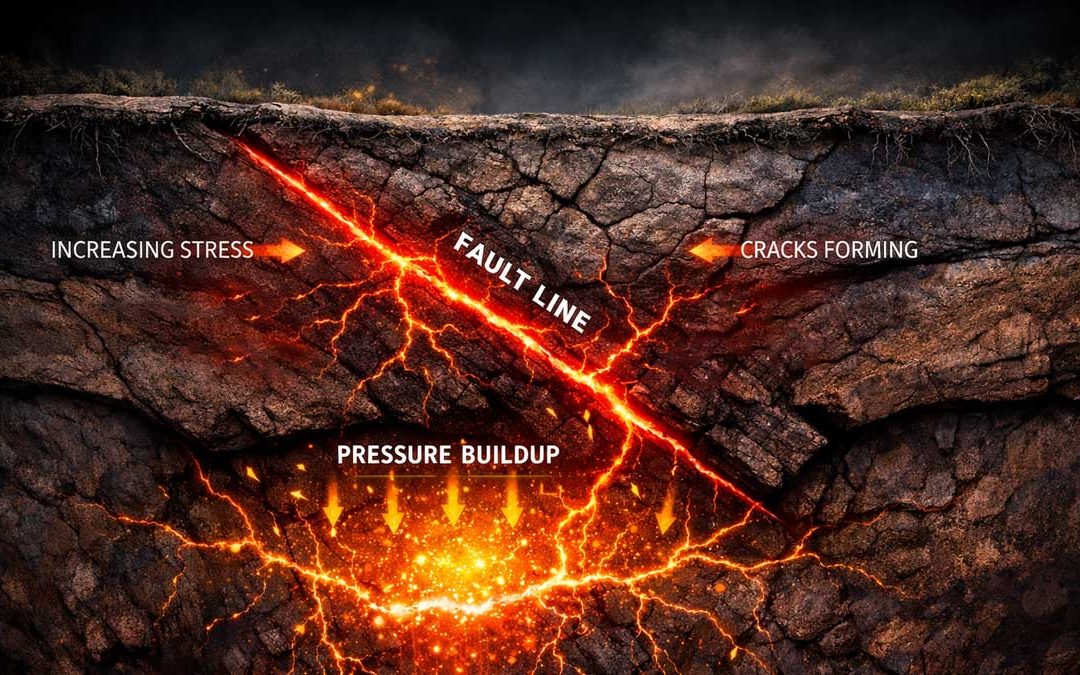
Most earthquakes feel sudden — but deep underground, the process begins long before the shaking starts.
The Earth doesn’t just “snap” instantly. Stress builds up over time along fault lines until the rock can no longer hold it.
To understand the full process, see our guide on what causes earthquakes
The Hidden Process Before an Earthquake
Before an earthquake happens:
- Tectonic plates slowly move
- Rocks along a fault become stuck
- Stress builds up over years or centuries
- Rocks begin to deform under pressure
- Eventually, the fault slips suddenly
That sudden release is what we feel as an earthquake.
Learn more about faults in our fault lines guide
Are There Any Warning Signs?
This is one of the most searched questions — but the answer is complicated.
There are possible signals, but none are reliable enough to predict earthquakes precisely.
1. Small Foreshocks
Sometimes, small earthquakes happen before a larger one.
- These are called foreshocks
- They occur near the same fault
The problem:
We only know they were foreshocks after the main earthquake happens.
2. Ground Movement
Scientists use GPS and satellites to detect tiny ground shifts.
- Plates slowly moving
- Land slightly deforming
But these changes happen constantly — not just before earthquakes.
3. Gas Emissions
Some studies suggest:
- increased radon gas release
- chemical changes in groundwater
However, results are inconsistent and not reliable for prediction.
4. Electrical Signals
In rare cases, stressed rocks may generate electrical changes.
This is still an active area of research.
Do Animals Sense Earthquakes?
There are many stories about animals behaving strangely before earthquakes:
- dogs barking
- birds flying away
- fish acting unusually
But there is no scientific proof that animals can consistently predict earthquakes.
The Only Reliable “Warning”: Early Detection
While we cannot predict earthquakes in advance, we can detect them just after they start.
Early warning systems work by:
- detecting fast-moving P-waves
- sending alerts before stronger S-waves arrive
Learn how waves travel in our seismic waves guide
Why this matters:
Even a few seconds can:
- alert people
- stop trains
- shut down systems
- allow people to take cover
Real Example: Japan
Japan has one of the most advanced early warning systems in the world.
Learn why earthquakes are so common there
Even though earthquakes cannot be predicted, rapid alerts help reduce damage and save lives.
What Happens Just Seconds Before Shaking?
Right before strong shaking:
- P-waves arrive first (fast, weak)
- S-waves follow (slower, stronger)
This is the small window where alerts are possible.
Learn more in our guide on can earthquakes be predicted
Why Some Areas Feel More Sudden Shaking
Even if warning signs exist, people experience earthquakes differently depending on:
- location
- soil type
- distance from fault
Learn more in our magnitude vs intensity guide
Frequently Asked Questions
No — exact prediction is not currently possible.
Some possible signals exist, but none are reliable enough for prediction.
A few seconds from early warning systems.
There is no scientific evidence supporting this.