
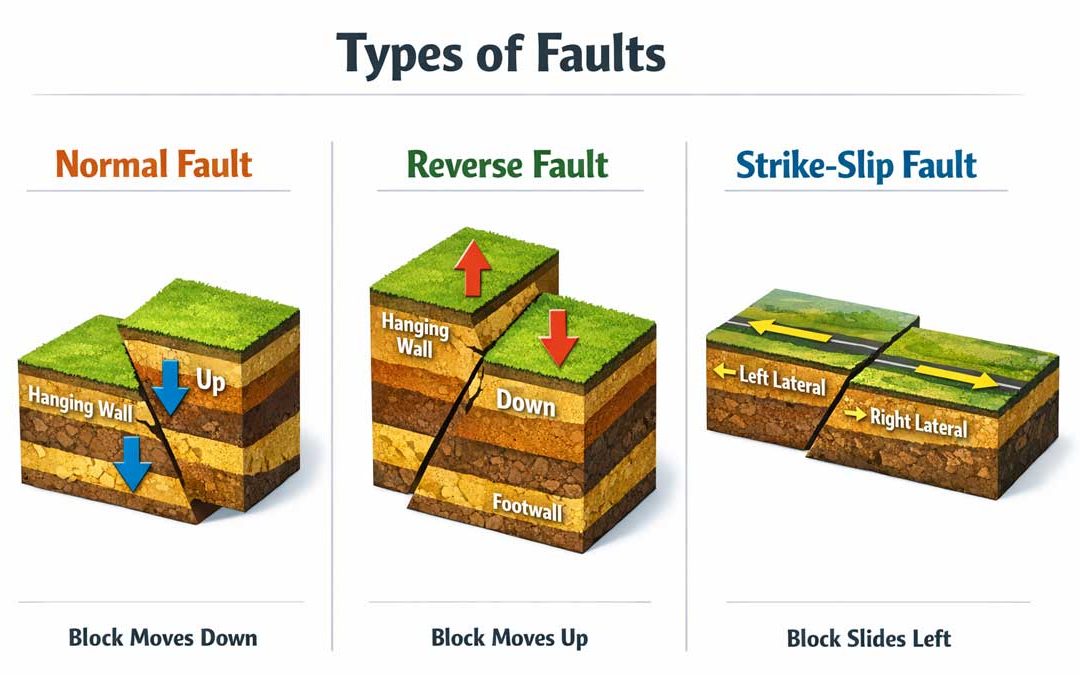
Fault lines are cracks or fractures in the Earth’s crust where rocks have moved. They are one of the main reasons earthquakes occur, as they are the locations where stress builds up and is suddenly released.
Understanding fault lines helps explain how earthquakes happen and why certain regions experience more seismic activity than others.
If you're new to the topic, it’s helpful to first understand what an earthquake is
What Is a Fault Line?
A fault line is a break in the Earth’s crust where blocks of rock move relative to each other.
This movement happens because of tectonic forces acting on the Earth’s surface. Over time, stress builds up along these faults until the rocks suddenly slip, releasing energy in the form of seismic waves.
In simple terms, fault lines are the places where earthquakes begin.
How Fault Lines Form
Fault lines form due to the movement of tectonic plates.
As plates:
- push against each other
- pull apart
- slide past each other
They create stress in the Earth’s crust. When the stress becomes too great, the rock breaks and forms a fault.
Over time, repeated movement along these faults can create large fracture zones.
Types of Fault Lines
There are three main types of fault lines based on how the rocks move.
Normal Fault
A normal fault occurs when the crust is pulled apart.
- One block moves downward
- Caused by tension forces
- Common in areas where the crust is stretching
Reverse Fault
A reverse fault happens when the crust is compressed.
- One block moves upward
- Caused by compression forces
- Often found in mountain-building regions
Strike-Slip Fault
A strike-slip fault occurs when two blocks slide past each other horizontally.
- Movement is sideways
- Caused by shear forces
- Common in transform plate boundaries
A well-known example is the San Andreas Fault in California.
Why Fault Lines Cause Earthquakes
Fault lines are zones of weakness where stress accumulates.
When the stress exceeds the strength of rocks:
- the rocks break or slip
- energy is released suddenly
- seismic waves are generated
This process results in an earthquake.
Even though the movement may be small, the energy released can be very large.
To see how stress builds up before movement occurs, you can learn more about what causes earthquakes
Where Are Fault Lines Found?
Fault lines are found all over the world, especially near tectonic plate boundaries.
Major fault zones include:
- San Andreas Fault (USA)
- North Anatolian Fault (Turkey)
- Alpine Fault (New Zealand)
These areas experience frequent earthquakes due to ongoing plate movement.
For example, cities along the San Andreas Fault—like San Francisco—face ongoing seismic risk, as explained in our guide on earthquakes in San Francisco
Fault Lines and Plate Boundaries
Fault lines are closely related to plate boundaries.
- Convergent boundaries → reverse faults
- Divergent boundaries → normal faults
- Transform boundaries → strike-slip faults
This connection explains why earthquakes are more common in certain regions.
Can Fault Lines Be Seen?
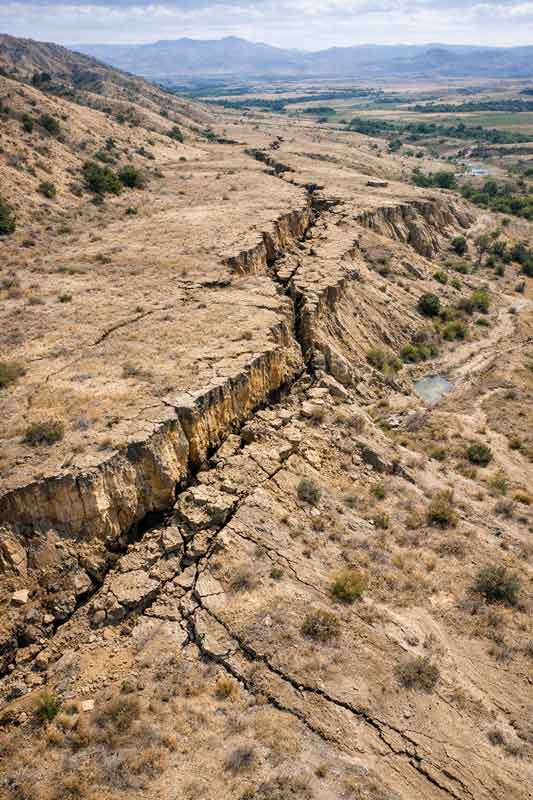
Some fault lines can be seen on the surface as visible cracks or offsets in the landscape.
Others are hidden underground and can only be detected using scientific instruments.
Scientists use geological mapping and seismic data to identify and study fault lines.
Why Understanding Fault Lines Matters
Understanding fault lines helps:
- identify earthquake-prone areas
- improve building design
- reduce damage risk
- support disaster planning
It also helps scientists better understand how the Earth’s crust moves over time.
Simple Explanation
In simple terms:
Fault lines are cracks in the Earth where rocks move, and this movement can cause earthquakes.
Conclusion
Fault lines play a critical role in earthquakes. They are the locations where stress builds up and is released as seismic energy. By studying fault lines, scientists can better understand earthquake patterns and help reduce risks in vulnerable areas.
For a complete overview of all related concepts, visit our complete guide to earthquakes
Frequently Asked Questions
A fault line is a crack in the Earth’s crust where rocks move relative to each other.
The main types are normal faults, reverse faults, and strike-slip faults.
Because stress builds up and is suddenly released when rocks move along the fault.
They are most common near tectonic plate boundaries.
Scientists can identify fault locations, but they cannot predict exactly when movement will occur.