
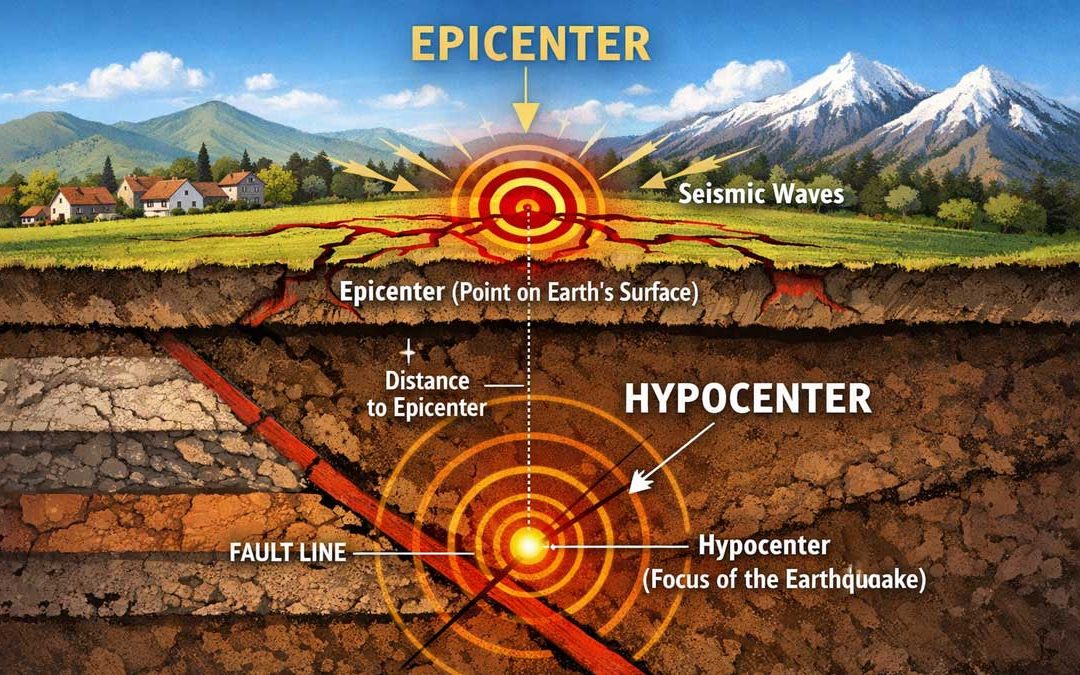
When an earthquake occurs, scientists use two important terms to describe where it begins and how it affects the surface: focus and epicenter.
Although they are closely related, they refer to two different locations. Understanding this difference helps explain how earthquakes spread and why some areas experience stronger shaking than others.
What Is the Focus of an Earthquake?
The focus, also called the hypocenter, is the exact point inside the Earth where an earthquake begins.
It is the location where:
- rocks first break or slip
- energy is released
- seismic waves are generated
The focus is always located below the Earth’s surface, sometimes deep underground.
If you're just starting, it helps to first understand what an earthquake is
What Is the Epicenter?
The epicenter is the point on the Earth’s surface directly above the focus.
This is the location usually reported in news and earthquake alerts because it is easier to identify on maps and relates to where people feel the shaking most strongly.
Key Difference Between Epicenter and Focus
Here is the simplest way to understand it:
- Focus → where the earthquake starts inside the Earth
- Epicenter → the point directly above it on the surface
Both points are connected vertically.
Why the Difference Matters
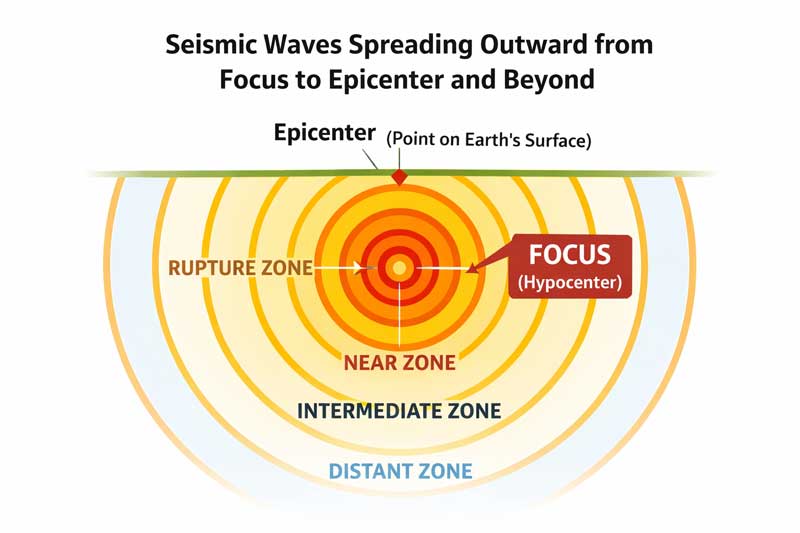
The difference between epicenter and focus is important because it affects how earthquake energy is distributed.
- Areas closer to the epicenter usually feel stronger shaking
- The depth of the focus determines how far the energy spreads
- Shallow earthquakes often cause more damage
Understanding both helps scientists assess risk and impact more accurately.
To better understand how earthquakes are measured and experienced, read about magnitude vs intensity
How Scientists Locate Epicenter and Focus
Scientists use data from seismographs to determine where an earthquake started.
By measuring:
- the arrival time of different seismic waves
- the distance between monitoring stations
They can calculate:
- the depth of the focus
- the location of the epicenter
This process is called triangulation.
Shallow vs Deep Focus
Earthquakes can have different depths depending on where the focus is located.
- Shallow focus (0–70 km) → stronger shaking at the surface
- Intermediate focus (70–300 km)
- Deep focus (300–700 km) → wider but weaker surface impact
Shallow earthquakes are usually more dangerous because their energy reaches the surface quickly.
Real-World Example
Imagine dropping a stone into the ground instead of water.
- The point where the stone hits underground = focus
- The point directly above it on the surface = epicenter
From there, vibrations spread outward in all directions.
Simple Explanation
In simple terms:
- Focus = starting point inside the Earth
- Epicenter = surface point above it
Conclusion
The focus and epicenter are two key points that help scientists understand where an earthquake begins and how it affects the surface. While the focus is the origin of energy release underground, the epicenter shows where that energy reaches the surface.
Understanding this difference makes it easier to interpret earthquake reports and understand why damage varies from place to place.
For a complete overview of causes, effects, and safety, visit our complete guide to earthquakes
Frequently Asked Questions
The focus is the point inside the Earth where the earthquake begins.
The epicenter is the point on the Earth’s surface directly above the focus.
Both are important. The focus shows where the earthquake starts, while the epicenter shows where it is felt on the surface.
Because their energy travels a shorter distance to the surface, resulting in stronger shaking.
They use seismic data from multiple stations and calculate the location using triangulation.