
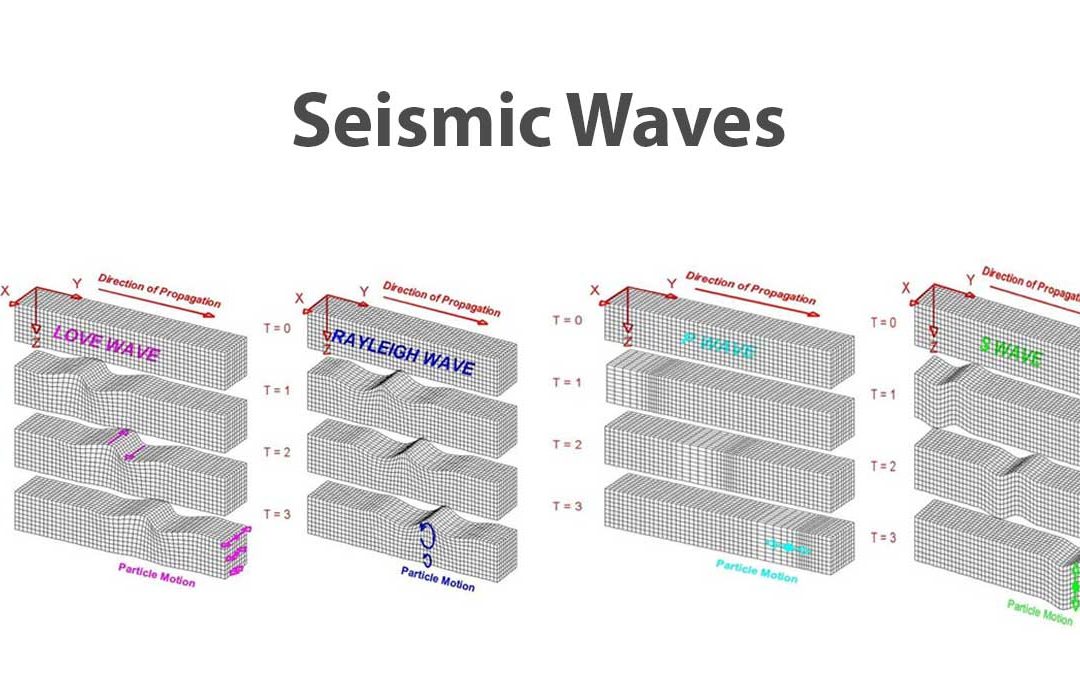
Seismic waves are the vibrations that travel through the Earth when an earthquake occurs. These waves carry the energy released at the focus of the earthquake and spread outward in all directions.
Scientists study seismic waves to understand how earthquakes happen, how strong they are, and what the Earth is like below the surface.
In simple terms, seismic waves are the reason the ground shakes during an earthquake.
What Are Seismic Waves?
Seismic waves are waves of energy produced by the sudden movement of rocks inside the Earth. They usually form when stress built up along a fault is released during an earthquake.
These waves travel through the Earth’s interior and across its surface. As they move, they cause shaking that may be felt by people and recorded by instruments called seismographs.
Seismic waves are important because they help scientists locate earthquakes and study the internal structure of the Earth.
If you're new to this topic, start by understanding what is an earthquake
How Seismic Waves Are Produced
When an earthquake begins, energy is released at the focus, also called the hypocenter. This energy radiates outward in the form of waves, much like ripples spreading across water after a stone is dropped.
The stronger the earthquake, the more energy is released and the more powerful the seismic waves can be.
These waves reach different places at different times depending on their speed and the material they travel through.
Main Types of Seismic Waves
Seismic waves are divided into two main groups:
- Body waves
- Surface waves
Body waves travel through the inside of the Earth, while surface waves move along the Earth’s surface.
Body Waves
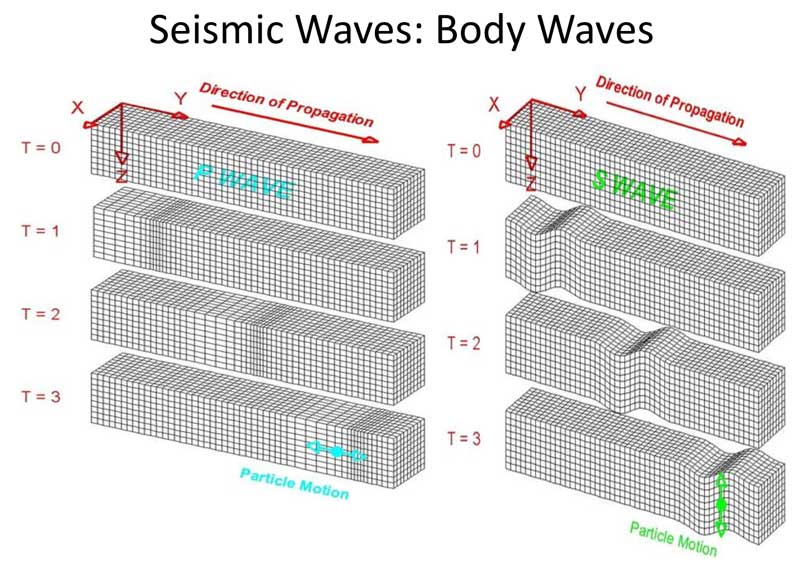
Body waves travel through the Earth’s interior and are the first waves produced during an earthquake.
There are two main types of body waves:
- P waves
- S waves
P Waves (Primary Waves)
P waves, or primary waves, are the fastest seismic waves. They are usually the first to arrive at a seismograph station after an earthquake begins.
Key features of P waves:
- travel fastest
- move in a push-pull motion
- pass through solids, liquids, and gases
- usually cause less damage than surface waves
Because they travel so quickly, P waves are often used in earthquake early warning systems.
S Waves (Secondary Waves)
S waves, or secondary waves, arrive after P waves. They move more slowly and create a side-to-side or up-and-down motion.
Key features of S waves:
- slower than P waves
- move in a transverse motion
- travel only through solids
- usually cause stronger shaking than P waves
One important fact is that S waves cannot travel through liquid. This helps scientists understand that parts of the Earth’s interior, such as the outer core, are liquid.
Surface Waves
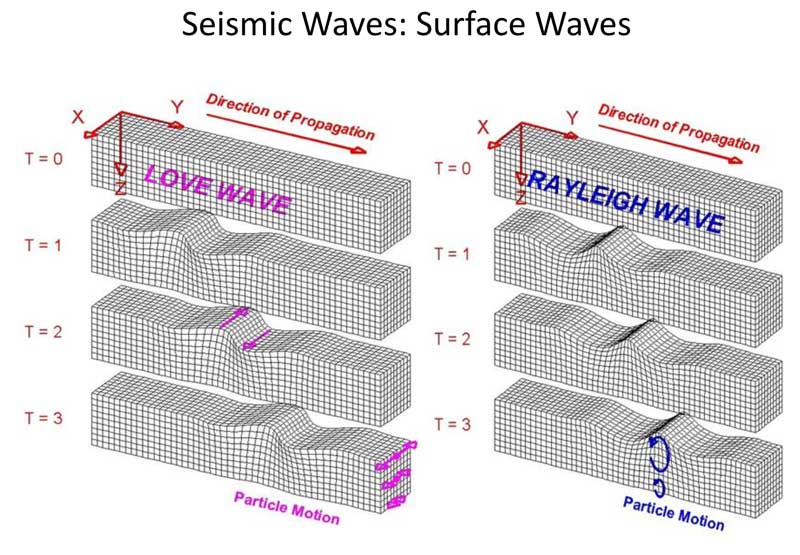
Surface waves travel along the Earth’s surface rather than through its interior. They usually arrive after P waves and S waves, but they are often the most destructive.
Key features of surface waves:
- move along the Earth’s surface
- slower than body waves
- create rolling and side-to-side ground movement
- cause most earthquake damage near the surface
Surface waves are often strongest near the epicenter and are especially harmful to buildings, roads, and bridges.
Types of Surface Waves
There are two main types of surface waves:
Love Waves
Love waves move the ground from side to side in a horizontal direction. This motion can be very destructive to buildings.
Rayleigh Waves
Rayleigh waves create a rolling motion, similar to ocean waves. They move both vertically and horizontally and can make the ground feel like it is rolling beneath your feet.
Difference Between P Waves, S Waves, and Surface Waves
Here is a simple comparison:
| Wave Type | Speed | Motion | Travels Through | Damage Level |
|---|---|---|---|---|
| P Waves | Fastest | Push-pull | Solids, liquids, gases | Lower |
| S Waves | Slower | Side-to-side / up-down | Solids only | Moderate |
| Surface Waves | Slowest | Rolling / horizontal | Earth’s surface | Highest |
This is why people may first feel a light movement and then stronger shaking as later waves arrive.
Why Seismic Waves Matter
Seismic waves are important for several reasons.
They help scientists:
- locate the epicenter of an earthquake
- estimate earthquake magnitude
- understand the Earth’s internal layers
- improve earthquake monitoring systems
Because different waves travel at different speeds, researchers can analyze their arrival times to calculate where an earthquake started and how it moved through the Earth.
How Seismographs Detect Seismic Waves
A seismograph is an instrument that records seismic waves. When waves pass through the ground, the instrument detects and records their motion.
By comparing the arrival time of P waves and S waves, scientists can estimate the distance from the recording station to the earthquake.
This is one of the main ways earthquakes are detected and studied.
To better understand how earthquakes are measured and felt, check magnitude vs intensity
Simple Explanation of Seismic Waves
In simple words:
- P waves arrive first
- S waves arrive second
- surface waves cause the most damage
This order helps both scientists and the public understand what happens during an earthquake.
Conclusion
Seismic waves are the energy waves released during an earthquake. They travel through the Earth and along its surface, causing the ground to shake.
P waves are the fastest, S waves are slower but stronger, and surface waves cause the most destruction. By studying these waves, scientists can better understand earthquakes and the structure of our planet.
To explore the full topic, read our complete guide to earthquakes and related pages on causes, types, and measurement.
Frequently Asked Questions
Seismic waves are vibrations of energy that travel through the Earth after an earthquake or similar underground disturbance.
P waves are faster and can travel through solids and liquids, while S waves are slower and can travel only through solids.
Surface waves usually cause the most damage because they move along the Earth’s surface where buildings and people are located.
P waves travel faster than all other seismic waves, so they reach seismograph stations first.
No. S waves cannot travel through liquids, which helps scientists study the Earth’s internal structure.
Seismic waves are recorded using instruments called seismographs.