
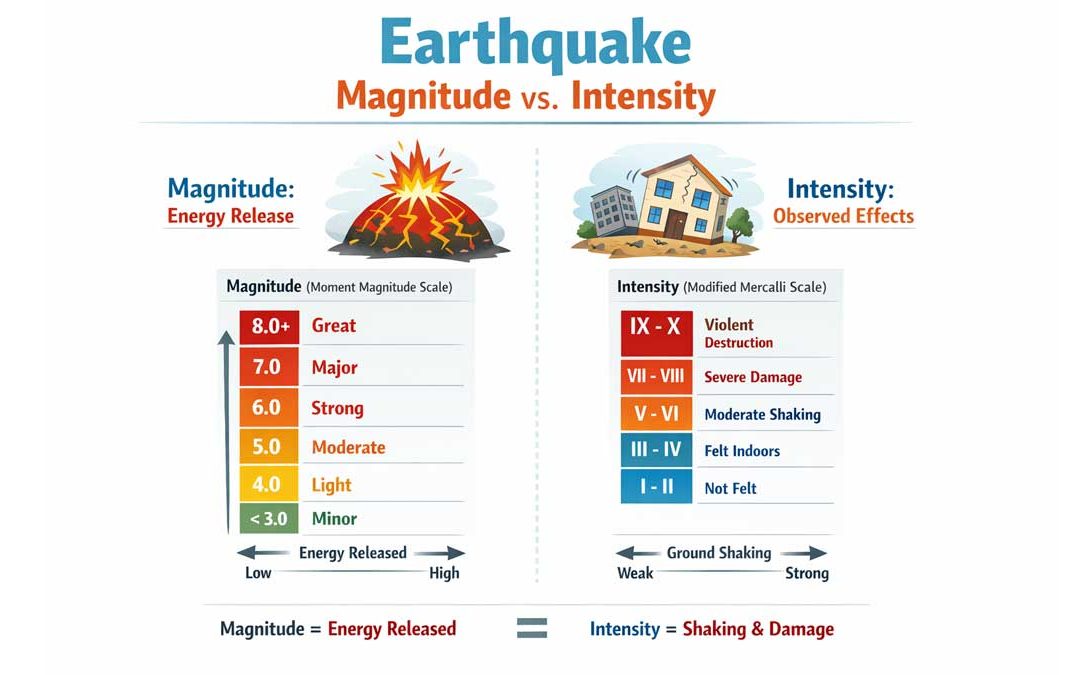
When an earthquake happens, you may hear two important terms: magnitude and intensity. While they are related, they describe different aspects of an earthquake.
Magnitude tells us how much energy an earthquake releases, while intensity describes how strong the shaking feels at a specific location.
Understanding this difference is important for interpreting earthquake reports and assessing their impact.
What Is Magnitude?
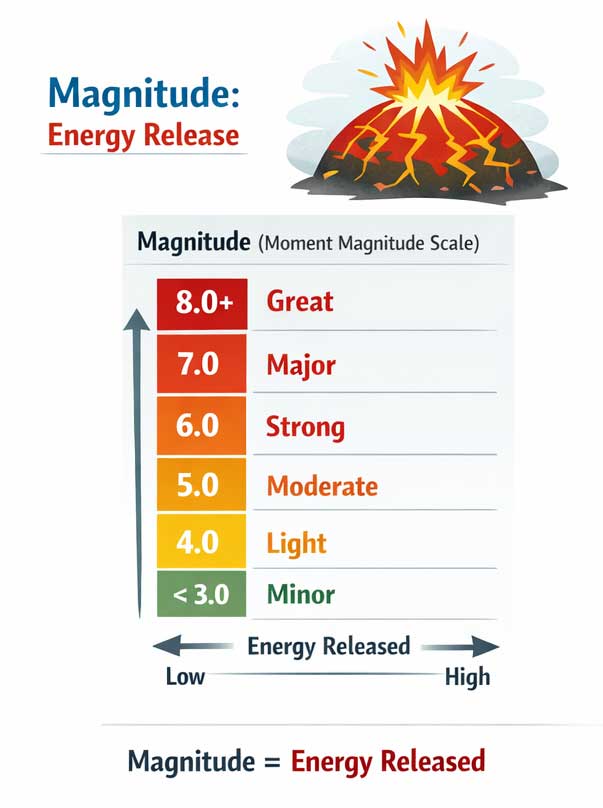
Magnitude measures the total energy released by an earthquake at its source.
It is a single value for each earthquake and does not change based on location.
Scientists use different scales to measure magnitude, including:
- Richter Scale (older method)
- Moment Magnitude Scale (modern standard)
For example:
- A magnitude 3 earthquake is small
- A magnitude 6 earthquake is strong
- A magnitude 8+ earthquake is very powerful
Magnitude increases logarithmically, meaning each whole number increase represents a much larger release of energy.
Learn more about: what causes earthquakes
A magnitude 7 earthquake releases far more energy than a magnitude 6 earthquake. You can estimate the difference using this earthquake energy calculator
What Is Intensity?
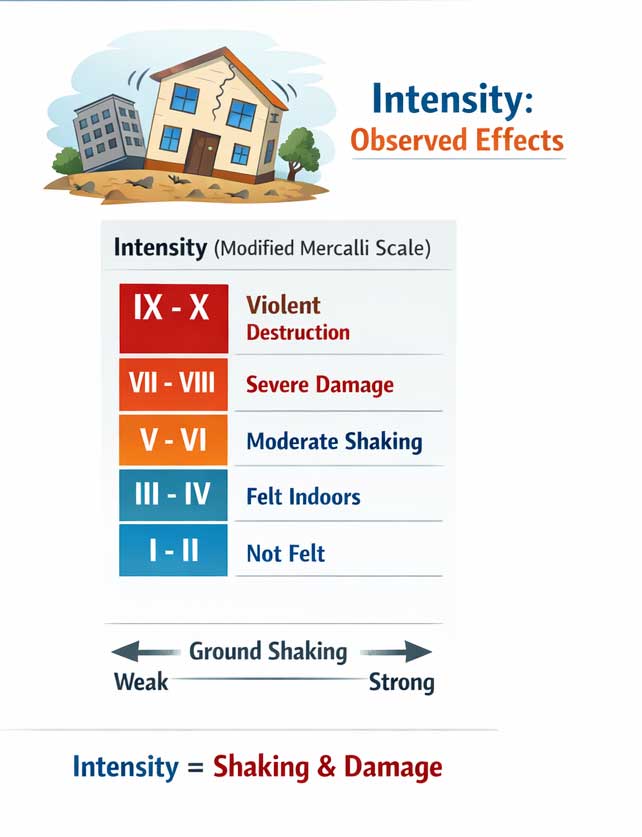
Intensity measures how strongly an earthquake is felt at a specific location.
Unlike magnitude, intensity:
- varies from place to place
- depends on distance from the epicenter
- depends on building structures and ground conditions
Intensity is measured using the Modified Mercalli Scale.
For example:
- Low intensity → slight shaking
- High intensity → damage to buildings
Learn more: modified mercalli scale
Key Differences Between Magnitude and Intensity
Here are the main differences:
| Feature | Magnitude | Intensity |
|---|---|---|
| Meaning | Energy released | Effects of shaking |
| Value | Single value | Multiple values |
| Measurement | Scientific instruments | Observations and damage |
| Depends on | Earthquake source | Location and conditions |
Why Magnitude Is Important
Magnitude helps scientists understand:
- how powerful an earthquake is
- how much energy was released
- how earthquakes compare globally
It is useful for:
- global reporting
- scientific research
- earthquake classification
Why Intensity Is Important
Intensity helps determine:
- how people experience the earthquake
- level of damage
- local impact
It is especially important for:
- emergency response
- disaster assessment
- safety planning
Example to Understand the Difference
Imagine an earthquake with magnitude 7.0.
- Near the epicenter → very high intensity (strong shaking, damage)
- Far from the epicenter → lower intensity (light shaking)
So even though magnitude stays the same, intensity changes depending on location.
Why Both Are Used Together
Magnitude and intensity work together to give a complete picture of an earthquake.
- Magnitude tells us the strength
- Intensity tells us the impact
Using both helps scientists and governments understand:
- how serious the earthquake is
- where damage is likely
- how to respond effectively
Simple Explanation
In simple terms:
- Magnitude = how strong the earthquake is
- Intensity = how strong it feels in a place
Conclusion
Magnitude and intensity are both essential for understanding earthquakes. While magnitude measures the total energy released, intensity shows how the earthquake affects different areas.
By combining both, scientists can better analyze earthquakes and help communities prepare for future events.
To learn more, explore our complete earthquake guide and related topics.
Frequently Asked Questions
Magnitude measures the total energy released during an earthquake.
Intensity measures how strong the shaking is at a specific location.
Because it depends on distance from the epicenter, ground conditions, and building structures.
Yes, intensity varies by location, even for the same earthquake.