
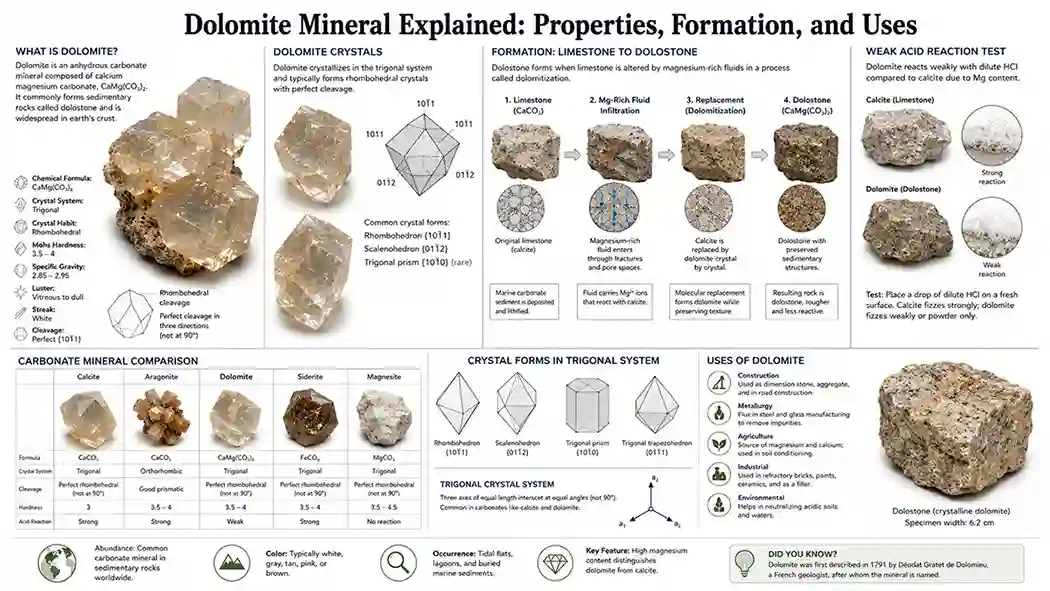
Dolomite is an important carbonate mineral composed of calcium magnesium carbonate. It is a major rock-forming mineral found in sedimentary environments and is the primary constituent of the rock known as dolostone.
Dolomite plays a significant role in:
- sedimentary geology
- carbonate rock formation
- industrial mineral resources
- soil and agricultural applications
Because it closely resembles calcite, dolomite is often studied alongside other carbonate minerals to understand geological processes and ancient marine environments.
Learn more → calcite mineral explained
What Is Dolomite?
Dolomite is a calcium-magnesium carbonate mineral. Its chemical formula is:
Dolomite contains:
- calcium (Ca)
- magnesium (Mg)
- carbon (C)
- oxygen (O)
It belongs to the carbonate mineral group
Basic Properties of Dolomite
| Property | Value |
|---|---|
| Chemical Formula | CaMg(CO₃)₂ |
| Mineral Group | Carbonate |
| Crystal System | Trigonal |
| Hardness | 3.5–4 |
| Streak | White |
| Luster | Vitreous to Pearly |
How Dolomite Forms
Dolomite commonly forms through:
Dolomitization
Magnesium-rich fluids alter limestone and replace calcite with dolomite.
Marine Environments
Shallow marine settings may promote dolomite formation.
Burial Processes
Chemical changes during sediment burial create dolomite deposits.
Hydrothermal Activity
Hot fluids can produce secondary dolomite.
The Process of Dolomitization
One of the most important geological processes involving dolomite is Dolomitization
Simplified reaction:
This process converts limestone into dolostone. It is one of the most studied topics in sedimentary geology.
Crystal Structure of Dolomite
Dolomite has a crystal structure similar to calcite but contains alternating layers of:
- calcium ions
- magnesium ions
This arrangement influences:
- hardness
- density
- chemical behavior
Its crystal structure is important in distinguishing dolomite from calcite.
Learn more → crystal structure in minerals
Crystal System of Dolomite
Dolomite belongs to the Trigonal Crystal System. Its symmetry is characterized by,
Common crystal forms include:
- rhombohedrons
- curved crystals
- granular masses
Learn more → trigonal crystal system
Physical Properties of Dolomite
| Property | Description |
|---|---|
| Color | White, gray, pink, tan |
| Streak | White |
| Luster | Vitreous to Pearly |
| Hardness | 3.5–4 |
| Cleavage | Perfect Rhombohedral |
| Transparency | Transparent to translucent |
| Specific Gravity | ~2.85 |
Dolomite vs Calcite
Dolomite and calcite are very similar minerals.
| Property | Dolomite | Calcite |
|---|---|---|
| Formula | CaMg(CO₃)₂ | CaCO₃ |
| Hardness | 3.5–4 | 3 |
| Acid Reaction | Weak (powdered) | Strong |
| Magnesium | Present | Absent |
The acid reaction is one of the most useful identification tests.
Learn more → calcite mineral explained
Acid Reaction of Dolomite
Unlike calcite, dolomite reacts weakly with dilute acid. Powdered dolomite reacts more readily than solid crystals. This behavior helps geologists distinguish dolomite from calcite during field investigations.
Learn more → chemical properties of minerals
Dolostone: The Rock Made of Dolomite
Dolostone is a sedimentary rock composed primarily of dolomite. It often resembles limestone but contains significantly more magnesium.
Dolostone commonly forms:
- cliffs
- ridges
- carbonate platforms
- ancient reef systems
Where Dolomite Is Found
Major dolomite occurrences include:
- sedimentary basins
- carbonate platforms
- evaporite environments
- hydrothermal deposits
Large deposits occur in:
- United States
- Canada
- Germany
- Italy
- China
- India
Industrial Uses of Dolomite
Dolomite has numerous industrial applications.
Construction
Used as crushed stone and aggregate.
Steel Industry
Acts as a flux during metal production.
Agriculture
Neutralizes acidic soils.
Glass Manufacturing
Provides magnesium and calcium.
Refractory Materials
Used in high-temperature industrial furnaces.
Major Uses of Dolomite
| Industry | Application |
|---|---|
| Construction | Aggregate |
| Steel | Flux |
| Agriculture | Soil treatment |
| Glass | Raw material |
| Refractory | Furnace lining |
Dolomite in Mineral Identification
Geologists identify dolomite using:
- rhombohedral cleavage
- hardness of 3.5–4
- white streak
- weak acid reaction
- association with carbonate rocks
These characteristics help distinguish it from calcite and other carbonate minerals.
Learn more → mineral identification guide
Dolomite Identification Summary
| Property | Dolomite |
|---|---|
| Formula | CaMg(CO₃)₂ |
| Hardness | 3.5–4 |
| Crystal System | Trigonal |
| Cleavage | Perfect Rhombohedral |
| Streak | White |
| Mineral Group | Carbonate |
Dolomite is composed of calcium magnesium carbonate with the formula CaMg(CO₃)₂.
No. Limestone is mainly calcite, while dolostone is mainly composed of dolomite.
Dolomite reacts weakly with dilute acid and is slightly harder than calcite.
Dolomite belongs to the trigonal crystal system.
Dolomite is used in construction, steel manufacturing, agriculture, glass production, and refractory materials.
Final Thoughts
Dolomite is one of the most important carbonate minerals in geology. Its role in sedimentary rock formation, dolomitization processes, and industrial applications makes it a key mineral for understanding Earth's surface environments and natural resources.
From ancient marine deposits to modern construction and agriculture, dolomite demonstrates the strong connection between geological processes and human industry.