
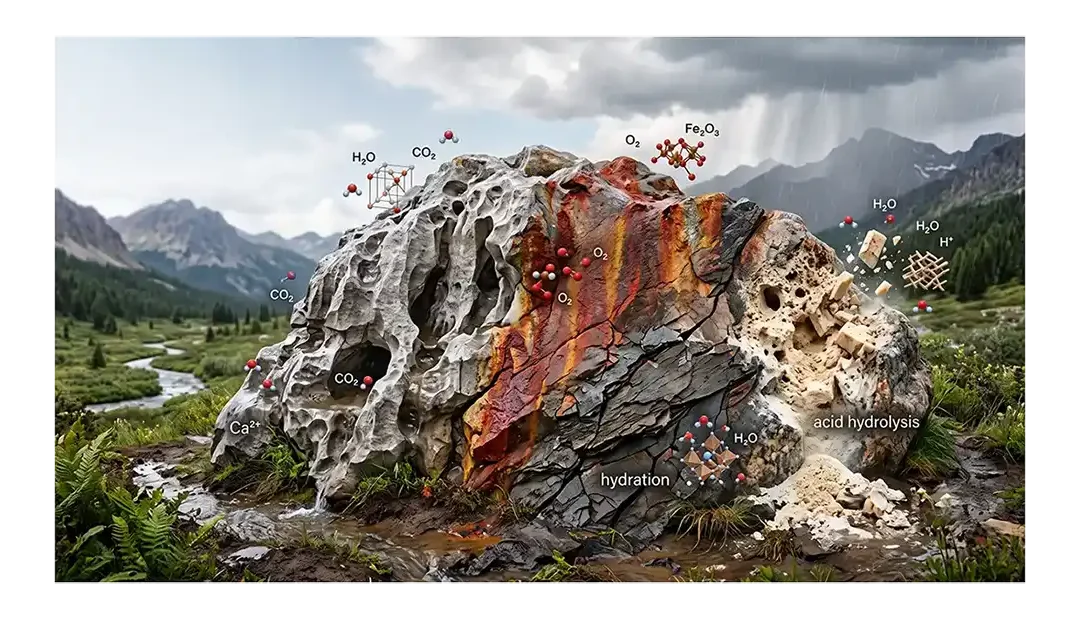
Chemical weathering is the fundamental geological process by which rocks and minerals undergo chemical breakdown, lattice alteration, and transformation into entirely new mineral products. While mechanical weathering physically fractures rock into smaller fragments without altering its internal composition, chemical reactions change the molecular and atomic structure of the minerals themselves. Driven by water, atmospheric oxygen, carbonic acid, and biological organisms, this continuous process converts tough igneous, metamorphic, and sedimentary bedrock into soft agricultural soils, soluble salts, and clay residue. From the sweeping limestone caverns of Mammoth Cave to the deep red clays of tropical regions, chemical reactions are constantly reshaping Earth's continental crust. In this comprehensive guide, we will analyze the core chemical weathering processes, examine the exact chemical formulas driving rock decay, and explore how these reactions regulate Earth's climate over geological time.
What is Chemical Weathering?
Chemical weathering refers to the natural alteration, breakdown, or dissolution of primary bedrock minerals when exposed to surface and near-surface environmental conditions. Bedrock minerals formed deep within Earth's crust or mantle crystallize under extreme temperatures and pressures. When tectonic uplift exposes these rocks to surface conditions—where liquid water, oxygen gas, organic acids, and low pressures prevail—their primary crystal lattices become thermodynamically unstable. Chemical weathering is Earth's mechanism for bringing these unstable minerals into chemical equilibrium with surface environments.
In academic geology, such as the comprehensive research detailed by Anderson and Anderson (2010, p. 183–202), chemical weathering processes are classified by their primary chemical mechanisms: dissolution, oxidation, reduction, hydration, and acid hydrolysis (including carbonation). Together, these reactions break down rock matrices, release vital nutrients like potassium and phosphorus into groundwater, and generate stable secondary minerals like kaolinite, illite, and bauxite. Furthermore, by consuming atmospheric carbon dioxide during the breakdown of silicate minerals, chemical weathering functions as Earth's natural long-term thermostat, regulating global climate across millions of years.
Dissolution in Chemical Weathering
Water acts as a powerful universal solvent during dissolution in chemical weathering. Dissolution occurs when water molecules come into contact with soluble minerals, utilizing their polar electrical charges to pull individual ions directly out of the crystal lattice and into fluid solution. A classic example is gypsum (CaSO₄·2H₂O) or halite (NaCl), which dissolve completely in natural water without leaving solid residue behind.
The rate and extent of mineral dissolution are governed by the equilibrium solubility of the mineral, local groundwater flow rates, temperature, and localized pH levels:
- Quartz (SiO₂): Exhibits an extremely low solubility in neutral and acidic groundwater. However, in strongly alkaline environments with a pH above 10, quartz solubility increases dramatically as silicate ions dissociate into solution.
- Alumina (Al₂O₃): Highly insoluble across normal surface conditions, dissolving only in extreme environmental conditions below pH 4 or above pH 9. Because natural rainwater is slightly acidic, silica (SiO₂) slowly leaches away while alumina remains behind as an insoluble residue, eventually concentrating into rich bauxite ores used for aluminum production.
- Calcium Carbonate (CaCO₃): In pure water, calcite has a low solubility that decreases further in alkaline environments. However, natural groundwater is rarely pure; it contains dissolved carbon dioxide (CO₂), converting insoluble calcium carbonate into highly soluble calcium bicarbonate (Ca(HCO₃)₂), which rapidly strips away limestone bedrock.
In natural environments, the presence of competing dissolved solutes complicates equilibrium solubility calculations for common aluminosilicates, making natural dissolution rates highly dynamic and dependent on groundwater chemistry.
| Mineral / Compound | Primary Formula | Solvent / Trigger | Environmental & Geological Outcome |
| Halite | NaCl | Pure Water | Complete dissolution; leaves no solid mineral residue |
| Gypsum | CaSO₄·2H₂O | Pure Water | Dissolves readily into dissolved Ca2+ and SO42− ions |
| Quartz | SiO₂ | Alkaline Water (pH > 10) | Insoluble in normal conditions; highly soluble in extreme alkaline environments |
| Alumina | Al₂O₃ | Extreme Water (pH < 4 or > 9) | Insoluble in normal soils; accumulates as concentrated bauxite ore |
| Calcium Carbonate | CaCO₃ | Carbonic Acid Water | Converts to soluble calcium bicarbonate, Ca(HCO3)2 |
Oxidation in Chemical Weathering
Oxidation in chemical weathering involves the transfer of electrons, where a mineral loses electrons (oxidation) while an oxidizing agent gains them (reduction). Oxygen gas (O2) dissolved in water is the most pervasive oxidizing agent in natural geological environments. When iron-bearing primary minerals encounter oxygenated water, reduced ferrous iron (Fe2+) loses an electron to become oxidized ferric iron (Fe3+), triggering lattice collapse and forming vibrant red, orange, and yellow rust minerals.
A major real-world manifestation of oxidation occurs in sulfide minerals like iron pyrite (FeS2). When pyrite encounters oxygenated surface water or anaerobic soil moisture, it oxidizes to yield iron hydroxide and sulfuric acid (H2SO4):
2FeS₂ + 7O₂ + 2H₂O → 2Fe²⁺ + 4SO₄²⁻ + 4H⁺
This process is a primary driver of natural acid rock drainage, which lowers water pH and accelerates the weathering of surrounding rocks. In soil environments, bacteria continuously oxidize organic material, producing carbon dioxide (CO2) and generating localized organic acidity. The redox potential (Eh), measured in millivolts (mV), measures an environment's electrochemical tendency to drive these oxidation or reduction reactions, determining whether minerals remain stable or break down.
Hydration in Chemical Weathering
Hydration in chemical weathering occurs when water molecules are absorbed directly into the crystal lattice structure of a mineral without causing complete dissolution. Instead of stripping ions away, whole H2O molecules become bonded within the mineral's internal atomic framework. This process expands the mineral's physical volume, increases its internal porosity, and lowers its structural density, creating severe mechanical stress that makes the rock far more vulnerable to secondary weathering forces.
A classic real-world example is the transformation of hematite (Fe2O3), a hard iron oxide, into limonite (FeO(OH). nH2O), a soft, hydrated iron hydroxide:
Fe₂O₃ + nH₂O → FeO(OH)·nH₂O
As water binds to hematite, the hard reddish rock expands into a soft, yellowish-brown crust. Another prominent geological example is the hydration of anhydrous anhydrite (CaSO4) into soft gypsum (CaSO4. H2O). This reaction causes volume expansions of up to 63%, generating massive physical forces capable of fracturing surrounding rock layers and causing land swelling.
| Primary Mineral | Hydrated Product | Crystal Lattice Change | Visual & Physical Result |
| Hematite (Fe2O3) | Limonite (FeO(OH)⋅nH2O) | H2O incorporates into lattice | Reddish crystalline rock swells into yellowish-brown crust |
| Anhydrite (CaSO4) | Gypsum (CaSO4⋅2H2O) | Water bonds into calcium sulfate matrix | Massive volume expansion (up to 63%), forming soft g |
Acid Hydrolysis in Chemical Weathering
Acid hydrolysis in chemical weathering is the dominant chemical process responsible for decomposing silicate minerals across Earth's continental crust. Silicate minerals—such as feldspars, micas, pyroxenes, and amphiboles—make up over 90% of Earth's crust. Acid hydrolysis occurs when hydrogen ions (H+) in acidic water react with these silicates, swapping places with metal cations inside the crystal lattice.
The primary driver of acid hydrolysis is carbonic acid (H2CO3), formed naturally when atmospheric carbon dioxide dissolves in rainwater:
H₂O + CO₂ ⇌ H₂CO₃ ⇌ H⁺ + HCO₃⁻
In soil horizons, root respiration and bacterial decomposition release additional CO2, making soil pore water up to 100 times more acidic than pure rain. During hydrolysis, free H+ ions attack the silicate framework, replacing essential metal cations like potassium (K+), sodium (Na+), calcium (Ca2+), and magnesium (Mg2+). As these cations leach into groundwater, the remaining aluminosilicate structure reorganizes into stable clay minerals:
Hydrolysis of Albite (Plagioclase Feldspar):
2NaAlSi₃O₈ + 2H₂CO₃ + 9H₂O → Al₂Si₂O₅(OH)₄ + 2Na⁺ + 2HCO₃⁻ + 4H₄SiO₄
Albite reacts with carbonic acid and water to yield solid kaolinite clay, dissolved sodium, bicarbonate ions, and silicic acid.
Hydrolysis of Orthoclase (Potassium Feldspar):
2KAlSi₃O₈ + 2H₂CO₃ + H₂O → Al₂Si₂O₅(OH)₄ + 2K⁺ + 2HCO₃⁻ + 4SiO₂
Potassium feldspar breaks down into kaolinite clay, releasing soluble potassium ions that fertilize plant life.
When carbon dioxide drives acid hydrolysis, the process is referred to as carbonation. Carbonation dominates the chemical weathering of limestone landscapes, driving the formation of dramatic karst features like sinkholes, underground rivers, stalactites, and caves.
Factors Influencing Chemical Weathering
The rate and intensity at which chemical weathering occurs depend on several environmental and geological factors:
- Climate (Temperature & Moisture): Warm, wet tropical climates experience the highest chemical weathering rates because chemical reactions accelerate at higher temperatures, and water provides the essential solvent for reactions.
- Rock Mineralogy (Bowen's Reaction Series): High-temperature minerals like olivine and pyroxene weather rapidly because they are farthest from their formation conditions. Quartz, formed at lower temperatures, is highly resistant and survives as river and beach sand.
- Surface Area: Mechanical fracturing exposes greater surface area, giving water, oxygen, and acids more contact zones to accelerate chemical attack.
- Soil pH and Biological Activity: Plant roots and soil microorganisms secrete organic acids and release CO2, dramatically increasing acidity and speeding up hydrolysis.
Mechanical weathering physically fractures rock into smaller pieces without altering its mineral composition. Chemical weathering changes the internal atomic structure of minerals through chemical reactions, turning original minerals into secondary products like clay.
Acid rain contains elevated levels of nitric and sulfuric acids from industrial emissions. These acids increase the concentration of hydrogen ions (H+) in rainwater, rapidly accelerating acid hydrolysis and dissolving limestone structures, monuments, and natural bedrock.
The most common secondary minerals formed by chemical weathering are clay minerals (such as kaolinite, illite, and smectite) and metal hydroxides (such as limonite, hematite, and bauxite).
Chemical reactions require heat and moisture. Warm temperatures speed up reaction rates, while abundant rainfall continuously supplies the water needed for dissolution, oxidation, hydration, and hydrolysis.
Carbonation is a form of acid hydrolysis where carbonic acid—created when CO2 dissolves in water—reacts with calcium carbonate in limestone. This converts solid calcite into soluble calcium bicarbonate, dissolving the rock.
Conclusion
Chemical weathering is an essential geological engine that continuously breaks down bedrock and forms living soil horizons. Through dissolution, oxidation, hydration, and acid hydrolysis, chemical reactions alter primary minerals into secondary clays and soluble nutrients. Beyond shaping local landscapes like caves and sandstone cliffs, chemical weathering regulates global carbon cycles and supplies essential minerals to ecosystems worldwide. Understanding these fundamental chemical reactions provides crucial insight into how Earth transforms solid mountain ranges into fertile, living environments over geological time.