
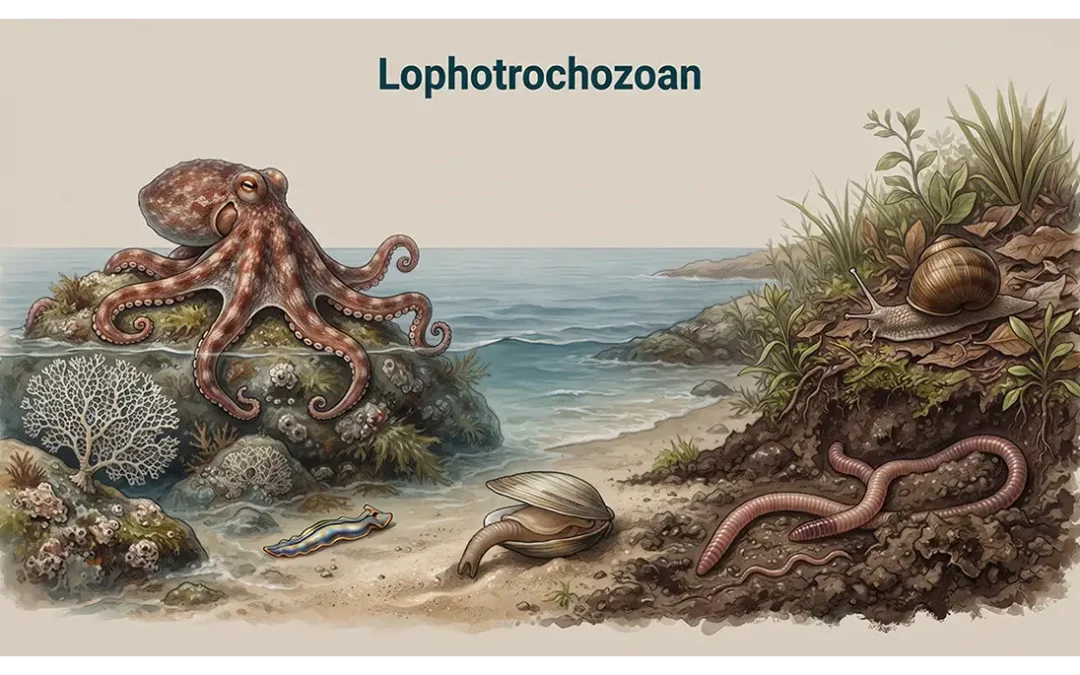
Lophotrochozoa is a diverse evolutionary group of animals that includes mollusks, annelid worms, flatworms, brachiopods, bryozoans, and several smaller lineages. Its members differ greatly in size, appearance, habitat, and lifestyle. Some have protective shells, others possess segmented bodies, and many are so small that they can only be studied with a microscope.
These animals play important roles in marine and freshwater ecosystems, terrestrial environments, and food webs. Their varied body structures also provide valuable evidence for understanding how animal diversity developed over hundreds of millions of years.
Although lophotrochozoans share evolutionary ancestry, they do not all possess the same physical characteristics. Scientists use anatomical evidence, embryonic development, and molecular data to investigate their relationships.
In this article, we explore what Lophotrochozoa is, its major animal groups, distinctive biological features, evolutionary history, habitats, and ecological importance.
What Is Lophotrochozoa?
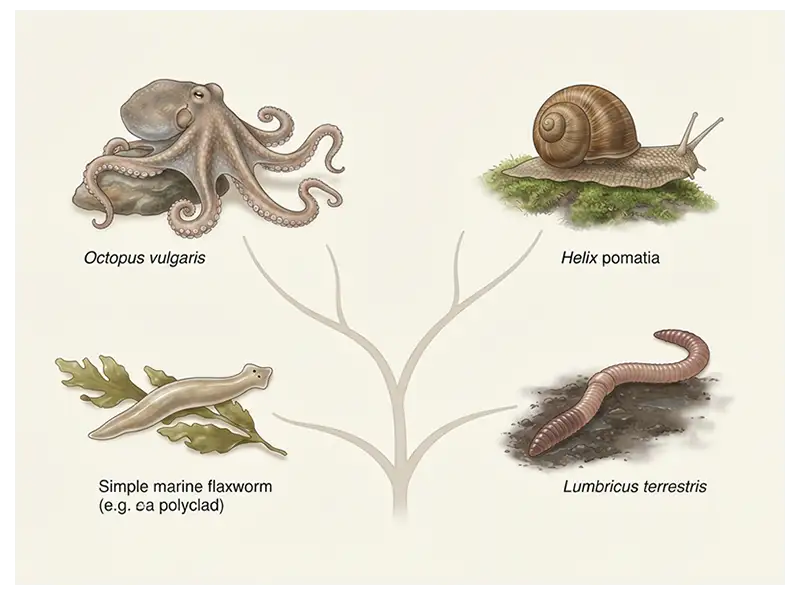
Lophotrochozoa is a major evolutionary grouping within the animal kingdom. It belongs to Protostomia, one of the two principal branches of Bilateria, a large group of animals that generally develop with bilateral symmetry.
The group contains several familiar animals, including snails, clams, octopuses, earthworms, leeches, and flatworms. It also includes less familiar marine organisms such as brachiopods, bryozoans, and phoronids.
The name Lophotrochozoa comes from two biological terms: lophophore and trochophore. A lophophore is a specialized feeding structure found in certain aquatic animals, while a trochophore is a type of ciliated larva found in many mollusks and annelids. These features helped scientists recognize important similarities among particular animal lineages.
However, not every member possesses a lophophore or develops a trochophore larva. Some members have highly modified body plans, and others pass through entirely different developmental stages.
Modern evolutionary studies use DNA and RNA comparisons alongside anatomy to investigate which animals belong together. Lophotrochozoa is commonly discussed in connection with Spiralia, a broader evolutionary grouping that includes many of these lineages. The exact boundaries and internal relationships can differ among scientific classification schemes.
Understanding this group helps explain how animals with very different appearances can share a common evolutionary history.
What Are the Main Characteristics of Lophotrochozoans?
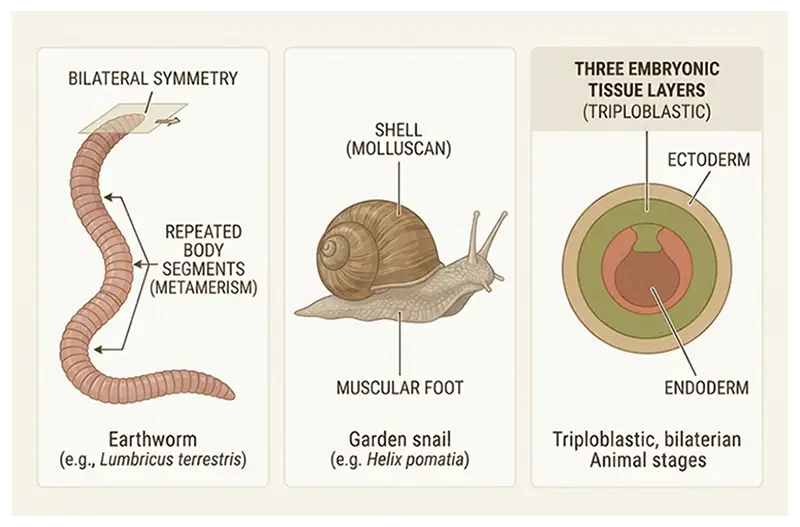
Lophotrochozoans display a remarkable range of body structures. Their common ancestry does not mean that every member has the same anatomy. Instead, scientists identify shared evolutionary relationships while recognizing the differences that developed within individual lineages.
Bilateral symmetry
Many lophotrochozoans have bilateral symmetry, meaning their bodies can be divided into roughly matching left and right sides. This arrangement is clear in animals such as earthworms, snails, and octopuses.
Bilateral symmetry is associated with a distinct front end in many animals. In some lineages, sensory organs and nervous tissue are concentrated toward the head region, helping the animal respond to its surroundings.
Some groups have become highly modified over evolutionary time, so their adult bodies may not show obvious bilateral symmetry.
Three embryonic tissue layers
Like other bilaterian animals, most familiar lophotrochozoans develop three primary embryonic tissue layers:
- Ectoderm: Forms structures such as the outer body covering and much of the nervous system.
- Mesoderm: Contributes to muscles and various internal tissues and organs.
- Endoderm: Forms much of the lining of the digestive system.
These tissue layers give rise to different structures as an animal develops. Their organization varies among groups, but they form an important foundation for understanding animal anatomy.
Diverse body cavities
A body cavity is a space within the body that can contain internal organs. Lophotrochozoans differ considerably in this feature. Annelids generally possess a true coelom, a body cavity lined by mesoderm. Many mollusks also retain a coelom, although it is reduced in adults and much of the internal space is associated with a blood-filled hemocoel.
Flatworms, by contrast, lack a true coelom and have tissues occupying much of the space between the body wall and digestive tract. These differences show why one anatomical description cannot accurately represent every member of the group.
Varied feeding structures
Lophotrochozoans obtain food in many ways. Some graze on algae, some filter suspended particles from water, and others hunt prey or feed on organic material in sediment. Certain mollusks use a rasping structure called a radula to collect or cut food. Many annelids ingest sediment containing organic matter, while some bryozoans use ciliated tentacles to capture tiny food particles from surrounding water. The diversity of feeding mechanisms reflects the range of ecological opportunities these animals occupy.
Different body coverings and support systems
Some lophotrochozoans produce hard shells, while others have flexible bodies or protective outer coverings. Mollusk shells are typically made largely of calcium carbonate. Brachiopods also produce shells, but their body organization and shell arrangement differ from those of clams.
Annelids rely on muscles and, in many species, fluid pressure within the body cavity to support movement. Other members use different combinations of muscles, internal structures, and external protection. Rather than one universal body plan, Lophotrochozoa is characterized by extensive anatomical diversity shaped by evolution.
What Are the Major Groups of Lophotrochozoa?
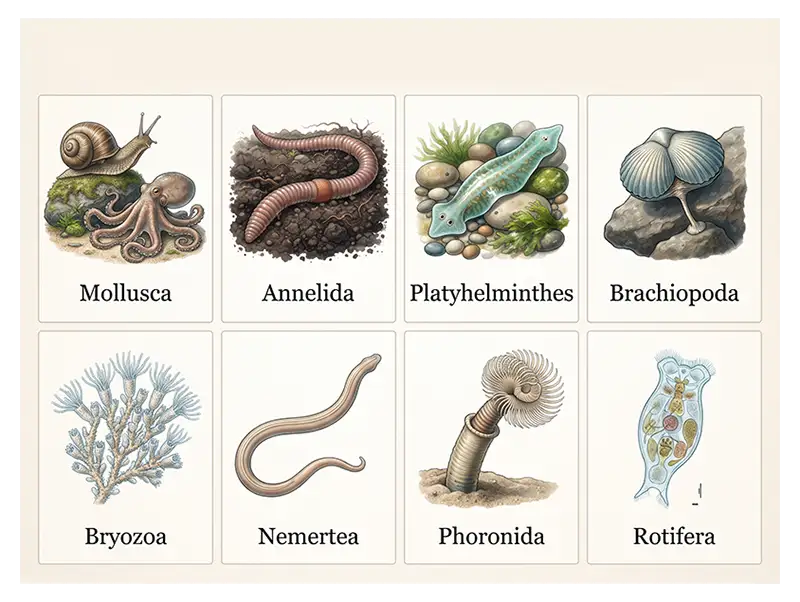
Lophotrochozoa includes several major animal lineages, each with its own body structure, feeding strategy, and ecological role. The following groups illustrate the breadth of this evolutionary branch.
Mollusca: Snails, clams, and cephalopods
Mollusca is one of the most diverse animal phyla within Lophotrochozoa. Its members include gastropods, bivalves, and cephalopods. Gastropods include snails, slugs, and limpets. Many have a muscular foot for movement, and numerous species produce a shell. Bivalves, such as mussels, oysters, and clams, have two shell valves and commonly feed by filtering particles from water.
Cephalopods include octopuses, squids, cuttlefish, and nautiluses. They possess specialized sensory systems and relatively complex nervous systems. Many are active predators that use arms or tentacles to capture prey.
Mollusks occupy marine, freshwater, and terrestrial environments. Their varied adaptations make them important consumers, prey animals, filter feeders, and predators.
Annelida: Segmented worms
Annelida includes earthworms, leeches, and many marine worms. Segmentation is a major feature of the traditional annelid body plan, in which the body is divided into repeated sections.
Earthworms help mix soil and break down organic material. Marine annelids live in environments ranging from sandy shorelines to deep-sea habitats. Some crawl over the seafloor, others burrow into sediment, and some live in tubes.
Leeches are another familiar annelid group. Although certain species feed on blood, others consume small invertebrates or organic material.
Annelids display a wide variety of feeding and locomotion methods, making them important components of both land and aquatic ecosystems.
Platyhelminthes: Flatworms
Platyhelminthes includes free-living flatworms and numerous parasitic species. Their bodies are generally flattened from the upper surface to the underside.
Free-living flatworms occur in marine, freshwater, and moist terrestrial environments. Many feed on small organisms or decaying material. Parasitic forms, including tapeworms and flukes, live in or on host organisms and often have specialized life cycles.
Many flatworms lack a circulatory system, and their flattened bodies help materials move between tissues and the surrounding environment. Their internal organization differs from that of more complex animals with extensive circulatory systems.
Brachiopoda: Lamp shells
Brachiopods are marine invertebrates with two shell valves. Although they can resemble clams, their internal anatomy and the orientation of their shells differ from those of bivalve mollusks.
Many brachiopods attach to hard surfaces using a stalk-like structure or live resting on the seafloor. They feed by filtering tiny suspended particles from water with the help of a lophophore.
Brachiopods were especially diverse in many ancient marine ecosystems and have a substantial fossil record. Living species remain in oceans today, although their diversity is much lower than during some periods of the geological past.
Bryozoa: Moss animals
Bryozoans are mostly small aquatic animals that often live in colonies. A colony may form a crust over a rock, branch into a delicate structure, or grow into a more complex shape.
Each individual, commonly called a zooid, occupies a small protective chamber. Many bryozoans extend a lophophore to collect food particles from the water.
They are especially common in marine environments, although freshwater species also exist. By filtering suspended material and providing small habitats for other organisms, bryozoans contribute to aquatic communities.
Nemertea: Ribbon worms
Nemerteans, commonly known as ribbon worms, usually have long, soft bodies. Most live in marine environments, although some species occur in freshwater or damp terrestrial habitats.
Many are predators that feed on small invertebrates. A distinctive feature is the proboscis, an extendable structure used in capturing prey or other defensive and feeding functions. It is housed in a specialized cavity separate from the digestive tract.
Some ribbon worms are capable of considerable extension relative to their resting body length. Their flexible bodies allow them to move through sediment, beneath rocks, and among other seafloor habitats.
Other lophotrochozoan lineages
Several additional groups contribute to the diversity of this evolutionary assemblage.
- Phoronida: Small marine animals that live in tubes and use a lophophore to collect food.
- Gastrotricha: Tiny aquatic animals found in marine and freshwater sediments.
- Rotifera: Mostly microscopic animals common in freshwater, with species also found in marine and damp environments.
- Entoprocta: Small aquatic animals that often live attached to surfaces and capture food using ciliated tentacles.
- Cycliophora: Microscopic animals known for living on the mouthparts of certain lobsters.
- Gnathostomulida: Tiny marine worms commonly found between sand grains.
- Micrognathozoa: Microscopic animals with complex jaw structures.
These groups differ greatly in size and anatomy. Their placement within the broader evolutionary tree is informed by molecular and anatomical research, and some relationships remain under investigation.
What Are Lophophores and Trochophore Larvae?
Two biological features are especially important for understanding the name Lophotrochozoa: the lophophore and the trochophore larva. They serve different purposes and occur in different subsets of the group.
The lophophore
underline, A lophophore underline is a feeding structure made up of a crown or arrangement of tentacles surrounding the mouth. The tentacles carry cilia, tiny hair-like structures that move water and help capture suspended food particles.
Lophophores are found in several aquatic lineages, including bryozoans, brachiopods, and phoronids. These structures allow animals to feed without actively chasing individual food items.
As water passes over the tentacles, cilia help direct food particles toward the mouth. The arrangement also creates a large feeding surface relative to the size of the animal.
A lophophore is not the same as a molluscan radula or a worm's proboscis. Each structure has a different anatomy and function, even though all can be involved in obtaining food.
The trochophore larva
A trochophore is a small larval form recognized by characteristic bands of cilia. These bands help the larva swim through water and collect food in species that feed while developing.
Trochophore larvae occur in many annelids and mollusks, although their forms and developmental stages differ. Some species have a free-swimming larval stage, while others develop within eggs or follow other life-history patterns.
A planktonic larva can help a species spread to new locations because ocean currents transport it away from the parent population. This can connect otherwise separated habitats and influence how populations are distributed.
However, not all lophotrochozoans have a trochophore stage. Many lineages have different larvae or develop directly into a juvenile resembling a smaller version of the adult.
The lophophore and trochophore are therefore useful biological concepts, but neither feature alone defines the entire group.
When Did Lophotrochozoans Evolve?
The evolutionary history of lophotrochozoans extends deep into the early diversification of animals. Researchers investigate this history using fossils, comparative anatomy, developmental biology, and genetic evidence.
Early animal diversification
During the Cambrian Period, which began about 539 million years ago, many major animal lineages became more visible in the fossil record. Marine environments contained a growing variety of organisms with different feeding methods, protective structures, and body plans.
Fossils from this period and later geological intervals provide evidence relevant to the early history of mollusks, annelids, and other lophotrochozoan lineages. However, the earliest history of these groups is difficult to reconstruct because soft-bodied animals are rarely preserved in detail.
The absence of an early fossil does not necessarily mean that a lineage had not yet evolved. It may instead reflect the limited chances of preservation or the difficulty of recognizing its remains.
What fossils can reveal
Shells and other hard structures are often preserved more readily than soft tissues. Mollusk shells and brachiopod valves therefore provide important evidence of past diversity and changes in marine communities.
Soft-bodied worms are harder to identify in ancient rocks. In some exceptional deposits, fine details of body outlines or internal structures have been preserved, helping scientists investigate organisms that would otherwise leave little trace.
Fossil evidence can establish that an identifiable group existed by a particular time. It does not always reveal the precise moment when the lineage first appeared.
Molecular evidence and evolutionary timing
Comparisons of DNA and RNA help researchers estimate relationships among living groups. When these comparisons are combined with fossils, scientists can develop estimates of when lineages diverged from shared ancestors.
Such estimates depend on the genetic data, evolutionary models, and fossil dates used. Different studies can produce different results, especially for ancient events where direct evidence is limited.
For this reason, Lophotrochozoa should be understood as a group with a deep evolutionary history rather than assigned one universally agreed date of origin.
Where Do Lophotrochozoans Live?
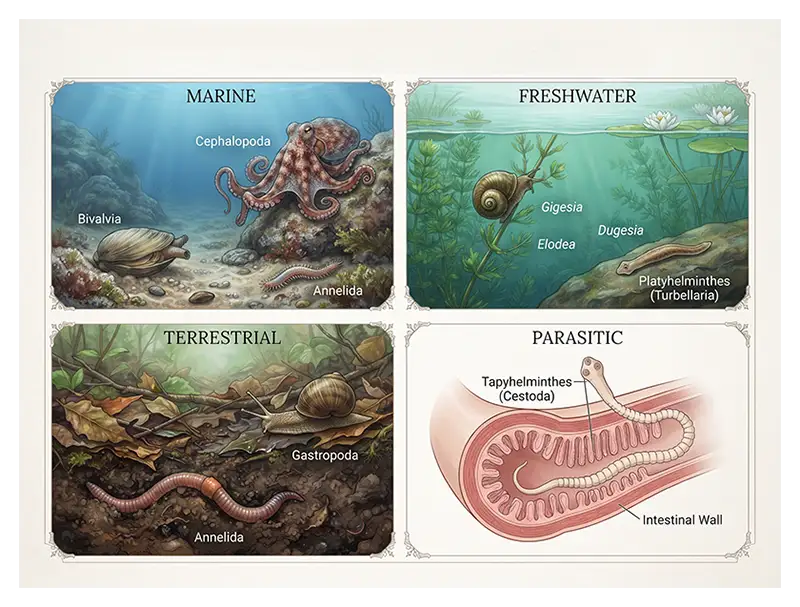
Lophotrochozoans occupy nearly every major type of aquatic environment and also include animals that live on land. Their distribution reflects differences in anatomy, food sources, reproduction, and tolerance of environmental conditions.
Marine environments
Oceans contain many of the group's most diverse lineages. Mollusks, annelids, brachiopods, bryozoans, ribbon worms, and phoronids all include marine species.
Some live on rocky shores, while others inhabit sandy bottoms, coral reefs, seagrass beds, or the deep seafloor. Many burrow into sediment, attach to hard surfaces, or hide among rocks and vegetation.
Filter-feeding animals remove suspended particles from the water. Predatory species capture other invertebrates, while deposit feeders consume organic material within sediments.
Freshwater habitats
Freshwater lakes, ponds, rivers, and streams support snails, bivalves, annelids, flatworms, rotifers, and several other lophotrochozoan groups.
Some species cling to submerged vegetation or rocks, while others live among sediment grains or in decaying leaves. Their food sources include algae, microorganisms, organic debris, and other small animals.
Freshwater habitats can experience large changes in temperature, oxygen levels, and water flow. Species living in these environments have adaptations that help them survive local conditions.
Terrestrial environments
Land-based lophotrochozoans include earthworms, leeches in moist habitats, and many gastropods such as snails and slugs.
Earthworms inhabit soil rich in organic material. By burrowing and consuming decomposing matter, they help move nutrients and alter soil structure. Land snails and slugs often prefer damp locations because their soft bodies can lose water easily.
Not all terrestrial members live directly in soil. Some occupy leaf litter, rotting wood, gardens, forests, and other places that provide moisture and shelter.
Parasitic lifestyles
Several lophotrochozoan lineages contain parasites that depend on other organisms for food or shelter. Tapeworms and flukes are familiar examples among flatworms.
Parasitic species may have complex life cycles involving more than one host. Different developmental stages can occupy different tissues or environments, helping the parasite move from one host to another.
These relationships can influence host health and population dynamics. However, parasitism represents only one part of the group's ecological diversity.
How Do Lophotrochozoans Feed and Reproduce?
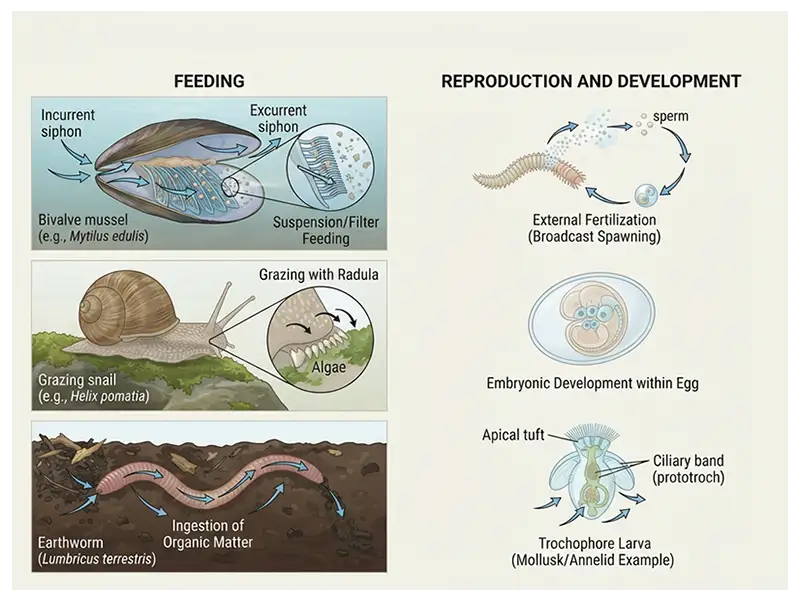
Lophotrochozoans use a wide range of feeding and reproductive strategies. Their methods reflect the habitats they occupy and the challenges of finding food, producing offspring, and surviving changing conditions.
Feeding strategies
Different groups obtain food in distinct ways.
- Filter feeding: Mussels, oysters, brachiopods, and many bryozoans collect suspended particles from water.
- Grazing: Many snails scrape algae and other material from rocks or plants, often using a radula.
- Predation: Octopuses, ribbon worms, and many marine annelids capture animal prey.
- Deposit feeding: Earthworms and numerous marine worms ingest soil or sediment containing organic material.
- Parasitism: Tapeworms and flukes obtain nutrients from their hosts.
Some species specialize in one food source, while others have more flexible diets. These differences reduce direct competition and allow multiple species to occupy the same ecosystem.
Sexual reproduction
Sexual reproduction is widespread among lophotrochozoans. In many species, eggs and sperm are produced by separate individuals, but other species are hermaphrodites, meaning an individual has both male and female reproductive organs.
Fertilization may occur externally, such as when eggs and sperm are released into water, or internally through transfer of sperm. The details vary considerably among lineages.
Some marine animals produce large numbers of eggs, increasing the chance that a few offspring survive. Others protect their eggs, provide parental care, or retain developing young within the body.
Asexual reproduction and regeneration
Certain lophotrochozoans can reproduce asexually, allowing populations to grow without fertilization. Some flatworms reproduce by splitting and regenerating missing body parts. Some colonial animals, including bryozoans, grow new individuals by budding.
Regeneration varies between species. The ability to replace damaged tissue does not mean that every member can regrow a complete body from any fragment.
Development and life cycles
Development may include a free-swimming larva, a stage that settles onto a surface, or direct development within an egg. Some parasitic species pass through several distinct stages and hosts.
These differences influence how animals spread, establish new populations, and respond to environmental change. They also provide researchers with useful evidence when comparing the evolutionary histories of different lineages.
How Are Lophotrochozoans Related to Other Animals?
To understand Lophotrochozoa, it helps to place it within the wider evolutionary tree of animals. Animals with bilateral symmetry are generally grouped within Bilateria. Among them, Protostomia contains two major evolutionary assemblages commonly recognized as Lophotrochozoa and Ecdysozoa. Deuterostomia is another major bilaterian branch.
These categories represent evolutionary relationships, not levels of complexity or a ranking from primitive to advanced animals.
Lophotrochozoa and Ecdysozoa
Ecdysozoa includes animals that grow by shedding an external cuticle, a process called ecdysis. Arthropods, such as insects, spiders, and crustaceans, belong to this group, as do nematodes.
Lophotrochozoans do not share this characteristic moulting process as a defining group-wide feature. Instead, their evolutionary grouping is supported by molecular evidence and a range of anatomical and developmental observations.
The contrast is useful because many lophotrochozoans and ecdysozoans occupy similar habitats despite following different evolutionary histories.
Lophotrochozoa and Deuterostomia
Deuterostomia includes chordates, such as vertebrates, along with echinoderms and hemichordates. Humans, fish, birds, sea stars, and acorn worms belong to this broad branch.
Traditional embryology distinguishes protostomes and deuterostomes partly by patterns of early development, including the fate of the blastopore. However, embryonic development is more varied than a simple two-category rule suggests. Modern classifications rely heavily on multiple lines of evidence rather than a single developmental characteristic.
How scientists reconstruct relationships
Researchers compare genetic sequences, anatomical structures, fossils, and developmental patterns to estimate how lineages are related. Computer-based phylogenetic analyses help identify possible branching patterns and test competing hypotheses.
Some relationships within Lophotrochozoa are well supported, while others remain debated or change as new evidence becomes available. This is particularly relevant for small groups with few living species or limited fossil records. Scientific classification is therefore an evolving explanation of animal ancestry, refined as new evidence emerges.
Why Are Lophotrochozoans Important?
Lophotrochozoans contribute to ecosystem function in ways that extend from soil formation to marine food webs. Their importance comes from the combined activities of many different lineages rather than from one shared ecological role.
Soil health and nutrient cycling
Earthworms consume decomposing leaves and other organic material. Their burrowing helps mix soil, and their waste returns nutrients to the environment.
These activities can improve soil structure and influence water movement and root growth. The effect depends on the species, soil conditions, and surrounding ecosystem.
Other soil-dwelling invertebrates also contribute to decomposition and nutrient cycling, making underground communities important to terrestrial productivity.
Aquatic food webs
Mollusks, annelids, flatworms, and other members serve as prey for fish, birds, crustaceans, and numerous other animals. Predatory lophotrochozoans also help regulate populations of smaller organisms.
Filter feeders process suspended particles, while deposit feeders consume material within sediments. These activities help move energy and nutrients through aquatic ecosystems. Because they occupy many different feeding levels, lophotrochozoans are important links in both freshwater and marine food webs.
Habitat formation and filtration
Some mollusks and bryozoans contribute to habitat structure. Oyster beds, for example, can create complex surfaces that shelter other organisms. Shell-producing animals may also contribute material to seafloor sediments over time.
Filter-feeding species remove particles from water as they feed. The overall ecological effect depends on population density, local conditions, and the kinds of particles being filtered.
These animals can therefore influence water quality and the structure of communities where they are abundant.
Human uses
Humans use several lophotrochozoan groups for food. Oysters, mussels, clams, scallops, squids, and octopuses support fisheries and aquaculture in many regions. Earthworms are used in composting systems because they help process organic waste. Some mollusks also provide shells used for ornaments and other materials.
Not every interaction is beneficial. Certain parasitic flatworms cause disease, and some introduced mollusk species can become agricultural or ecological pests.
Scientific research
Lophotrochozoans provide useful research models for investigating development, regeneration, evolution, behavior, and environmental responses. Flatworms are studied for their regenerative abilities, while cephalopods are used in research on nervous systems, sensory biology, and behavior. Mollusk shells and other hard structures also help paleontologists reconstruct ancient environments.
Their diversity makes the group valuable for understanding both the history of life and the biological processes that operate in living organisms.
Conclusion
Lophotrochozoa is a major evolutionary grouping within the animal kingdom, encompassing mollusks, annelids, flatworms, brachiopods, bryozoans, and several less familiar lineages. Its members range from microscopic aquatic organisms to large, behaviorally complex animals such as octopuses.
Their anatomy, feeding mechanisms, habitats, and reproductive strategies vary widely. Lophophores and trochophore larvae are important features in understanding the group's name and evolutionary history, but neither occurs in every member.
Fossils and molecular evidence continue to improve our understanding of how these lineages evolved and became so diverse. From enriching soil and supporting aquatic food webs to providing food and scientific research opportunities, lophotrochozoans have significant ecological and practical value.
Studying them reveals how different body plans can emerge from shared ancestry and how evolution produces a wide range of solutions to the challenges of survival.
Lophotrochozoa is an evolutionary grouping of animals within Protostomia. It includes mollusks, annelids, flatworms, brachiopods, bryozoans, and several other lineages.
Common examples include snails, clams, octopuses, earthworms, leeches, flatworms, ribbon worms, brachiopods, and bryozoans. The precise membership depends on the classification used.
The name refers to a lophophore, a specialized feeding structure found in certain aquatic animals, and a trochophore, a type of ciliated larva found in many mollusks and annelids.
No. The group includes animals with many different body forms, including snails, clams, octopuses, and colonial bryozoans, as well as several types of worms.
No. A lophophore occurs in particular lineages, including bryozoans, brachiopods, and phoronids. Many other members lack this feeding structure.