
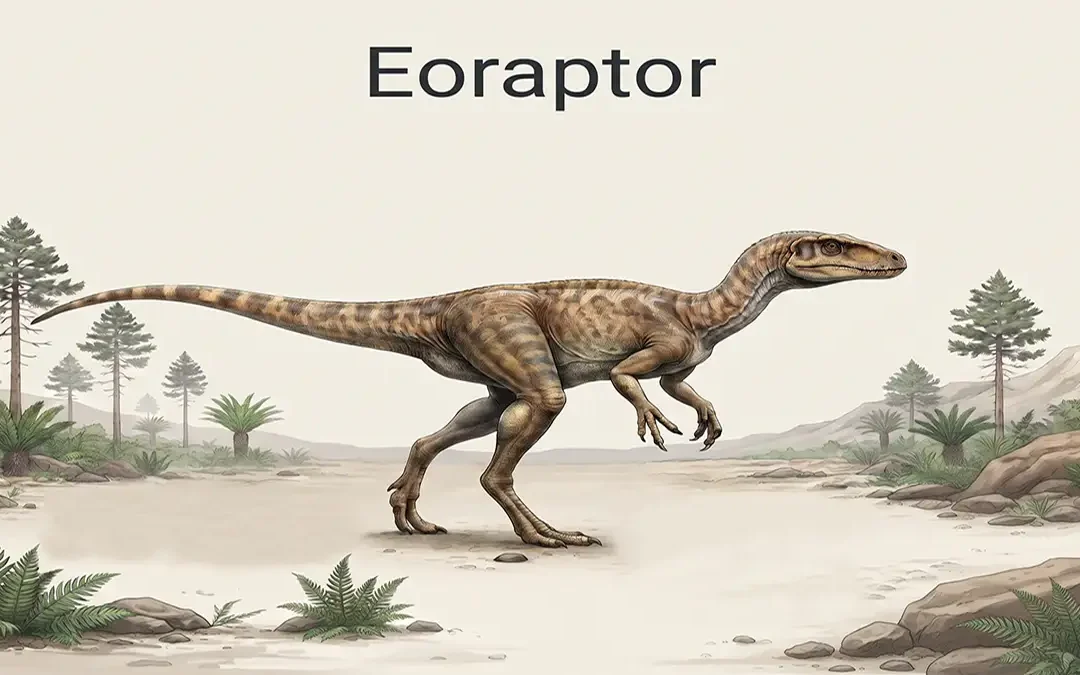
Eoraptor was a small dinosaur that lived in what is now Argentina approximately 230 million years ago, during the Late Triassic Period. Although it was much smaller than the famous dinosaurs that appeared later, its fossils have helped scientists understand the early evolution and diversification of dinosaurs.
Known from a remarkably informative fossil skeleton, Eoraptor had a lightweight body, long hind limbs, a lengthy tail, and a skull containing different types of teeth. These features provide clues about how early dinosaurs moved, fed, and adapted to their environments.
Scientists originally classified Eoraptor as an early theropod, the group that includes animals such as Tyrannosaurus rex and modern birds. Later studies proposed that it belonged instead among early sauropodomorphs, the lineage that eventually included long-necked dinosaurs such as Diplodocus. Its precise evolutionary position illustrates how new fossil evidence can change scientific interpretations.
What Was Eoraptor?
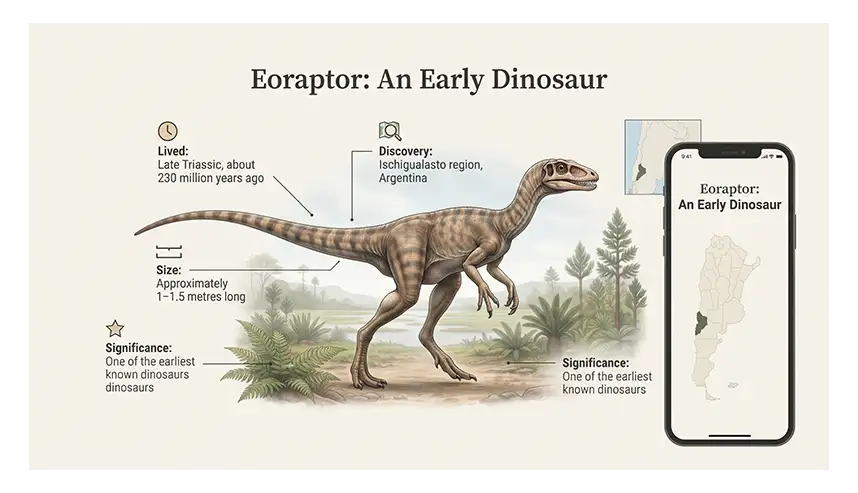
Eoraptor was a small, lightly built dinosaur that lived during the Late Triassic, near the early stages of dinosaur evolution. Its scientific name is Eoraptor lunensis, with Eoraptor being the genus and lunensis the species name.
The name Eoraptor is commonly translated as “dawn plunderer,” referring to its early place in dinosaur history. The name lunensis refers to the Valley of the Moon, or Valle de la Luna, a landscape in Argentina associated with the fossil discovery.
Scientists recognize Eoraptor as one of the early dinosaurs known from the fossil record. It lived when dinosaurs were beginning to diversify, alongside many other reptiles and early archosaurs. Dinosaurs had not yet become the dominant large land animals that many groups would later become.
Unlike later dinosaurs with highly specialized bodies, Eoraptor retained a mixture of relatively primitive and more specialized anatomical features. These characteristics make it useful for studying the early diversity of dinosaurs.
When Did Eoraptor Live?
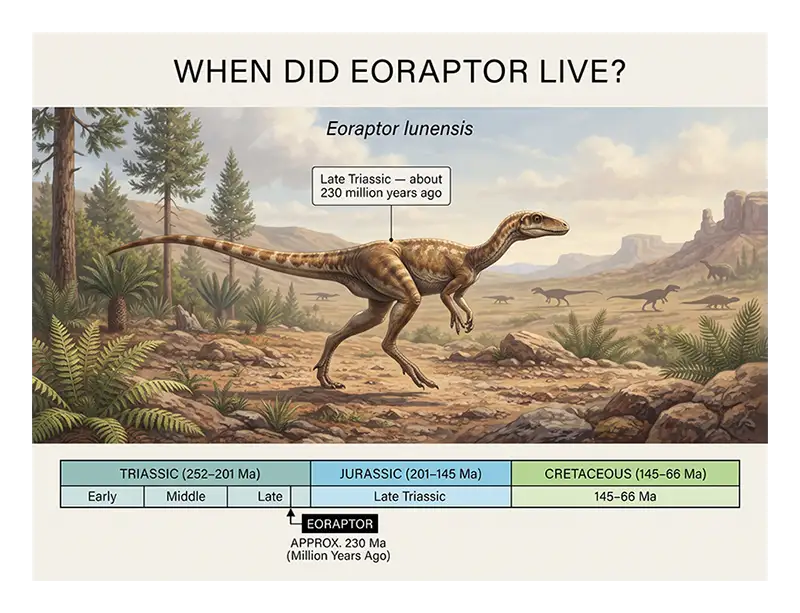
Eoraptor lived approximately 230 million years ago, during the Late Triassic Period. More specifically, its fossils come from rocks of the Ischigualasto Formation in Argentina, commonly dated to around 228 million years ago.
The Triassic Period lasted from approximately 252 to 201 million years ago. It followed the Permian–Triassic mass extinction, after which ecosystems gradually recovered and new groups of land vertebrates diversified.
During the Late Triassic, early dinosaurs shared their environments with other reptiles, including relatives of crocodilians and various archosaurs. The first dinosaurs were not yet the dominant animals in every ecosystem. Instead, they represented one part of a diverse and changing animal community.
The age of Eoraptor is important because it shows that dinosaurs had already evolved recognizable body structures by this time. Other dinosaur lineages must have originated earlier, even though their earliest members remain incompletely represented in the fossil record.
Who Discovered Eoraptor?
The fossil of Eoraptor was discovered in 1991 by Argentine paleontologist Ricardo Martínez during fieldwork in the Ischigualasto region of northwestern Argentina. The specimen was subsequently studied by an international research team led by paleontologist Paul Sereno.
In 1993, Sereno and his colleagues formally described Eoraptor lunensis in a scientific paper published in the journal Nature. The discovery attracted considerable attention because the skeleton preserved many details of an early dinosaur's anatomy.
The fossil came from the Ischigualasto Formation in San Juan Province. This geological formation is famous for preserving a rich collection of Late Triassic animals, including several early dinosaurs.
The discovery was valuable not simply because the animal was old, but because its preserved bones helped researchers investigate what early dinosaurs looked like and how they were related to other dinosaur groups.
What Did Eoraptor Look Like?
Eoraptor had a slender body, a relatively small skull, long hind limbs, short forelimbs, and a long tail. Its overall build suggests an agile, two-legged animal rather than a heavy-bodied dinosaur.
Its skull contained several different types of teeth. Some were curved and suited to cutting or gripping food, while others had different shapes. This variation, known as heterodont dentition, is an important anatomical feature because it provides clues about how an animal processed food.
The forelimbs were shorter than the hind limbs, and the hands had fingers with claws. These hands may have helped the animal grasp objects or food, although their precise function cannot be determined from appearance alone.
Its long tail likely helped balance the body during movement. Like many early dinosaurs, Eoraptor also had relatively lightweight limb bones and a body plan suited to moving on two legs.
Scientists cannot reconstruct every detail of its external appearance from bones. The exact colors of its skin, whether it had feathers, and the full texture of its body covering remain uncertain.
How Big Was Eoraptor?
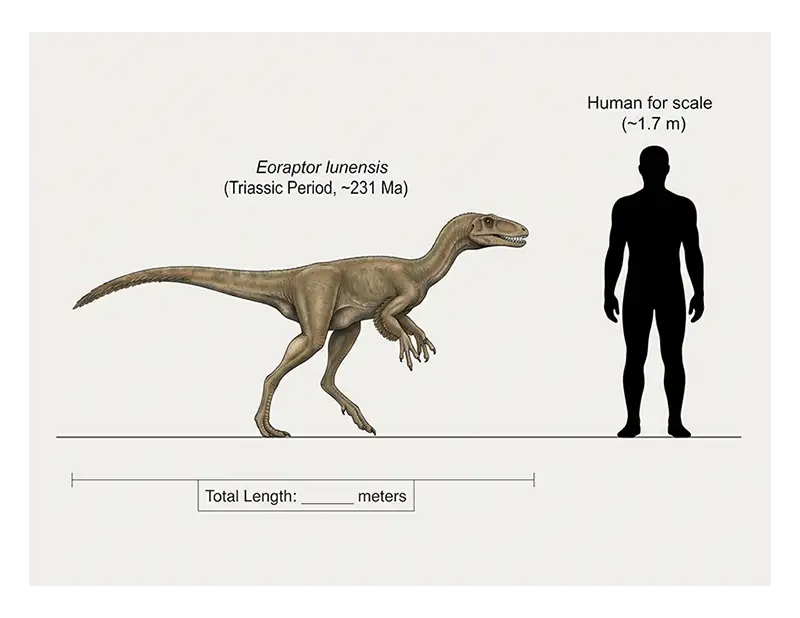
Eoraptor was small compared with many dinosaurs that evolved later. Common estimates place its total length at roughly 1 to 1.5 metres, although estimates differ among references and reconstructions.
Its body was relatively light, and its long hind limbs gave it a much taller stance than its small size might suggest. It was nowhere near the size of later giant theropods or the enormous long-necked sauropods.
Size estimates for extinct animals are not always exact. Researchers use preserved bones, comparisons with related animals, and measurements from reconstructed skeletons to estimate length and body mass. The completeness of a specimen and the method used can affect the final figures.
Despite its small stature, Eoraptor is scientifically significant. Its value comes from the information preserved in its skeleton, not from its size or strength.
What Did Eoraptor Eat?
The exact diet of Eoraptor remains uncertain. Its teeth provide evidence about the kinds of food it may have eaten, but they do not establish a complete menu.
Some teeth were curved and had serrated edges, features that could help cut or grip animal tissue. Other teeth had different shapes, suggesting that its feeding adaptations were not as specialized as those of some later meat-eating dinosaurs.
Because of this combination, researchers have considered whether Eoraptor may have eaten both animal and plant material. However, interpretations differ, and it is important not to describe an omnivorous diet as conclusively proven.
Small animals and other available food sources may have formed part of its diet. Plant material could also have been consumed, depending on its feeding behaviour and digestive capabilities.
Scientists investigate dinosaur diets by examining tooth shape, wear patterns, jaw structure, fossilized stomach contents when available, and comparisons with other animals. For Eoraptor, the available evidence supports cautious interpretation rather than a definitive conclusion.
How Did Eoraptor Move?
Eoraptor walked on two hind legs, a form of locomotion known as bipedalism. Its hind limbs were longer than its forelimbs, and its body structure supports the interpretation that it moved with its body held above the ground.
Its long tail likely helped counterbalance the front part of the body as it walked or ran. Balance would have been important for a small animal that moved on two legs.
The forelimbs were much shorter than the hind limbs, but they were not simply useless remnants. Their hands and claws may have helped with grasping or manipulating food and other objects.
Its leg proportions suggest that Eoraptor was capable of active movement. However, claims about its exact running speed or agility are difficult to establish from fossil bones alone.
The ability to move on two legs was not unique to Eoraptor. Bipedal locomotion appeared in several early dinosaur lineages and became an important feature in many later groups.
Where Did Eoraptor Live?
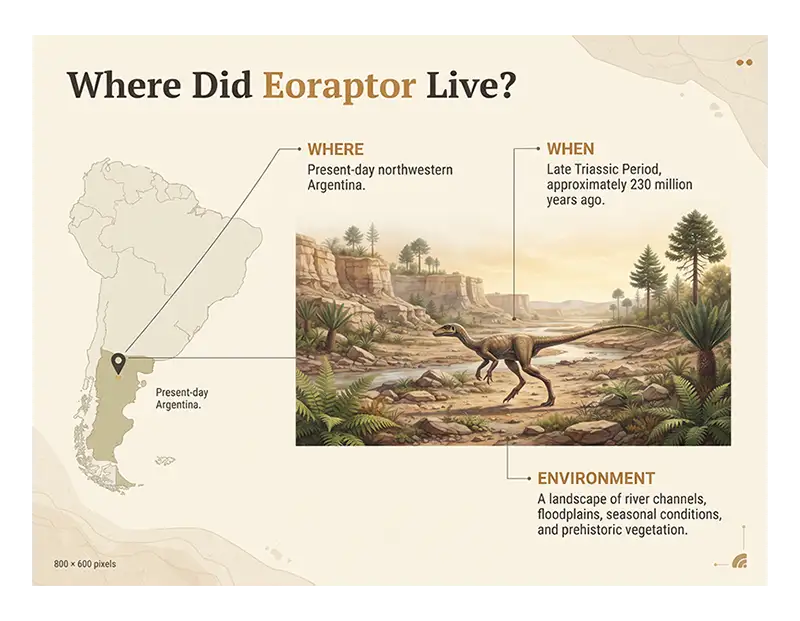
Eoraptor lived in what is now northwestern Argentina, in the region preserved by the Ischigualasto Formation. Today, parts of this area are dry and rugged, but the environment was different during the Late Triassic.
Rocks from the formation preserve evidence of ancient rivers, floodplains, soils, and volcanic activity. These deposits record a changing landscape that supported a variety of plants and animals.
The environment provided food and habitats for early dinosaurs and numerous other vertebrates. Eoraptor lived alongside animals that occupied different ecological roles, including other early dinosaurs and non-dinosaurian reptiles.
The region is particularly important to paleontology because it preserves one of the best-known assemblages of early dinosaurs. Fossils from the same formation have helped researchers compare the anatomy and diversity of animals living during this period.
Studying the surrounding rocks is as important as studying the skeleton itself. Geological evidence helps scientists estimate when the animal lived and reconstruct the broader ecosystem in which it survived.
Was Eoraptor the First Dinosaur?
Eoraptor is often described as one of the earliest known dinosaurs, but scientists cannot confidently identify it as the single first dinosaur.
The fossil record is incomplete. Fossilization requires particular conditions, and many animals that lived in the past left no fossils that have been discovered. The oldest known fossil of a group therefore does not necessarily represent the moment when that group first evolved.
By the time Eoraptor lived, dinosaurs already possessed specialized skeletal features that distinguished them from other reptiles. This suggests that their evolutionary history had begun before the animals preserved in the Ischigualasto Formation appeared.
Other early dinosaurs, including Herrerasaurus, lived during a broadly similar period. Discoveries from different regions and geological layers continue to improve scientists' understanding of when the earliest dinosaurs originated.
It is more accurate to describe Eoraptor as an early dinosaur that helps researchers investigate the origins of the group than to call it the definite first dinosaur.
What Was Eoraptor's Place in Dinosaur Evolution?
The evolutionary classification of Eoraptor has changed as researchers have studied its anatomy in greater detail. When it was first described in 1993, scientists classified it as a basal theropod. Theropods include many predominantly meat-eating dinosaurs, as well as birds, their only living dinosaur descendants.
Later research, including a detailed anatomical study published in 2013, supported placing Eoraptor among early sauropodomorphs. Sauropodomorphs were the dinosaur lineage that eventually included large, long-necked plant-eaters such as Diplodocus and Brachiosaurus.
This change in interpretation was based on anatomical details that became clearer as more of the skeleton was studied. Features of the skull, teeth, and hands helped researchers compare Eoraptor with other early dinosaurs.
The debate highlights a challenge in studying early dinosaur evolution: many early species shared similar body plans, and small differences in their bones can influence how scientists reconstruct their relationships.
For this reason, its classification should be presented with appropriate context. The sauropodomorph interpretation has received support from detailed studies, but its evolutionary position is best discussed in relation to the evidence and the history of scientific debate.
How Was Eoraptor Different from Other Early Dinosaurs?
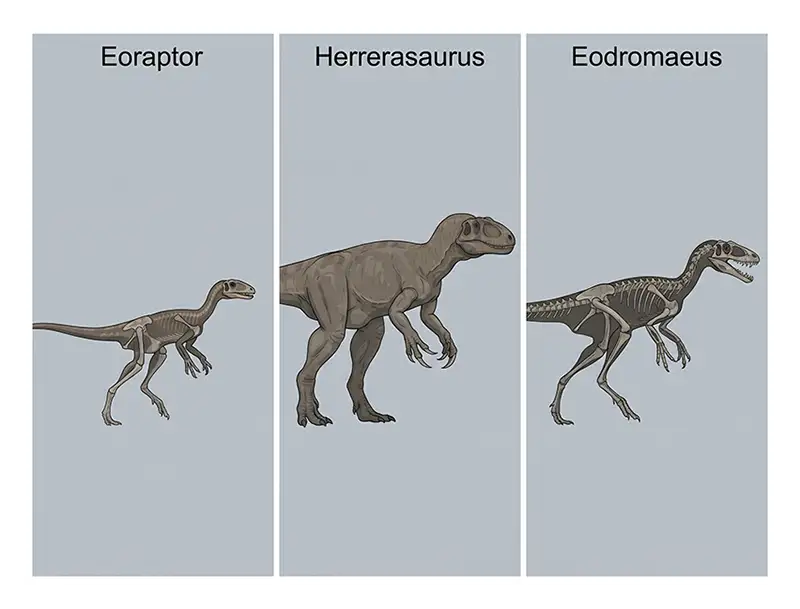
Several early dinosaurs lived during the Late Triassic, but they differed in body size, anatomy, and likely feeding habits. Comparing them helps explain why the earliest dinosaur communities were more diverse than a single example might suggest.
Eoraptor: A small, lightly built dinosaur with a long tail, short forelimbs, and varied tooth shapes. Its exact evolutionary position has been debated.
Herrerasaurus: A larger and more strongly built early dinosaur with a skull and teeth adapted for capturing and processing animal prey. It is generally recognized as a predatory dinosaur, although its precise position within the dinosaur family tree has also been discussed.
Eodromaeus: Another small early dinosaur from the Ischigualasto Formation. It is generally interpreted as an early theropod and provides a useful comparison with Eoraptor because the two lived in the same broad region and period.
These animals show that early dinosaurs were not all identical. Even when they shared some general features, their skeletons contained differences that helped researchers investigate their ecological roles and evolutionary relationships.
The comparison also illustrates why scientists examine individual bones rather than relying only on an animal's overall appearance. Two dinosaurs of similar size could belong to different evolutionary lineages.
What Do Eoraptor Fossils Reveal?
The fossils of Eoraptor preserve information about its anatomy, movement, feeding adaptations, and place in the history of dinosaurs. Its skull and teeth help researchers investigate its possible diet. The relative lengths of its limbs provide evidence for bipedal locomotion, while the hands and claws reveal aspects of its forelimb structure.
The skeleton also allows paleontologists to compare Eoraptor with other early dinosaurs. These comparisons help identify shared features, distinguish different lineages, and test hypotheses about dinosaur evolution.
The surrounding rock layers provide a separate source of evidence. Their geological age helps establish when Eoraptor lived, while the other fossils found in the formation provide information about the ecosystem it inhabited.
Fossils cannot answer every question. They do not directly reveal its exact behavior, colors, or complete diet, and some anatomical features can support more than one interpretation. Scientists therefore combine fossil evidence with geological context and comparisons across many species.
The importance of Eoraptor lies in how much its remains contribute to the wider picture of early dinosaur diversity and evolution.
Conclusion
Eoraptor was a small dinosaur from the Late Triassic that provides valuable evidence about the early evolution of dinosaurs. Its fossil skeleton reveals a lightweight, two-legged animal with a long tail, short forelimbs, and varied teeth.
Although its exact diet and evolutionary position have been debated, its remains help scientists investigate how early dinosaurs differed from one another and how their major lineages developed.
Rather than proving which animal was the very first dinosaur, Eoraptor offers a detailed glimpse into a time when dinosaurs were still diversifying. Its fossils remain an important part of the evidence used to reconstruct the early history of the dinosaur family tree.
Eoraptor is commonly translated as “dawn plunderer.” The name refers to its early position in dinosaur history.
Eoraptor lived during the Late Triassic, approximately 230 million years ago. Its fossil-bearing rocks are commonly dated to around 228 million years ago.
Its exact diet is uncertain. Some teeth suggest adaptations for processing animal tissue, while the varied tooth shapes have led researchers to consider a possible omnivorous diet.
It is one of the earliest known dinosaurs, but there is insufficient evidence to identify it as the single first dinosaur. The fossil record does not preserve every species that ever lived.
Its fossil was discovered in 1991 in the Ischigualasto region of northwestern Argentina, within the Ischigualasto Formation.