
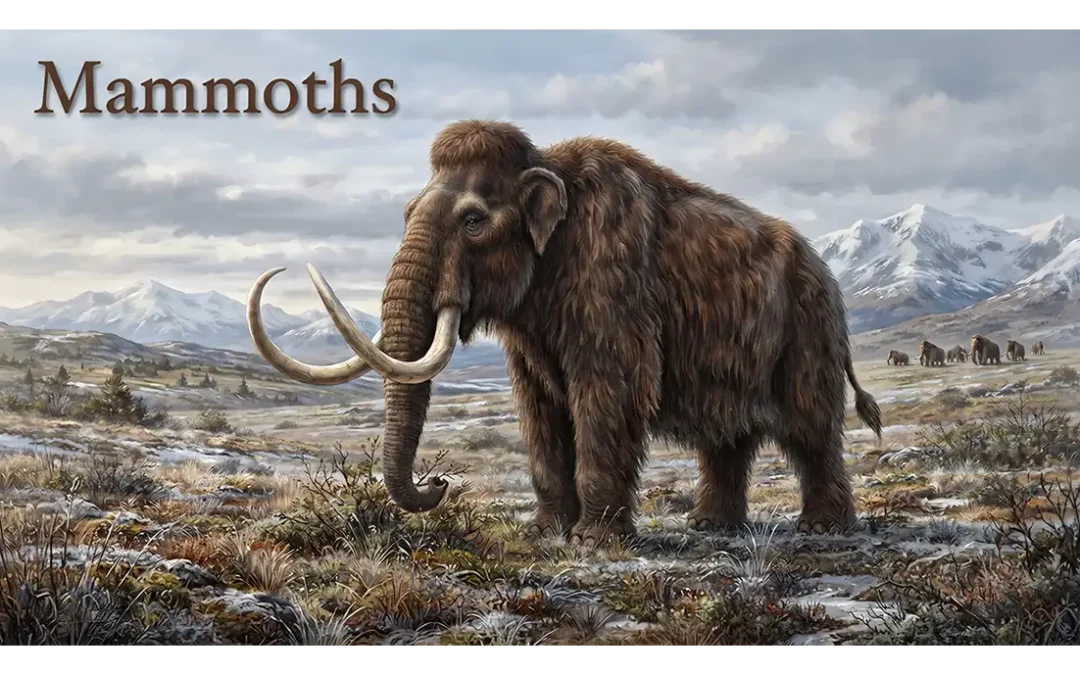
Mammoths were large, extinct mammals that belonged to the elephant family. They lived for millions of years and became famous for their long, curved tusks, massive bodies, and, in some species, thick coats of fur. The woolly mammoth is the best-known example, but many other species evolved in different environments across Africa, Eurasia, and North America.
These prehistoric animals were important members of ancient ecosystems. Their fossils help scientists understand how large mammals adapted to changing climates, spread across continents, and eventually disappeared. Some mammoth remains have even preserved hair, skin, and other biological material, providing valuable evidence about their lives.
Although mammoths are often associated with the Ice Age, their history began millions of years before the coldest periods of the Pleistocene. Their story includes a remarkable evolutionary journey, a wide variety of species, and the survival of a few isolated populations until relatively recent times.
What Are Mammoths?
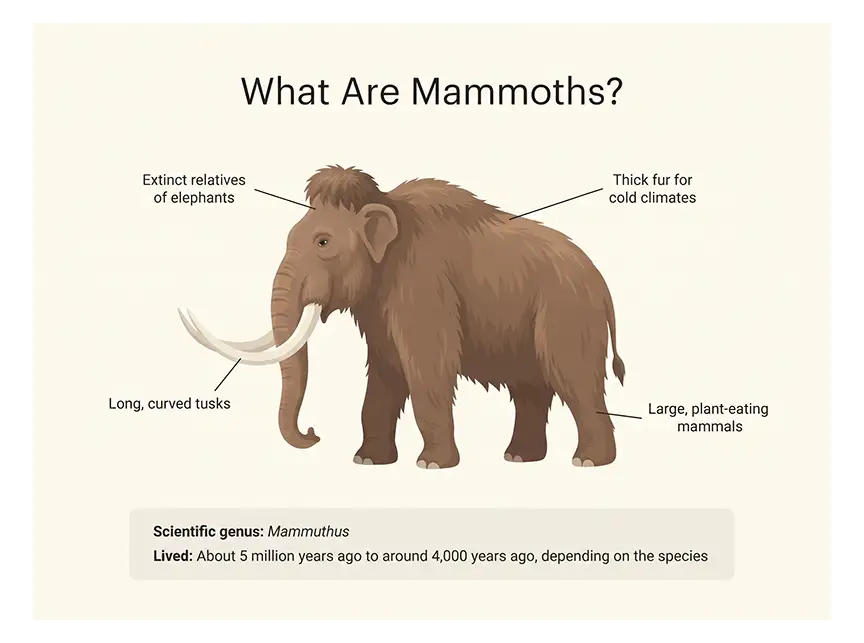
Mammoths were extinct elephant relatives belonging to the genus Mammuthus. They were members of the family Elephantidae, the same family that includes living elephants. However, mammoths were not simply ancient versions of modern elephants; they represented their own diverse evolutionary lineage.
Mammoths varied in size, appearance, and habitat. Some were adapted to cold, open environments, while earlier species lived in warmer regions. The woolly mammoth (Mammuthus primigenius) developed thick fur and other features that helped it survive in cold conditions. Other species had less specialized adaptations for freezing temperatures.
Like living elephants, mammoths had long trunks, large ears of varying sizes, sturdy legs, and tusks made of ivory. Their tusks were elongated upper incisor teeth that continued growing throughout much of their lives. These structures could be used for digging, moving vegetation, competing with other animals, and other activities.
Mammoths were herbivores, meaning they ate plant material rather than hunting other animals. Their diets included grasses, sedges, leaves, shrubs, and other vegetation, depending on the species and its environment.
It is important to distinguish mammoths from mammals in general. Mammal is the name of a large animal class that includes humans, bats, whales, dogs, and elephants. Mammoth refers specifically to members of the extinct genus Mammuthus.
When Did Mammoths First Appear and Disappear?
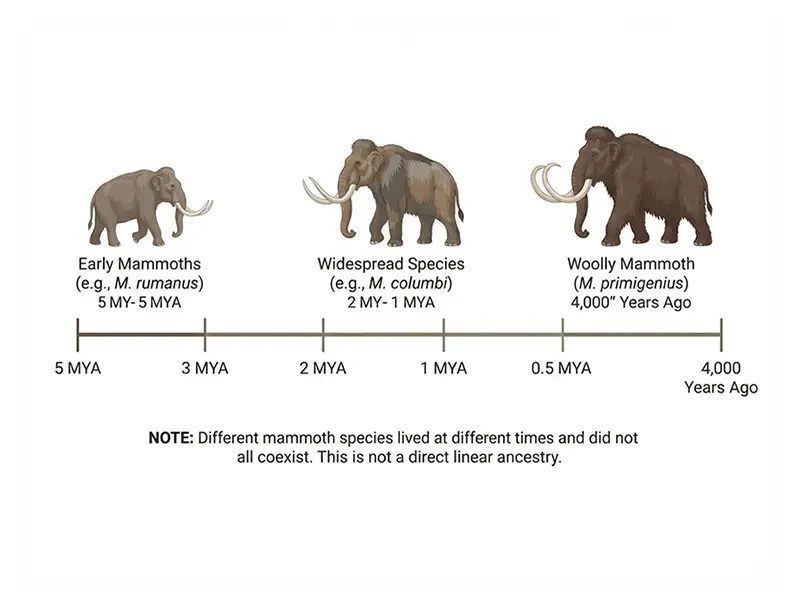
Mammoths first appeared approximately five million years ago, during the late Miocene or early Pliocene boundary period, depending on how early fossil records are classified. Their evolutionary history continued through the Pliocene and Pleistocene epochs and into the Holocene for a few surviving populations.
The genus developed in Africa before its members spread into Eurasia and eventually North America. Over time, different mammoth species adapted to a range of climates and landscapes.
The following timeline highlights major stages in mammoth history:
- Around 5 million years ago: Early mammoths appeared in Africa.
- Pliocene Epoch: Mammoths diversified and expanded into parts of Eurasia.
- Pleistocene Epoch, about 2.58 million to 11,700 years ago: Several species flourished, including the woolly mammoth and Columbian mammoth.
- Around 15,000–10,000 years ago: Many mainland mammoth populations disappeared during major environmental changes near the end of the last Ice Age.
- About 4,000 years ago: A small population of woolly mammoths survived on Wrangel Island in the Arctic until this approximate date.
These dates are estimates, and mammoth species did not all appear or disappear at the same time. Their history extended across millions of years, while the final isolated populations survived long after many mainland groups were gone.
The survival of mammoths into the Holocene is especially interesting because it means some lived at the same time as early human civilizations. However, this does not mean that mammoths remained widespread during that period; their final populations were small and geographically isolated.
What Did Mammoths Look Like?
Mammoths had many features in common with modern elephants, but their appearance varied among species. Their size, coat, ear shape, tusks, and body proportions reflected their evolutionary history and the environments in which they lived.
Body size and shape
Many mammoths were large, powerful animals with broad bodies, thick limbs, and long trunks. The largest species could reach impressive heights at the shoulder, although size differed considerably among species and individuals.
The woolly mammoth was generally smaller than some of the largest mammoth species. Its body had a high shoulder region, a sloping back, and a compact build that helped reduce heat loss in cold environments.
Not all mammoths were giants. Some island populations evolved much smaller bodies because of the limited resources available in their habitats. This process, known as island dwarfism, occurred in several large mammal lineages.
Fur and cold-weather adaptations
The woolly mammoth possessed a thick coat of hair, including long outer hairs and a dense undercoat. Beneath the skin, it had a layer of fat that provided insulation and stored energy.
Its relatively small ears and tail reduced the amount of body surface exposed to cold air. These adaptations helped conserve heat in freezing environments.
Other mammoth species lived in warmer climates and did not necessarily have the same thick coat. It would therefore be inaccurate to picture every mammoth as a shaggy animal covered in long fur.
Tusks and trunk
Mammoth tusks were elongated upper incisors made of ivory. They often curved outward and upward, although their shape varied among species and individuals. Some tusks grew to several metres in length.
Tusks could help mammoths move snow or soil, reach vegetation, compete with rivals, and display their size. Their exact use depended on the situation, and researchers cannot always determine the purpose of a particular tusk shape from fossils alone.
The trunk was a flexible muscular organ used for grasping vegetation, bringing food to the mouth, exploring surroundings, and interacting with other animals. Together, the trunk and tusks gave mammoths useful tools for feeding and everyday activities.
How Did Mammoths Evolve?
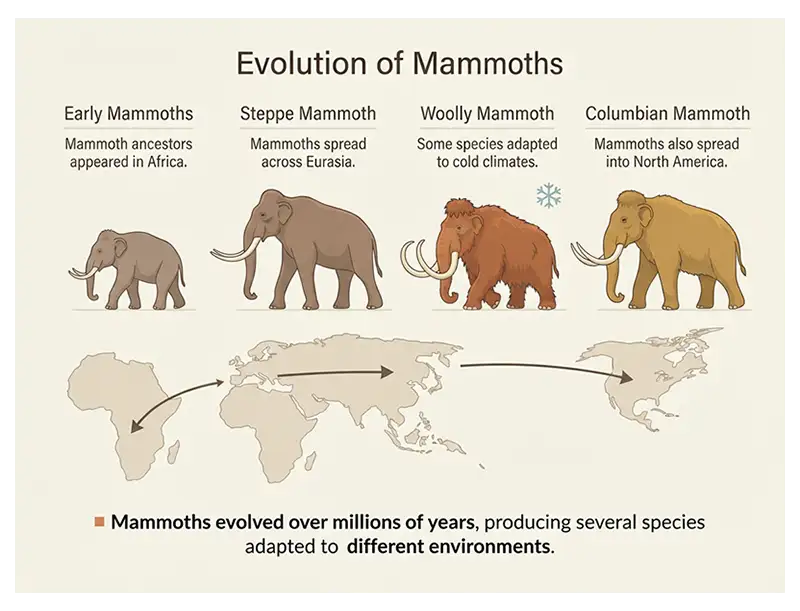
Mammoths evolved from earlier elephant relatives in Africa. Their ancestors belonged to a much older evolutionary history that also gave rise to other members of the elephant family. Over millions of years, changes in climate, vegetation, and geography helped shape the different forms of proboscideans, the group that includes elephants, mammoths, and their extinct relatives.
The genus Mammuthus emerged around five million years ago. Early mammoths gradually diversified, and some lineages moved beyond Africa into Eurasia. Later, mammoths spread into North America, where they evolved alongside other large mammals.
A major part of their success was their ability to adapt to different habitats. Some species occupied relatively warm environments, while others developed features suited to colder conditions. Changes in teeth, body proportions, and tusks reflected different feeding strategies and ecological pressures.
The woolly mammoth evolved in northern Eurasia and became highly adapted to cold, open landscapes. Its thick coat, insulating fat, and other physical characteristics helped it survive in regions with long winters.
Mammoths were closely related to modern elephants, but living elephants did not descend directly from woolly mammoths. Instead, mammoths and modern elephants share common ancestors. Genetic research also shows that mammoths were more closely related to Asian elephants than to African elephants.
Evolution was not a straight sequence in which one mammoth species simply transformed into the next. It was a branching process, with different lineages appearing, spreading, adapting, and becoming extinct at different times.
What Were the Different Species of Mammoths?
Scientists have identified several mammoth species from fossil evidence. They differed in size, anatomy, geographic range, and environmental adaptations. The following examples are among the most widely discussed.
Woolly mammoth (Mammuthus primigenius)
The woolly mammoth is the most familiar species. It lived across northern Eurasia and North America during the Pleistocene and was especially well adapted to cold, open environments.
Its long hair, dense undercoat, small ears, and insulating body fat helped it conserve heat. Its high-crowned molars contained numerous enamel ridges suited to processing grasses and other abrasive vegetation. Frozen specimens from Siberia have preserved hair, skin, and other tissues, allowing scientists to study this species in unusual detail.
Columbian mammoth (Mammuthus columbi)
The Columbian mammoth lived in North America, particularly in areas south of the main range of the woolly mammoth. It generally occupied warmer environments, including grasslands and open woodland.
It was a large species with long tusks and teeth adapted to processing plant material. Compared with the woolly mammoth, it was less specialized for extreme cold.
Evidence indicates that Columbian and woolly mammoths sometimes interbred in parts of North America. Their evolutionary relationships were therefore more complex than a simple division between two completely separate populations.
Steppe mammoth (Mammuthus trogontherii)
The steppe mammoth was an important Eurasian species that lived before and during parts of the Pleistocene. It was large and adapted to open landscapes, including grass-rich environments.
This species is significant because it is closely associated with the evolutionary history of later mammoths, including the woolly mammoth. Its fossil record helps researchers investigate how mammoths changed as climates and habitats shifted.
Southern mammoth (Mammuthus meridionalis)
The southern mammoth was an early species that lived across parts of Europe and Asia during the Pliocene and early Pleistocene. It occupied environments that were generally warmer than the Arctic habitats associated with the woolly mammoth.
Its fossils help document the early spread and diversification of mammoths outside Africa.
Dwarf mammoths
Some mammoths evolved much smaller bodies after their ancestors became isolated on islands. Examples include the Channel Islands pygmy mammoth (Mammuthus exilis) off the coast of California.
Limited food supplies and restricted living space likely contributed to their smaller size over many generations. These animals demonstrate that mammoths were not all enormous and that island environments could drive substantial evolutionary changes.
What Is the Difference Between Mammoths and Mastodons?
Mammoths and mastodons are often confused because both were extinct, tusked relatives of modern elephants. However, they belonged to different evolutionary groups and had important differences in their teeth, feeding habits, and evolutionary histories.
Mammoths belonged to the genus Mammuthus in the family Elephantidae. Mastodons, including the American mastodon (Mammut americanum), belonged to the family Mammutidae.
The main differences include the following:
Teeth: Mammoths had molars with many plate-like enamel ridges. These teeth were well suited to grinding grasses and other abrasive plants. Mastodons had molars with prominent rounded cusps, which were useful for crushing leaves, twigs, and other vegetation.
Body and skull: Both groups were large and had trunks and tusks, but their body proportions and skull structures differed. Many mammoths had more sloping backs, while American mastodons generally had a more robust build. These features varied among species and individuals.
Diet: Mammoths often relied heavily on grasses, particularly species adapted to open grasslands and steppe-tundra. Mastodons commonly browsed on leaves, branches, and other woody vegetation. Neither group had an identical diet in every environment.
Evolutionary relationships: Mammoths were more closely related to living elephants than mastodons were. Mastodons belonged to a separate branch of proboscidean evolution.
Geographic range: Mammoths lived across parts of Africa, Eurasia, and North America at different times. American mastodons lived mainly in North America.
Both groups disappeared, but their extinction histories were not identical. Their fossils provide evidence of different ways that large herbivores adapted to changing environments.
What Did Mammoths Eat?
Mammoths were herbivores that fed on a variety of plants. Their diets depended on the species, the season, and the vegetation available in their surroundings.
Many woolly mammoths lived in cold, open landscapes where grasses, sedges, and other low-growing plants were abundant. They also ate herbs, shrubs, and other vegetation when available.
Mammoths used their trunks to gather plants and bring them to their mouths. Their large molars then broke down the food through repeated chewing. In woolly mammoths, the numerous enamel ridges on the molars helped process tough, abrasive plant material.
Different species did not necessarily eat the same foods. Mammoths living in warmer or more wooded habitats could consume a wider range of leaves, twigs, and other plants. Their feeding behaviour changed according to local conditions.
Scientists reconstruct mammoth diets using several kinds of evidence:
- Tooth wear: Scratches and microscopic patterns on teeth can reveal the types of food an animal processed.
- Dental structure: The shape and arrangement of enamel ridges provide clues about feeding adaptations.
- Stable isotopes: Chemical measurements in teeth and bones can help identify broad dietary patterns and the types of plants consumed.
- Preserved stomach contents and dung: Rare discoveries can provide direct evidence of food eaten by individual animals.
- Pollen and plant remains: Nearby sediments can help researchers reconstruct the vegetation that existed in mammoth habitats.
These methods reveal that mammoths were not all specialized grass eaters. Their diets varied among species and changed as environments shifted.
Where Did Mammoths Live?
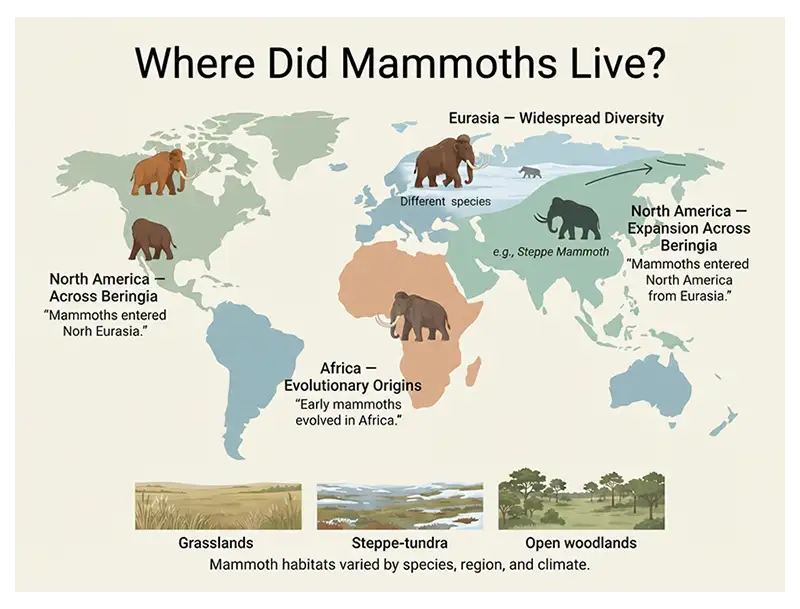
Mammoths occupied a broad geographic range over millions of years. Their earliest members appeared in Africa, after which different species spread into Eurasia and North America.
Their distribution changed over time because of migration, climate shifts, changing vegetation, and the formation or disappearance of suitable habitats.
Africa
Africa was the evolutionary starting point for mammoths. Early members of the genus lived there before some lineages spread into other continents. Mammoths did not remain equally widespread across Africa throughout their history.
Eurasia
Mammoths later became widespread across parts of Europe and Asia. Different species occupied a variety of landscapes, from relatively warm regions to the cold northern environments of the Pleistocene.
The woolly mammoth was especially associated with northern Eurasia, where open, cold landscapes provided extensive grazing areas.
North America
Mammoths entered North America from Eurasia through Beringia, the region that connected northeastern Asia and northwestern North America when sea levels were low. Several mammoth species lived across the continent, including the woolly mammoth in colder northern areas and the Columbian mammoth farther south.
Their ranges sometimes overlapped, and fossil and genetic evidence shows that different mammoth populations could interbreed.
Habitats and climate
The habitats used by mammoths included grasslands, open woodlands, and cold steppe-tundra environments. The woolly mammoth was strongly associated with the mammoth steppe, a cold, largely open ecosystem that supported grasses, sedges, and other plants.
Not every species lived in a frozen landscape. Earlier mammoths and some populations occupied warmer environments with different vegetation.
As the climate warmed toward the end of the last Ice Age, many open habitats changed. In some regions, woody vegetation expanded and grass-rich environments declined. These changes affected the food and living space available to mammoths, although the effects varied across their range.
What Do Mammoth Fossils Reveal?
Mammoth fossils provide some of the most detailed evidence available for studying extinct large mammals. They include bones, teeth, tusks, footprints, and, in rare cases, preserved soft tissues.
Most mammoth discoveries consist of hard parts such as teeth and bones. These remains can reveal body size, age, injuries, disease, and aspects of an animal's life. Tusks can also preserve growth patterns that help researchers study changes in an individual's condition over time.
Frozen mammoth remains
Permafrost in northern regions has preserved some mammoth carcasses with hair, skin, and other tissues. Such discoveries are rare, but they offer information that ordinary fossilized bones cannot provide.
Preserved material can help scientists investigate body structure, parasites, diet, and genetic characteristics. However, the condition of each specimen differs, and not every frozen mammoth is perfectly preserved.
Ancient DNA
Researchers have recovered and studied DNA from mammoth remains, especially those preserved in cold environments. Genetic analyses have helped clarify relationships among species and populations, reveal interbreeding, and investigate changes in genetic diversity.
DNA breaks down over time, so ancient genetic material is usually fragmented and vulnerable to contamination. Results must therefore be evaluated carefully and compared with other evidence.
Fossil excavation and analysis
Paleontologists study mammoth remains using field excavation, laboratory preparation, imaging, anatomical comparisons, and chemical analysis. Researchers may compare a fossil with modern elephant bones to identify similarities and differences.
The location and geological layer in which a specimen is found also matter. These details can help establish its approximate age and environmental context.
Together, fossils, genetics, and geological evidence allow scientists to reconstruct mammoth evolution and investigate the conditions in which these animals lived.
Why Did Mammoths Become Extinct?
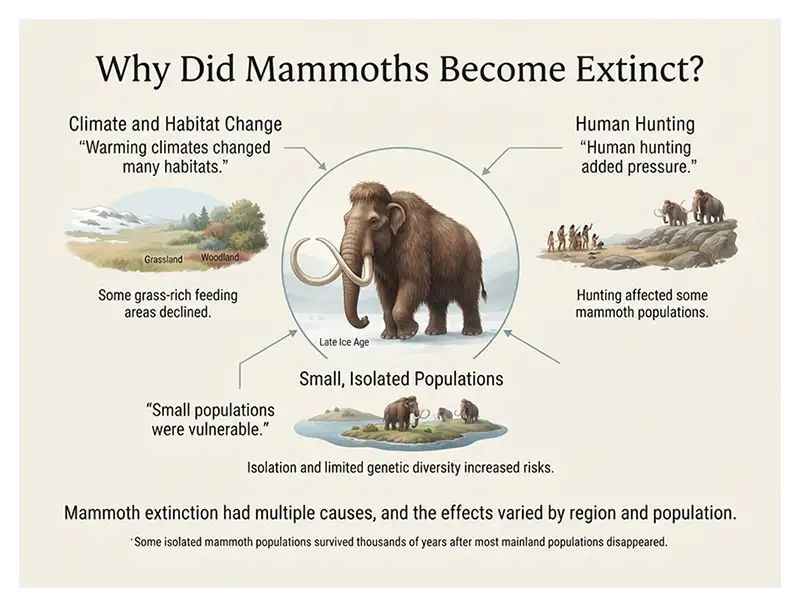
Mammoths disappeared at different times in different regions. Many mainland populations became extinct near the end of the Pleistocene, while small, isolated groups survived longer. Their disappearance cannot be explained by one universal cause.
Several factors probably contributed, although their relative importance differed among populations.
Climate and habitat changes
As the last Ice Age ended, temperatures rose in many regions. Precipitation patterns and vegetation also changed. Some open, cold environments became less extensive, while forests, shrubs, or other plant communities expanded in certain areas.
These changes affected the distribution of food and suitable habitat. Mammoths adapted to cold, open landscapes may have faced increasing pressure when those environments became fragmented or less productive.
Human hunting
Modern humans lived alongside mammoths and hunted them in some regions. Archaeological sites containing mammoth bones, cut marks, and hunting-related evidence show that people used these animals for food and materials.
Hunting may have placed additional pressure on populations already affected by environmental change. However, its impact varied by location and period, and researchers continue to examine how much it contributed to the disappearance of different groups.
Small and isolated populations
Some mammoths survived after most mainland populations had vanished. The woolly mammoths of Wrangel Island in the Arctic Ocean are a well-known example. This population persisted until approximately 4,000 years ago.
Isolation and small population size can increase the risk of extinction. Limited genetic diversity, environmental disturbances, and other pressures may have affected the final island populations. The exact circumstances of their disappearance remain an active subject of research.
A combination of pressures
The evidence supports a complex explanation involving environmental change, human activity, and differences among populations. It is unlikely that every mammoth group disappeared for exactly the same reason.
Studying their extinction helps scientists understand how large animals respond to rapid environmental change and why small, isolated populations can be especially vulnerable.
Conclusion
Mammoths were a diverse group of extinct elephant relatives whose history extended across millions of years. They evolved in Africa, spread into Eurasia and North America, and adapted to a range of environments. Their distinctive tusks, specialized molars, and varied body forms reflect the different ecological challenges they faced.
The woolly mammoth remains the best-known species, but the mammoth genus included many other forms, from early species to the dwarf mammoths of isolated islands. Fossils, ancient DNA, and geological evidence continue to reveal how these animals lived and how their populations changed over time.
Their extinction resulted from a complex combination of pressures that differed across regions. By studying mammoths, scientists gain insight into evolution, climate change, ancient ecosystems, and the vulnerability of large mammals when environmental conditions shift.
No. Mammoths were mammals belonging to the genus Mammuthus and the family Elephantidae. They lived millions of years after the extinction of non-avian dinosaurs.
Yes. Mammoths and living elephants share common ancestors. Genetic evidence indicates that mammoths were more closely related to Asian elephants than to African elephants, but modern elephants did not descend directly from woolly mammoths.
Woolly mammoths varied in size. Many adults stood roughly 2.7–3.4 metres at the shoulder, although individuals differed. Some other mammoth species were larger, and some island species evolved much smaller bodies.
Tusks may have helped mammoths move snow or soil, access vegetation, compete with other individuals, and display their size. Their use likely varied with the animal's environment and behaviour.
The last known woolly mammoth populations survived on Wrangel Island until approximately 4,000 years ago. Most other mammoth populations disappeared much earlier, with many mainland groups becoming extinct near the end of the last Ice Age.