
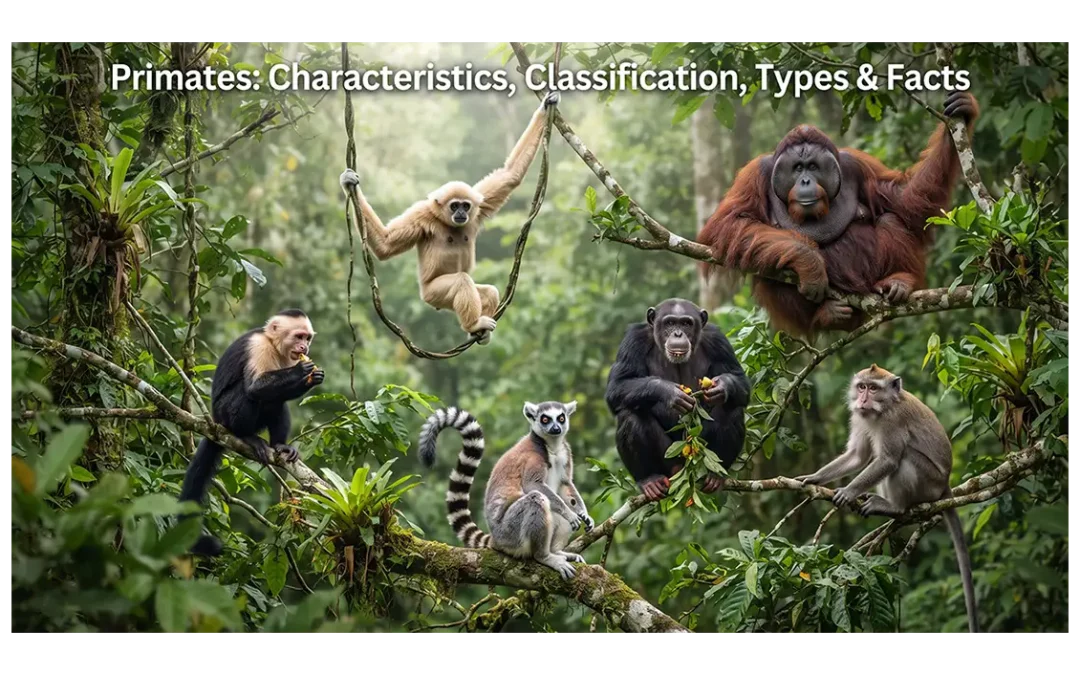
Primates are a diverse group of mammals that includes lemurs, lorises, tarsiers, monkeys, apes, and humans. They inhabit tropical forests, woodlands, savannas, and some mountainous regions, displaying a wide range of body sizes, diets, and behaviors. Although primates differ greatly in appearance, they share several anatomical and behavioral features that distinguish them from many other mammals.
Most primates have grasping hands or feet, flexible limbs, forward-facing eyes, and relatively large brains compared with their body size. These adaptations help them climb, handle food, judge distances, and respond to complex surroundings. Many species also live in social groups where communication, cooperation, and learning play important roles.
The scientific study of primates provides valuable information about mammalian evolution, animal intelligence, social behavior, and the biological history of humans. Understanding their characteristics, classification, habitats, and ecological roles helps explain why this group is so important to the natural world.
What Are Primates?
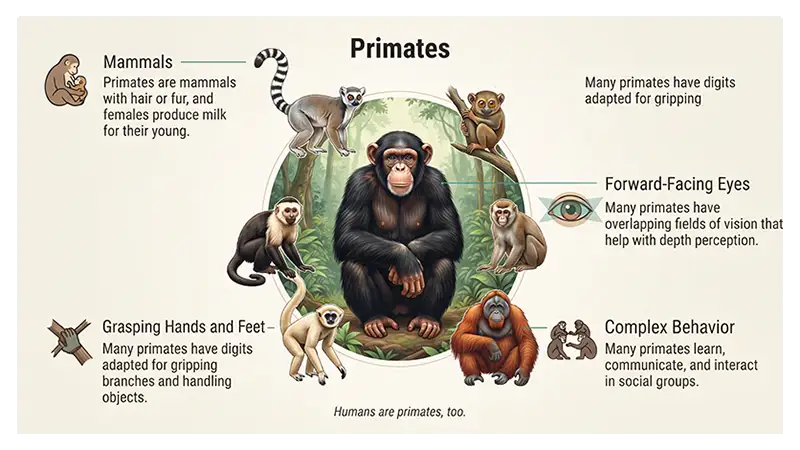
Primates are an order of mammals belonging to the class Mammalia. They are classified within the scientific order Primates, which includes more than 500 living species, depending on the classification system used. Their diversity ranges from tiny mouse lemurs to large apes such as gorillas, as well as humans.
Primates are generally recognized by their grasping extremities, forward-facing eyes, flexible shoulders, and relatively well-developed brains. However, these features vary among species. Some primates have long tails, while others have short tails or none at all. Certain species are adapted mainly for life in trees, whereas others spend much of their time on the ground.
Most living primates inhabit tropical and subtropical regions of Africa, Asia, Madagascar, and Central and South America. Their habitats include rainforests, dry forests, bamboo forests, shrublands, and grassland environments with scattered trees. Humans have spread across nearly every continent, but most nonhuman primates remain concentrated in warmer regions.
Primates are especially interesting because they combine physical adaptability with complex behavior. Many species use their hands to manipulate objects, learn from experience, recognize social relationships, and communicate through sounds, facial expressions, gestures, or scent.
Humans belong to this same mammalian order. Our hands, forward-facing eyes, social behavior, and evolutionary history reflect characteristics shared with other primates, although human language, culture, and technological abilities have developed in distinctive ways.
What Are the Main Characteristics of Primates?
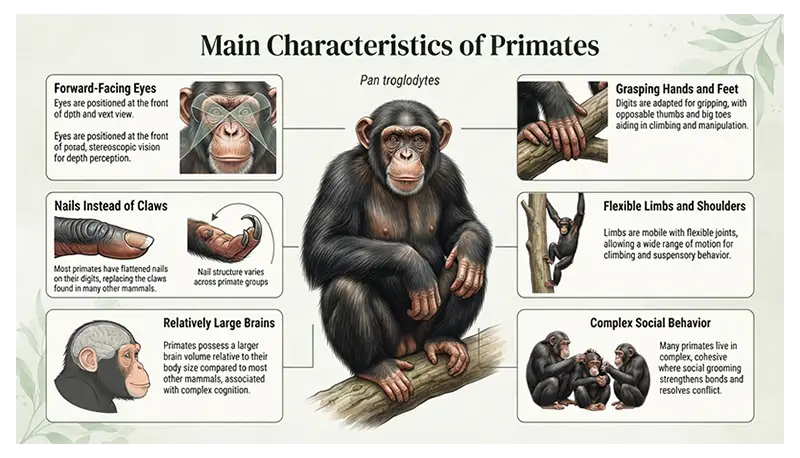
Primates share a collection of anatomical features that support movement, feeding, sensory perception, and interaction with their environment. Not every species possesses all these features to the same degree, but several traits are common throughout the group.
Grasping hands and feet
Many primates have hands and feet adapted for gripping branches and handling objects. Their fingers are relatively flexible, and many species possess opposable thumbs or big toes that can move against other digits to improve grip.
An opposable digit helps an animal hold food, climb, or manipulate its surroundings. However, opposability varies among primates, and humans have particularly specialized hands for precise manipulation.
Some species also have nails instead of claws on most digits. Nails protect the tips of the fingers and toes while allowing sensitive skin to remain exposed for touch. Certain primates, including some lemurs and marmosets, retain specialized claws on particular digits.
Forward-facing eyes and depth perception
Many primates have eyes positioned toward the front of the head. The overlapping visual fields of both eyes provide binocular vision, helping the brain estimate distances.
This ability is especially useful for animals moving through branches, where judging the distance between supports can prevent falls. Color vision is also well developed in many primates, although its extent differs among species. Some rely more heavily on smell or hearing, particularly when active at night.
Flexible limbs and shoulders
Primates often have mobile shoulder joints, flexible wrists, and limbs capable of a variety of movements. These features support climbing, reaching, hanging, and moving between branches.
Their locomotion differs considerably. Some leap between trees, others move along branches on all fours, and certain apes use their long arms for climbing or suspending themselves beneath branches. Humans are specialized for upright walking on two legs.
Relatively large brains
Compared with many mammals of similar body size, primates tend to have relatively large brains and well-developed areas involved in sensory processing and learning. These abilities help many species solve problems, remember locations, recognize individuals, and adapt their behavior to changing circumstances.
Brain size alone does not measure intelligence. Cognitive abilities depend on several factors, including brain organization, sensory systems, ecological demands, and the particular skills needed by a species.
Teeth adapted to different diets
Primate teeth vary according to what each species eats. Many have incisors for cutting food, canines that may be used in feeding or social displays, and molars for crushing or grinding.
Leaf-eating species often have molars suited to processing fibrous vegetation, while fruit-eating species may have teeth adapted to softer foods. These differences help researchers understand how primates obtain nutrition and adapt to different environments.
How Are Primates Classified?
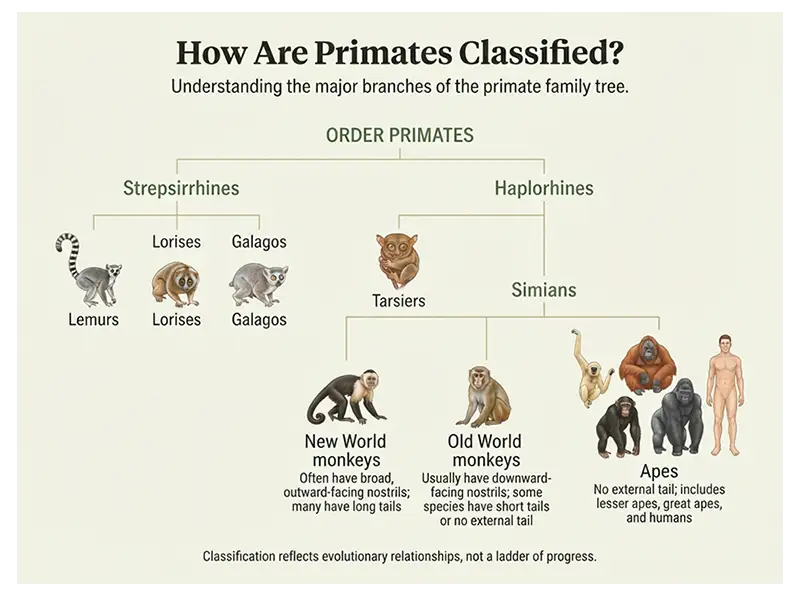
Scientists classify primates according to evolutionary relationships, anatomical features, and genetic evidence. Their classification has changed as researchers have gained a better understanding of how different groups evolved. At a broad level, living primates are divided into two major groups: strepsirrhines and haplorhines.
Strepsirrhines
Strepsirrhines include lemurs, lorises, and galagos. Many possess a moist nose, a strong sense of smell, and specialized adaptations around the eyes and mouth. Several species are nocturnal, although some lemurs and other members of this group are active during the day.
Lemurs are native to Madagascar, where they have evolved into a remarkable variety of forms. Lorises inhabit parts of Africa and Asia, while galagos are found in sub-Saharan Africa.
Haplorhines
Haplorhines include tarsiers, monkeys, apes, and humans. Many have greater reliance on vision than smell, although their sensory abilities vary according to their lifestyles.
Tarsiers are small primates with very large eyes and powerful hind limbs adapted for leaping. Monkeys and apes belong to a subgroup called simians, also known as anthropoids.
Monkeys and apes
Monkeys are divided into two major groups based on their evolutionary history and geographical distribution.
- New World monkeys: Native to Central and South America, these include capuchins, howler monkeys, squirrel monkeys, and spider monkeys. Some species possess prehensile tails that can grasp branches.
- Old World monkeys: Native to Africa and Asia, these include baboons, macaques, colobus monkeys, and guenons. Their tails, when present, are generally not prehensile.
Apes form another major group of simians. They include gibbons, orangutans, gorillas, chimpanzees, bonobos, and humans. Apes lack external tails and generally have highly mobile shoulders, although body structure and movement differ among species.
Modern classification uses genetic and anatomical evidence to reconstruct evolutionary relationships. These groupings describe shared ancestry rather than a ladder of progress: living primates have all continued evolving, and no living species is simply an earlier stage of another.
What Are the Main Types of Primates?
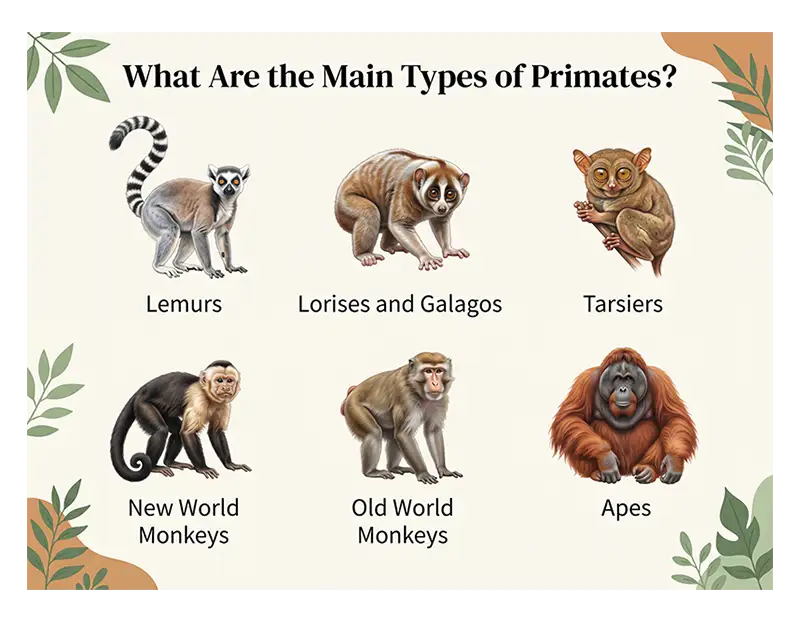
The order Primates contains several recognizable groups, each with distinctive adaptations, lifestyles, and ecological roles.
Lemurs
Lemurs are found naturally on Madagascar and nearby islands. They vary greatly in size, appearance, and behavior. Some are active during the day, while others are mainly nocturnal.
Their diets include fruit, leaves, flowers, nectar, and insects, depending on the species. Many live in social groups, and some female lemurs have an unusually prominent role in group organization. Habitat loss is a major threat to their survival.
Lorises and galagos
Lorises live in parts of Africa and Asia and are often slow-moving, nocturnal climbers. Their strong grasp helps them move through branches while searching for insects, fruit, and other foods.
Galagos, sometimes called bush babies, are small African primates known for their large eyes, strong hind limbs, and impressive leaping abilities. Many are active at night and use calls and scent marking to communicate.
Tarsiers
Tarsiers are small, mainly nocturnal primates native to Southeast Asia. Their enormous eyes help them see in low light, and their elongated hind limbs allow them to leap between supports.
Unlike many primates that eat a mixture of plant and animal foods, tarsiers are primarily animal-eaters. Their diet consists largely of insects and other small animals, making them unusual among living primates.
New World monkeys
New World monkeys inhabit tropical and subtropical regions of Central and South America. Their diversity includes capuchins, tamarins, marmosets, howler monkeys, and spider monkeys.
Some have prehensile tails that act like an additional gripping limb. Others rely on agile hands and feet to move through trees. Their diets range from fruit and leaves to insects, nectar, and small animals.
Old World monkeys
Old World monkeys occur across much of Africa and Asia. Examples include baboons, macaques, mandrills, and colobus monkeys.
They occupy a wide range of habitats, from tropical forests to open woodland and savannas. Some are largely terrestrial, while others spend much of their time in trees. Their diets also vary, with different species specializing in fruit, leaves, seeds, insects, or mixed foods.
Apes
Apes include gibbons, orangutans, gorillas, chimpanzees, bonobos, and humans. Compared with most monkeys, apes lack external tails and generally have highly mobile shoulder joints.
Gibbons are adapted for rapid movement beneath branches, while orangutans spend much of their time in trees. Gorillas are large-bodied apes that consume substantial amounts of vegetation, and chimpanzees and bonobos have varied diets and complex social lives.
Humans are the only living primate species with a global distribution resulting from extensive migration, technology, and cultural development. All living apes share evolutionary ancestry, but each lineage has followed its own path.
Where Do Primates Live?
Most nonhuman primates inhabit tropical and subtropical regions, where relatively warm temperatures and diverse vegetation provide food and shelter. Their distribution is shaped by evolutionary history, climate, habitat structure, food availability, and geographical barriers.
Tropical rainforests
Rainforests support a particularly large variety of primates. Their layered vegetation provides fruit, leaves, flowers, insects, nesting sites, and routes for movement through the canopy.
Many monkeys and apes depend heavily on forest environments. Spider monkeys travel through the upper canopy, while orangutans use trees for feeding, resting, and building sleeping nests. Some lemurs also rely on Madagascar's forests for survival.
Dry forests and woodlands
Not all primates live in wet rainforests. Some species occupy seasonal forests, scrublands, and woodlands where rainfall changes considerably throughout the year.
Baboons and several macaque species can use a variety of habitats, including open areas. Their ability to feed on different foods and travel along the ground helps them survive in environments where forest cover is less continuous.
Mountainous environments
Certain primates live in cooler, high-elevation regions. Examples include some langurs and macaques that inhabit mountain forests, where temperatures can be low and seasonal food supplies may be limited.
These animals may have adaptations that help them cope with cold conditions, including dense fur, changes in activity, or seasonal shifts in feeding behavior.
Geographic distribution
Primates naturally occur in Africa, Asia, Madagascar, and Central and South America. Their distribution is not uniform: Madagascar is especially important for lemurs, while South America supports a distinctive diversity of New World monkeys.
Humans have expanded far beyond the natural range of other primates through migration and the development of settlements. Some nonhuman primates also live near human communities, where access to crops or discarded food can bring them into conflict with people.
Habitat destruction, fragmentation, hunting, and illegal wildlife trade have reduced populations of many species. Protecting forests and connecting fragmented habitats are important measures for maintaining primate diversity.
What Do Primates Eat?
Primates have varied diets that reflect their body size, digestive systems, teeth, habitat, and the foods available in their environment. Many are omnivorous, meaning they consume both plant and animal material, while others rely heavily on particular food sources.
Fruit and seeds
Fruit is a major food source for many primates. It supplies energy, water, and nutrients, while seeds may provide additional nourishment. Capuchins, spider monkeys, chimpanzees, and many lemurs eat fruit when it is available.
By swallowing fruit and later passing viable seeds in their waste, some primates help plants reproduce and spread into new areas. This makes fruit-eating species important contributors to forest regeneration.
Leaves and other plant material
Leaf-eating primates include colobus monkeys, some langurs, and gorillas. Leaves often contain less readily available energy than ripe fruit and may contain chemicals that make digestion more difficult.
Species that depend heavily on foliage have adaptations that help them process fibrous material. These may include specialized teeth, larger digestive systems, and gut microbes that assist in breaking down plant compounds.
Insects and small animals
Many primates supplement plant foods with insects, eggs, and other small animals. Marmosets and tamarins consume insects as well as fruit and other plant material, while tarsiers depend mainly on animal prey.
Animal foods can supply protein, fats, and other nutrients that may be limited in some plant-based diets. The amount consumed varies by species, season, and opportunity.
Specialized feeding strategies
Some primates obtain food in distinctive ways. Certain marmosets feed on tree gum, some macaques eat shellfish or other coastal foods, and capuchins can use objects to help open hard food items.
These differences illustrate the relationship between diet and behavior. Feeding strategies may involve memory, learning, tool use, and cooperation, especially when foods are difficult to access.
There is no single primate diet. Instead, the group includes fruit specialists, leaf-eaters, insectivores, and flexible omnivores, each adapted to particular ecological conditions.
How Do Primates Behave and Communicate?
Primate behavior includes social interaction, learning, communication, cooperation, competition, and responses to environmental challenges. Many species live in groups, although their group sizes and social structures differ widely.
Social organization
Some primates live in large communities, while others form small family groups or spend much of their time alone. Group living can offer benefits such as protection from predators, access to mates, and opportunities to learn from other individuals.
However, living together also creates competition for food, territory, and social position. Different species have developed different ways of managing these challenges.
Baboons often form structured groups with complex social relationships. Gibbons commonly live in small family groups, while orangutans are generally more solitary than many other apes. These examples show that primate social behavior is diverse rather than uniform.
Communication
Primates communicate through vocal calls, facial expressions, body movements, touch, and scent. The importance of each method varies with the species and its environment.
Monkeys may use alarm calls when predators are nearby. Apes communicate through gestures, vocalizations, and facial expressions, while scent marking is particularly important for many lemurs and lorises.
Communication can convey information about danger, food, reproductive condition, and social relationships. Some signals are flexible and context-dependent, but the complexity of human language remains distinctive.
Learning and problem-solving
Many primates learn by observing others, exploring objects, and remembering previous experiences. Young animals often acquire feeding techniques, movement skills, and social rules through repeated interactions with group members.
Chimpanzees in some populations use sticks to extract insects or other tools to access food. Capuchins can manipulate objects to open hard foods, and certain macaques have learned to wash or otherwise handle food in characteristic ways.
These behaviors demonstrate that learning and innovation occur beyond humans. However, not every population exhibits the same behavior, and researchers must distinguish learned traditions from actions that develop independently.
Play and cooperation
Young primates frequently engage in play, which can help develop coordination, social skills, and the ability to interpret signals from other individuals. Play may involve chasing, wrestling, climbing, and manipulating objects.
Cooperation also occurs in various forms, including mutual grooming, group defense, and coordinated activities. Grooming can remove parasites and dirt, but it also helps maintain social bonds.
These behaviors contribute to the survival and organization of primate communities, although their exact functions vary among species and situations.
How Do Primates Reproduce and Care for Their Young?
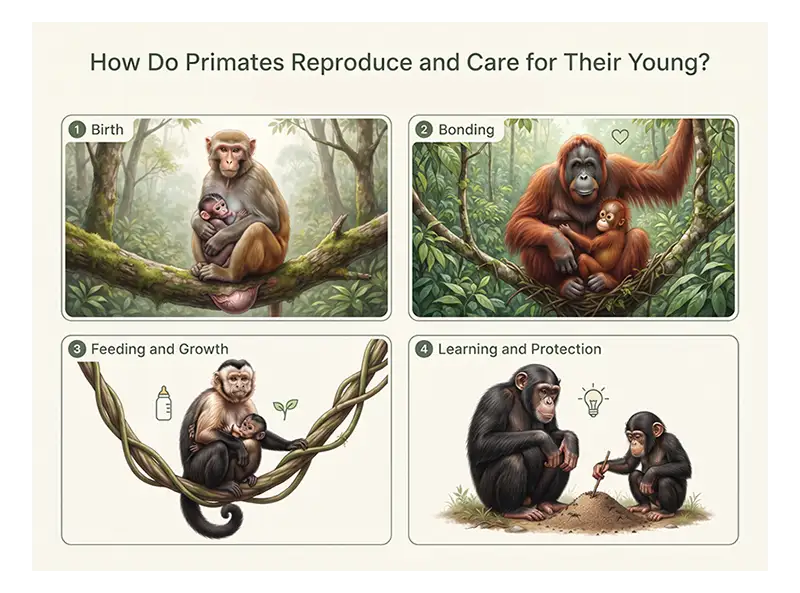
Primate reproduction varies among species in mating systems, pregnancy length, birth patterns, and parental care. These differences reflect body size, habitat, social structure, and the demands of raising young that often require substantial learning and development.
Mating systems
Some primates form relatively stable pairs, while others live in groups where individuals mate with multiple partners. Gibbons often form pair-living social units, whereas many monkey species have more complex mating arrangements.
In several species, competition for mates can influence body size, canine development, displays, and social behavior. However, mating systems are not fixed in every population, and social relationships do not always correspond directly to genetic parentage.
Pregnancy and birth
Most primates give birth to live young, as do other placental mammals. Pregnancy length differs considerably across the order, generally being longer in larger-bodied species than in many small primates.
Many species usually give birth to one infant at a time, although twins occur in some groups, particularly among marmosets and tamarins. The number of offspring and the time between births vary with the species and environmental conditions.
Parental care
Young primates often depend on adults for food, protection, warmth, and opportunities to learn. Mothers commonly provide the main care, but fathers and other group members may also contribute in some species.
In certain monkeys and apes, infants cling to their mothers as they move through trees. Other group members may carry, groom, protect, or interact with the young, giving them opportunities to develop social skills.
Growth and development
Primates generally have a prolonged period of development compared with many mammals of similar size. Young individuals must learn how to move efficiently, identify suitable foods, respond to danger, and navigate social relationships. The length of this period differs widely. Smaller species may mature relatively quickly, while great apes and humans have extended childhoods.
Long development can support complex learning, but it also means that young individuals may require sustained care. Successful reproduction depends on more than producing offspring. Access to suitable habitat, food, social stability, and protection from threats can all affect whether young primates survive to adulthood.
How Did Primates Evolve?
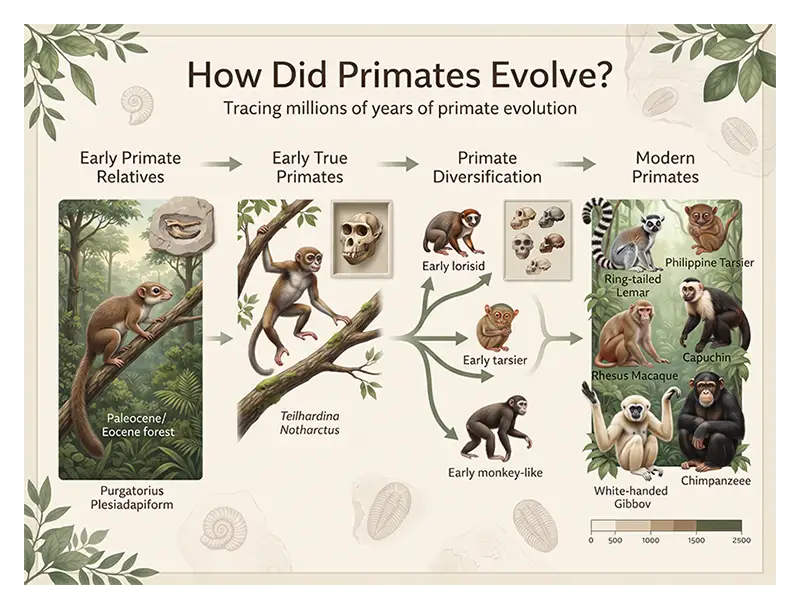
Primate evolution extends back more than 50 million years, although the precise origins and relationships of early primates remain subjects of scientific research. Their history is reconstructed using fossils, comparative anatomy, and genetic evidence.
Early primate evolution
After the extinction of the non-avian dinosaurs around 66 million years ago, mammals diversified into many ecological roles. Early primate relatives emerged during the following period, and primate-like mammals became increasingly diverse during the Paleocene and Eocene epochs.
Early forms developed combinations of grasping abilities, sensory adaptations, and limb structures that were useful for moving and feeding in wooded environments. Not all early relatives possessed the same features, and the evolutionary history was branching rather than a straight line.
Diversification into major groups
Over millions of years, primate lineages diversified into the groups represented today by lemurs, lorises, tarsiers, monkeys, and apes. Changes in geography and climate influenced where populations lived and how they evolved.
The ancestors of New World monkeys reached South America, while Old World monkeys and apes diversified in Africa and Asia. Madagascar's long isolation helped shape the distinctive evolutionary history of its lemurs.
Fossils provide evidence of extinct species and anatomical changes, while genetic comparisons help researchers infer relationships among living primates. Together, these methods reveal both shared ancestry and the many separate paths taken by different lineages.
The evolution of apes and humans
Humans are members of the ape family Hominidae, alongside orangutans, gorillas, chimpanzees, and bonobos. Humans did not evolve from any of these living species; instead, humans and other apes share ancestors that lived in the past.
The human lineage developed several distinctive traits, including habitual upright walking, changes in the structure of the hands and feet, increased brain size over evolutionary time, and increasingly complex forms of communication and culture.
Human evolution was not a simple march toward a predetermined goal. Several hominin species existed at different times, and many evolutionary branches eventually became extinct. Modern humans, Homo sapiens, are the only surviving species of the human genus.
Studying primate evolution helps scientists understand how anatomical traits, behavior, and environmental pressures change across generations. It also places humans within the broader history of mammalian life.
Why Are Primates Important to Ecosystems and Humans?
Primates contribute to ecosystem function and provide important opportunities for scientific research. Their effects vary according to species, diet, population density, and habitat, but several roles are particularly significant.
Seed dispersal and forest regeneration
Fruit-eating primates can help forests regenerate by moving seeds away from parent plants. After consuming fruit, they may deposit seeds in new locations, sometimes with nutrients that support germination.
This process can influence plant distribution and forest diversity. If primate populations decline, some plants may lose an important means of dispersal, although the effects depend on which other animals perform similar roles in that ecosystem.
Food webs and nutrient cycling
Primates form part of food webs as consumers of fruit, leaves, insects, and other organisms. They can also serve as prey for natural predators, particularly when young or vulnerable.
Their feeding and movement contribute to the transfer of energy and nutrients through ecosystems. By affecting seed availability and plant regeneration, some primates can also influence the structure of forest communities.
Scientific research
Primate studies help researchers investigate learning, memory, social relationships, communication, movement, and evolutionary biology. Comparisons among different species can reveal how similar challenges have led to different behavioral or anatomical adaptations.
Research on nonhuman primates can also contribute to understanding human biology and disease, although ethical standards, conservation concerns, and the availability of alternative methods are important considerations.
Cultural and educational significance
Primates appear in the traditions, stories, art, and everyday experiences of many human societies. They also attract public interest through wildlife documentaries, zoos, conservation programs, and scientific education.
Responsible public engagement can help people understand animal behavior and the importance of protecting natural habitats. However, close resemblance to humans should not be mistaken for a complete understanding of another species' needs or behavior.
Conservation challenges
Many primate species face serious threats, including deforestation, habitat fragmentation, hunting, illegal wildlife trade, disease, and climate change. Forest clearance for agriculture, roads, mining, and development can reduce the availability of food and safe movement routes.
Conservation measures include protecting habitats, restoring forest connections, enforcing wildlife laws, supporting local communities, and reducing demand for illegally traded animals. Research and long-term population monitoring help identify species at risk and evaluate whether protection measures are working.
Protecting primates is important both for the survival of individual species and for the ecosystems in which they play a role.
Conclusion
Primates are an important order of mammals distinguished by grasping abilities, flexible movement, well-developed sensory systems, and diverse forms of behavior. From lemurs and tarsiers to monkeys, apes, and humans, they occupy a wide range of habitats and have developed different strategies for finding food, raising young, and interacting with others.
Their evolutionary history provides insight into the development of mammalian anatomy, intelligence, and social life. In ecosystems, many primates help disperse seeds and contribute to food webs, while scientific research reveals more about their biology and relationships.
However, habitat loss, hunting, wildlife trafficking, and environmental change threaten many species. Protecting primates and their habitats is essential for conserving their evolutionary diversity and maintaining the ecosystems on which they depend.
FAQ's
Madame Berthe's mouse lemur (Microcebus berthae), native to Madagascar, is widely recognized as the smallest living primate species by body mass. Adults typically weigh around 30 grams, although individual weights vary.
Forward-facing eyes provide overlapping fields of vision, helping primates judge distances and perceive depth. This ability is particularly useful for climbing, leaping between branches, and handling food.
No. Although many primates are adapted to climbing, some spend considerable time on the ground. Baboons, for example, frequently travel and forage terrestrially, while humans are specialized for upright walking.
Scientists compare fossils, skeletal features, DNA, and other biological evidence to reconstruct evolutionary relationships. These methods help identify shared ancestors and explain how different primate lineages diverged over millions of years.
Many primates depend on specific forest habitats for food, shelter, and reproduction. Deforestation can fragment their populations, restrict movement, reduce food availability, and make animals more vulnerable to hunting and other human-related threats.