
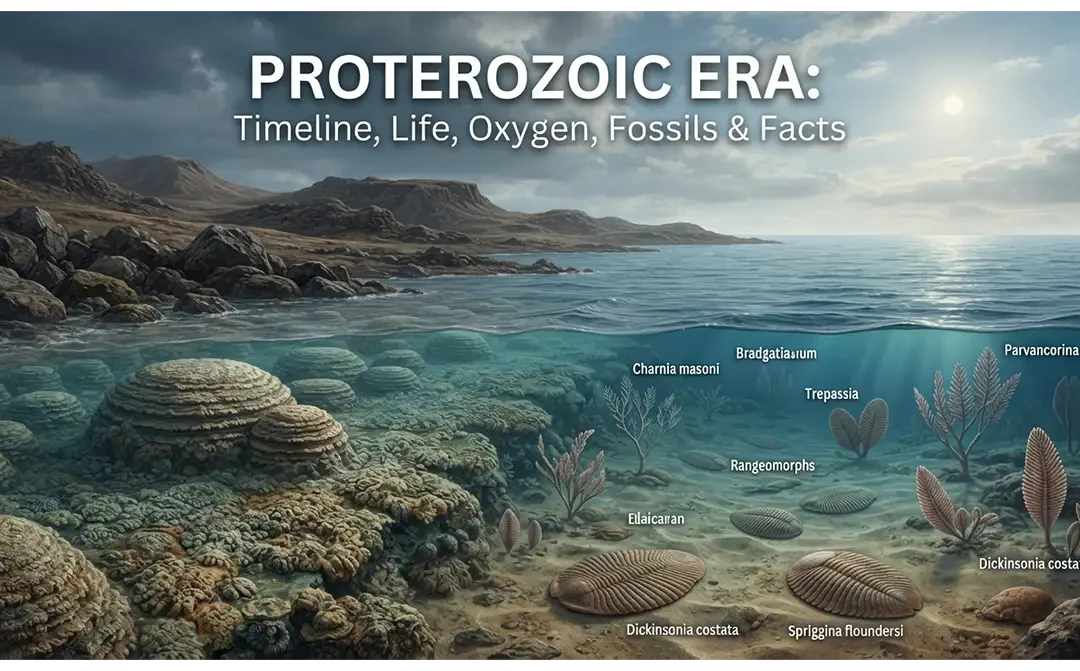
The Proterozoic Era was a major chapter in Earth's history when the atmosphere changed, continents developed, and life became increasingly complex. During this immense span of geological time, microscopic organisms transformed the planet, eukaryotic cells emerged, and early multicellular organisms appeared in the oceans.
Although the Proterozoic is commonly called an era, it is formally classified as an eon in the geological timescale. It lasted from approximately 2.5 billion to 538.8 million years ago, bridging the Archean Eon and the Phanerozoic Eon. Its history includes major changes in atmospheric oxygen, severe global glaciations, and biological developments that helped shape later ecosystems.
What Was the Proterozoic Era?
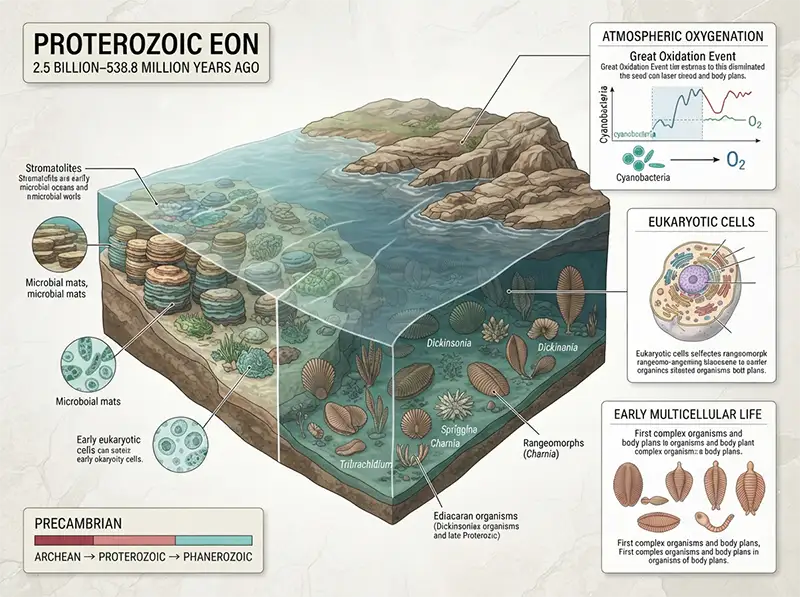
The Proterozoic was the final eon of the Precambrian, the broad span of Earth history before the Phanerozoic began. It followed the Archean, when the earliest known life had already developed, and preceded the interval famous for its abundant visible fossils.
Much of the Proterozoic world would have looked unfamiliar today. The atmosphere contained far less oxygen than it does now, oceans had different chemical conditions, and most organisms were microscopic. Over time, however, biological activity and geological processes changed these environments.
Several important developments defined this eon:
- Atmospheric oxygenation: Oxygen produced by photosynthetic microorganisms accumulated in the environment.
- Continental growth: Ancient landmasses joined, separated, and reorganized through plate tectonic activity.
- Cellular complexity: Eukaryotic organisms appeared and diversified.
- Multicellular life: Algae and other organisms developed bodies made of multiple cells.
- Major glaciations: Some intervals experienced exceptionally extensive ice cover.
- Macroscopic organisms: The late Proterozoic preserved diverse fossils of organisms visible to the naked eye.
These changes did not happen simultaneously. They unfolded across more than a billion years, with different regions experiencing different environmental conditions. The Proterozoic is therefore important not because of a single event, but because it records a long transition toward the biological and environmental systems that would characterize later Earth.
When Did the Proterozoic Era Begin and End?
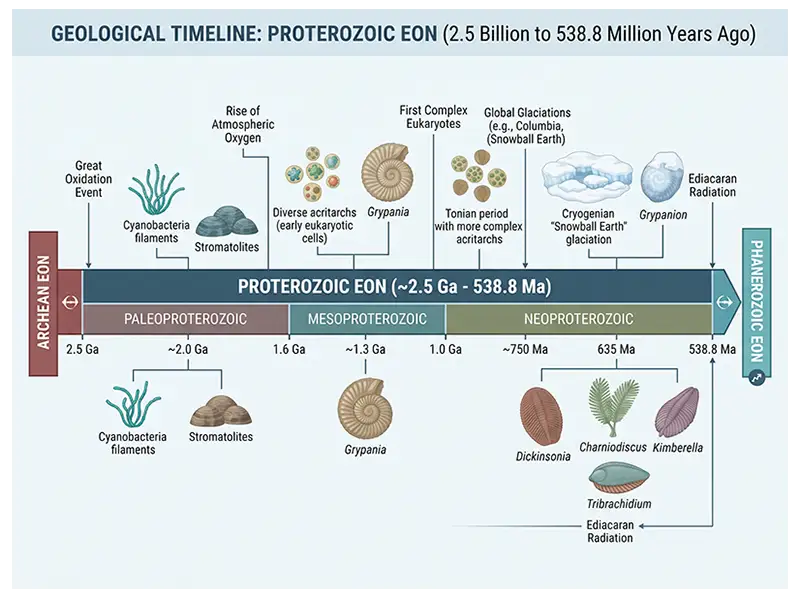
The Proterozoic Eon began approximately 2.5 billion years ago and ended about 538.8 million years ago. It lasted roughly 1.96 billion years, making it the longest eon in Earth's history.
Its boundaries mark major stages in geological time rather than sudden changes that occurred everywhere at once.
- Beginning — about 2.5 billion years ago: The Archean ended and the Proterozoic began, during a period of significant changes in Earth's surface environments and atmosphere.
- Middle — around 1.6 billion years ago: The Mesoproterozoic was underway, with evolving continental systems and a long history of eukaryotic development.
- Late stages — about 720–538.8 million years ago: The Neoproterozoic included severe glaciations, changing ocean chemistry, and the appearance of diverse macroscopic organisms.
- Ending — about 538.8 million years ago: The Proterozoic gave way to the Phanerozoic Eon, whose beginning is associated with the Cambrian Period.
The final boundary is especially significant because the Cambrian records a major expansion in the diversity of animal fossils. This transition was not the first appearance of life or even the first appearance of multicellular organisms. Instead, it marks a major change in the abundance and variety of preserved complex life.
What Are the Three Subdivisions of the Proterozoic?
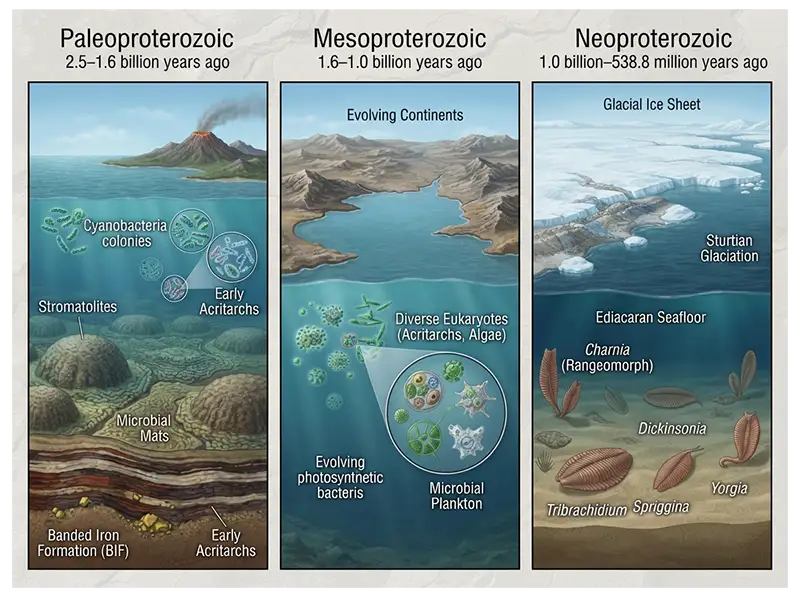
Geologists divide the Proterozoic into three eras based on major boundaries in Earth's geological record. Each subdivision represents a different stage in the development of continents, oceans, atmospheric conditions, and living organisms.
1. Paleoproterozoic Era
2.5–1.6 billion years ago, this interval witnessed the Great Oxidation Event, during which oxygen began accumulating more significantly in Earth's atmosphere. Iron-rich sedimentary deposits formed in many ancient marine environments, and early eukaryotic life emerged during the broader Proterozoic history.
2. Mesoproterozoic Era
1.6–1.0 billion years ago, continental regions continued to assemble and reorganize. Marine environments supported diverse microorganisms, including eukaryotes and algae. Some fossil evidence also indicates that multicellular eukaryotes existed during this interval, although their forms were generally unlike familiar modern animals.
3. Neoproterozoic Era
1.0 billion–538.8 million years ago, this final subdivision included the Cryogenian glaciations and the Ediacaran Period. Extensive ice sheets developed during some intervals, while later marine ecosystems contained a remarkable variety of large, soft-bodied organisms.
Together, these subdivisions provide a framework for understanding how Earth changed from a world dominated by microbial ecosystems to one that supported increasingly complex forms of life.
What Was Earth Like During the Proterozoic?
Earth's surface underwent major geological changes throughout the Proterozoic. Continents grew through the addition of crustal material, while plate tectonics moved existing landmasses into new arrangements. Some continental blocks collided to form larger landmasses; others later separated.
Supercontinents were an important feature of this history. Columbia, also called Nuna, assembled during the early to middle Proterozoic, although the timing and configuration remain subjects of scientific research. Rodinia formed later, mainly during the Mesoproterozoic to early Neoproterozoic, before breaking apart.
These changes affected the physical environment in several ways:
- Mountain building: Continental collisions raised mountain ranges and created new geological structures.
- Ocean development: Changing coastlines and seafloors influenced marine habitats and sediment deposition.
- Volcanic activity: Eruptions released gases and produced new rocks, affecting local and global environments.
- Sedimentary deposits: Rivers, shallow seas, and chemical reactions preserved layers that now help scientists reconstruct ancient conditions.
The oceans were particularly important because they hosted most known life during this eon. Their chemistry differed from modern seawater, with oxygen availability varying between surface waters, deeper regions, and different geological periods.
The Proterozoic atmosphere also evolved substantially, but oxygen did not rise steadily or uniformly. Its concentration remained much lower than today's level for much of the eon, despite significant changes during particular intervals.
How Did the Great Oxidation Event Change Earth?
The Great Oxidation Event, commonly abbreviated as GOE, was a major environmental transition that began around 2.4 billion years ago. It involved a sustained increase in atmospheric oxygen after photosynthetic microorganisms had produced oxygen for a long period.
Certain bacteria, especially cyanobacteria, perform oxygen-producing photosynthesis. They use sunlight to convert carbon dioxide and water into organic matter, releasing oxygen as a by-product. Initially, much of this oxygen reacted with substances in the oceans and Earth's crust rather than accumulating freely in the atmosphere.
One important consequence was the formation of banded iron formations. These distinctive rocks contain alternating iron-rich and silica-rich layers, recording chemical changes in ancient marine environments. Although their formation involved complex processes, reactions between dissolved iron and oxygen played a major role in many deposits.
The Great Oxidation Event had several long-term effects:
- Atmospheric chemistry changed: Oxygen became a more persistent component of the air.
- Anaerobic organisms faced new conditions: Oxygen was toxic to many organisms adapted to oxygen-free environments, although anaerobic life continued to survive in suitable habitats.
- New metabolic opportunities developed: Oxygen-based respiration eventually supported highly efficient energy production in many organisms.
- Surface minerals changed: Oxidation influenced the formation and preservation of iron-rich rocks and other mineral deposits.
The event did not immediately create a modern oxygen-rich atmosphere. Oxygen levels fluctuated, and substantial increases occurred at different times afterward. Nevertheless, the Great Oxidation Event transformed Earth's surface chemistry and established conditions that influenced subsequent biological evolution.
What Types of Life Existed During the Proterozoic?
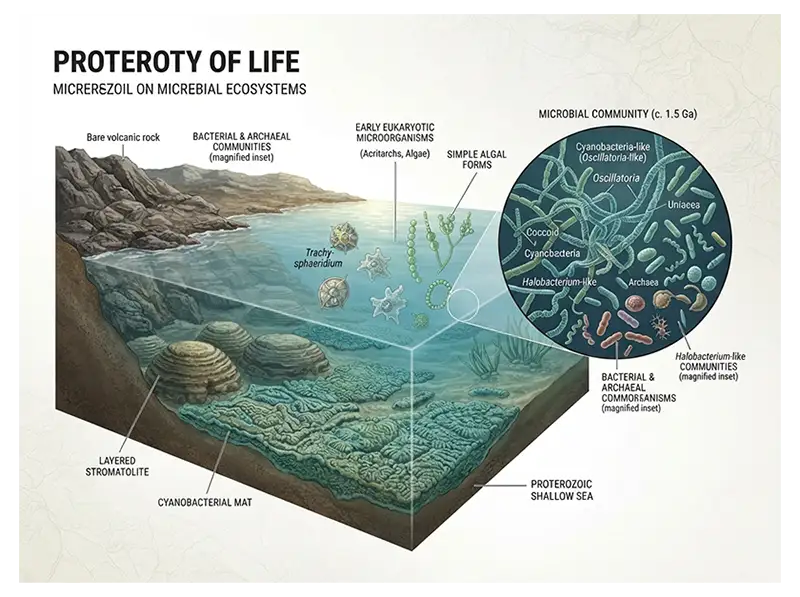
Microorganisms dominated Proterozoic ecosystems, inhabiting oceans, sediments, and other environments where water and nutrients were available. Bacteria and archaea occupied diverse ecological roles, from producing organic matter to breaking down compounds and recycling nutrients.
Cyanobacteria were especially influential because their photosynthesis released oxygen. Many lived in microbial communities, sometimes forming layered structures known as stromatolites. These structures developed as microbes trapped sediment, bound particles together, or promoted mineral precipitation.
Other important groups included:
- Bacteria: Highly diverse microorganisms involved in photosynthesis, decomposition, and chemical transformations.
- Archaea: Single-celled organisms with distinctive molecular and biochemical features, many adapted to particular chemical environments.
- Early eukaryotes: Cells containing nuclei and other internal structures, including forms related to algae and other microbial groups.
- Algae: Photosynthetic eukaryotes that contributed to marine food webs and, in some lineages, developed multicellular bodies.
- Early macroscopic organisms: Particularly during the late Proterozoic, larger organisms appeared in marine settings, including the diverse Ediacaran biota.
Not every organism from this eon can be assigned confidently to a modern group. Some fossils preserve only cell shapes, chemical traces, or impressions, leaving scientists to investigate their biological relationships.
The important change was the growing diversity of cellular organization and ecological roles. Microbial communities remained widespread, but the biological world was no longer limited to simple single-celled life.
How Did Eukaryotic Cells Evolve?
Eukaryotic cells contain a nucleus that houses most of their genetic material, along with specialized internal structures called organelles. They differ from bacteria and archaea, which lack a nucleus enclosed by a membrane.
The origin of eukaryotes was one of the most consequential developments in early biological history. Fossil evidence indicates that eukaryotic organisms existed during the Proterozoic, although the exact timing of their origin remains uncertain.
Scientists explain a key part of this development through the endosymbiotic theory. According to this theory, an ancestral cell formed a lasting relationship with bacteria that eventually became mitochondria, the organelles responsible for much of a cell's energy production.
A later endosymbiotic event gave rise to chloroplasts in the ancestors of photosynthetic eukaryotes. These organelles enabled cells to capture sunlight and produce organic compounds through photosynthesis.
Several lines of evidence support endosymbiosis:
- Mitochondria and chloroplasts contain their own DNA.
- Both organelles have bacterial-like ribosomes.
- They reproduce by dividing within cells.
- Their genetic relationships connect mitochondria to bacteria and chloroplasts to photosynthetic bacteria.
Eukaryotic cells eventually gave rise to diverse lineages, including animals, fungi, plants, and numerous groups of protists. However, these groups did not all originate at the same time, and their evolutionary relationships developed through branching processes rather than a single progression.
How Did Multicellular Life Develop?
Multicellular life developed when cells formed organisms in which multiple cells worked together. This required more than simply living in a cluster: in many lineages, cells became coordinated, communicated, and performed different functions.
Evidence for multicellular eukaryotes appears well before the end of the Proterozoic. Some ancient fossils represent filamentous algae or other organisms with organized cellular structures. Their precise relationships to living groups are not always clear, but they demonstrate that complex cellular arrangements evolved gradually.
During the Neoproterozoic, particularly the Ediacaran Period (approximately 635–538.8 million years ago), marine environments contained an unusual range of macroscopic organisms. Many had soft bodies and are preserved as impressions in sedimentary rocks.
The Ediacaran biota included forms such as Dickinsonia, with its distinctive segmented appearance, and rangeomorphs, whose branching structures differed greatly from most familiar animals. Some organisms may represent early animals, while others have uncertain evolutionary positions.
Multicellularity evolved independently in several branches of life, rather than appearing just once. Its advantages could include larger body size, division of labor, and the ability to exploit different food sources or environmental conditions.
By the end of the Proterozoic, life included organisms far more complex than the earliest microbial communities. This development helped establish the biological context for the greater diversity of animal fossils seen during the Cambrian.
What Caused the Major Proterozoic Glaciations?
The Neoproterozoic included some of the most extreme glaciations known from Earth's geological record. During the Cryogenian Period, approximately 720–635 million years ago, at least two major glacial episodes occurred: the Sturtian and Marinoan glaciations.
These events are often discussed in connection with the Snowball Earth hypothesis, which proposes that ice may have extended across much or nearly all of the planet's surface during the most severe episodes. The precise extent of ice cover remains debated, and scientific models include different versions of the hypothesis.
Several factors may have contributed to these glaciations:
- Greenhouse gas changes: Lower atmospheric carbon dioxide could have reduced the amount of heat retained by the planet.
- Continental positions: The arrangement of landmasses, including areas at low latitudes, may have influenced weathering and climate.
- Ice-albedo feedback: Expanding ice reflects more sunlight, which can cause additional cooling and further ice growth.
- Volcanic carbon dioxide: Volcanic emissions could eventually have helped warm the planet after long periods of ice cover.
Geologists identify ancient glaciations through deposits such as tillites, which form from glacial sediment, and other rocks associated with ice-related processes. Some glacial deposits occur alongside sedimentary layers that suggest ice reached low latitudes.
After major glacial episodes, Earth's climate warmed and ice retreated. These transitions may have altered ocean chemistry and nutrient availability, although their precise effects on biological evolution remain an active area of research.
The Cryogenian glaciations were important environmental events, but they should not be treated as a single cause of complex life. Biological evolution involved many interacting factors over long periods.
What Do Proterozoic Fossils Reveal About Early Life?
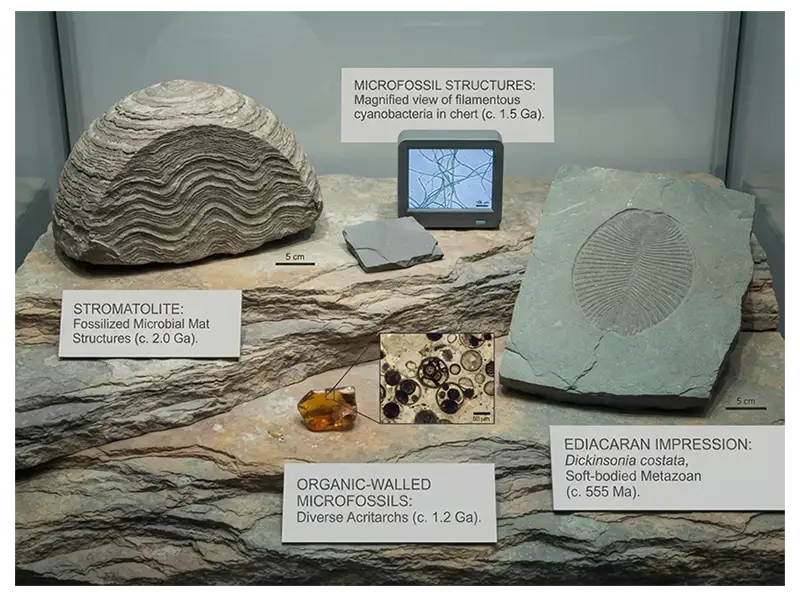
Proterozoic fossils preserve evidence of organisms and environmental processes that are rarely visible in the fossil record of later geological intervals. Because many early organisms were microscopic or soft-bodied, their remains are often more difficult to identify than the hard shells and bones common in younger rocks.
Important fossil types include:
- Stromatolites: Layered structures formed through microbial activity, sediment trapping, and mineral precipitation. They provide evidence of ancient microbial ecosystems, although not every layered structure is biological.
- Microfossils: Preserved microscopic cells and cell-like structures that help scientists investigate early organisms. Identifying their biological origins can require careful analysis.
- Organic-walled fossils: Carbon-rich remains of microscopic organisms, including some eukaryotes, preserved in sedimentary rocks.
- Ediacaran body fossils: Impressions and other remains of large, often soft-bodied organisms from late Proterozoic seas.
- Chemical evidence: Molecular signatures and mineral patterns that can reveal ancient biological activity, even when recognizable body fossils are absent.
Scientists study these remains using microscopy, rock chemistry, radiometric dating, and comparisons with living organisms. No single clue always provides a complete answer, so conclusions often rely on several independent lines of evidence.
Fossils also help reconstruct ancient habitats. For example, stromatolites indicate microbial activity in particular environments, while Ediacaran impressions reveal that large organisms lived on or near the seafloor before the Cambrian began.
The fossil record is incomplete, but Proterozoic rocks show that biological complexity emerged long before the abundance of animal fossils characteristic of the Cambrian.
What Happened at the End of the Proterozoic, and Why Is It Important?
The Proterozoic ended approximately 538.8 million years ago, when the Phanerozoic Eon began. This boundary falls near the transition from the Ediacaran Period to the Cambrian Period.
Late Proterozoic ecosystems were already diverse. The Ediacaran Period contained many large, soft-bodied organisms, and some animals or their close relatives had appeared before the Cambrian. The beginning of the Phanerozoic therefore did not mark the first appearance of complex life; instead, it marks a major change in the geological record and the start of an interval with increasingly abundant animal fossils.
Several developments helped establish the conditions for later diversification:
- Changing ocean chemistry: Variations in oxygen and nutrient availability influenced marine environments, although conditions differed between locations.
- Evolving ecological relationships: Organisms increasingly interacted through feeding, competition, and other ecological processes.
- New body forms: The late Ediacaran and early Cambrian record shows increasing variety in organism structure and ways of life.
- Improved fossil visibility: The expansion of organisms with preservable hard parts during the Cambrian made many groups easier to recognize in rocks.
The Proterozoic is important because it provides the geological and biological background for much of the life that followed. Its atmospheric transformations, cellular innovations, and changing ecosystems influenced the opportunities available to later organisms.
Its legacy extends beyond paleontology. Proterozoic rocks preserve evidence of ancient continental assembly, early atmospheric oxygenation, major glaciations, and chemical changes that continue to inform research into Earth's evolution.
Conclusion
The Proterozoic Eon represents a fundamental stage in Earth's transformation. Its long history included the accumulation of atmospheric oxygen, the emergence of eukaryotic cells, the development of multicellular organisms, and severe glacial episodes that reshaped the planet's environments.
Although much of its life was microscopic, its geological record reveals increasingly complex biological systems and changing relationships between organisms and their surroundings. The Proterozoic ultimately established an important foundation for the diverse ecosystems that became more visible in the Cambrian fossil record.
Understanding this eon helps explain how Earth evolved from a world dominated by microbial communities into a planet capable of supporting a much wider range of complex life.
The Proterozoic Eon lasted approximately 1.96 billion years, from about 2.5 billion to 538.8 million years ago.
It is formally an eon. The familiar phrase “Proterozoic Era” is often used informally, but the geological timescale places the Proterozoic above its three subdivisions: the Paleoproterozoic, Mesoproterozoic, and Neoproterozoic eras.
Evidence of possible early animals occurs in the late Proterozoic, particularly during the Ediacaran Period. Many Ediacaran organisms have uncertain relationships to living animals, so not every fossil can be classified confidently.
It was a major increase in atmospheric oxygen beginning around 2.4 billion years ago. Oxygen-producing photosynthesis and reactions involving Earth's surface materials played important roles in this transition.
Snowball Earth is a hypothesis proposing that extreme global glaciations may have covered much or nearly all of Earth's surface with ice. The Neoproterozoic includes strong geological evidence for severe glaciation, although the exact extent of ice remains debated.