
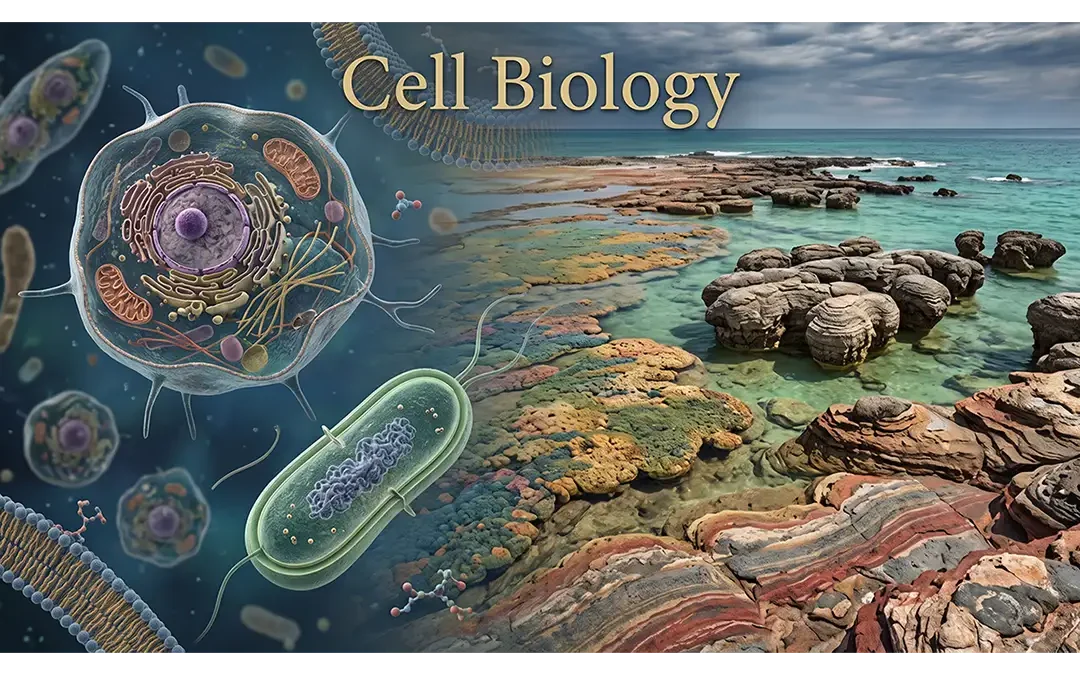
Cell Biology is the study of cells, their structures, functions, genetic information, and interactions with their surroundings. Cells are the fundamental units of life, and understanding them helps scientists explain how organisms grow, reproduce, adapt, and evolve.
Cell biology is also important beyond modern organisms. Evidence from ancient microorganisms, microfossils, stromatolites, and chemical signatures preserved in rocks provides clues about the earliest stages of life on Earth. By combining cellular biology with paleontology and Earth science, researchers can investigate how life developed and influenced the planet over billions of years.
What Is Cell Biology?
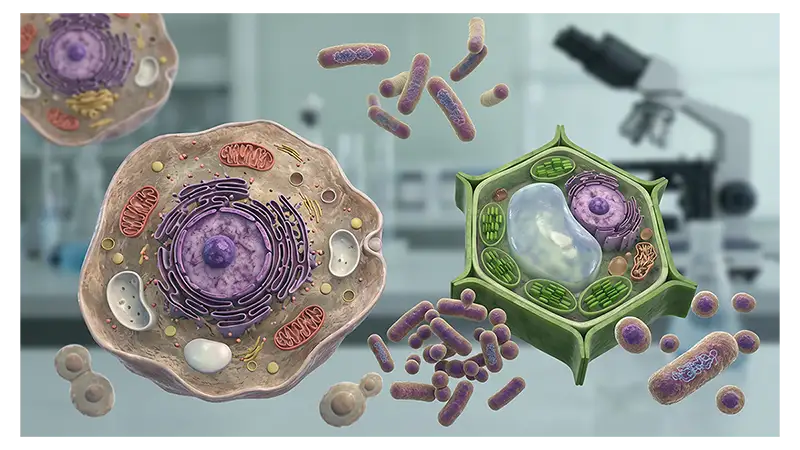
Cell biology is the branch of biology that examines cells and the processes that occur within them. It covers everything from the molecular components inside a cell to the ways cells interact with other cells and their environment.
A cell contains organized structures that work together to maintain life. These structures allow cells to obtain materials, produce energy, build proteins, store genetic information, remove waste, and respond to changes around them.
Cell biology can be studied at several levels:
- Cell structure: Examines the physical organization of cells and their internal components.
- Cellular processes: Investigates activities such as metabolism, transport, growth, and division.
- Genetic activity: Studies how DNA stores and transmits biological information.
- Cell communication: Explores how cells receive and respond to signals.
- Cell evolution: Investigates how cellular systems changed through Earth's history.
The subject connects with many other scientific fields. Genetics helps explain how cellular information is inherited, while biochemistry examines the chemical reactions that keep cells functioning. Evolutionary biology uses cellular and molecular evidence to investigate relationships among organisms. Paleontology adds evidence from ancient life preserved in rocks and fossils.
This makes cell biology particularly useful for understanding the history of life on Earth.
How Are Cells Organized?
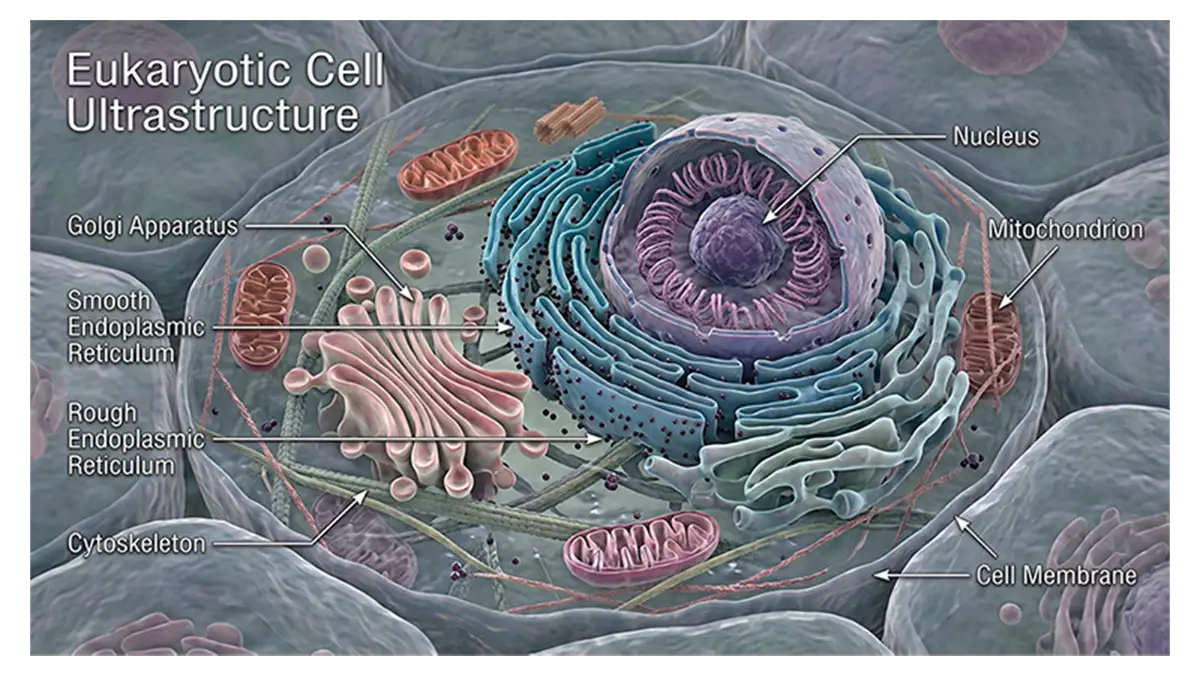
Although cells vary greatly in size, shape, and complexity, they share several basic components. These components create an organized system that separates the cell from its surroundings and allows its internal processes to operate.
Cell Membrane
The cell membrane forms the outer boundary of every cell. It separates the internal environment from the surrounding environment while controlling the movement of many substances into and out of the cell.
The membrane is mainly composed of lipids and proteins. Some membrane proteins transport substances, while others receive signals or help cells interact with neighboring cells.
Cytoplasm
The cytoplasm is the internal region where many cellular activities occur. It contains the cytosol, along with structures and molecules involved in metabolism, transport, and other processes.
Genetic Material
DNA contains the hereditary information used by cells to build proteins and regulate biological activities. In prokaryotic cells, the main DNA molecule is located in a region called the nucleoid. In eukaryotic cells, most DNA is enclosed within the nucleus.
Cellular Compartments
Eukaryotic cells contain membrane-bound compartments called organelles. These compartments allow different chemical activities to occur in specialized locations.
This organization creates an important distinction between the two major cellular categories:
- Prokaryotic cells generally lack a membrane-bound nucleus.
- Eukaryotic cells contain a nucleus and several specialized membrane-bound organelles.
Despite these differences, both types maintain organized internal systems that support life.
What Are the Main Types of Cells?
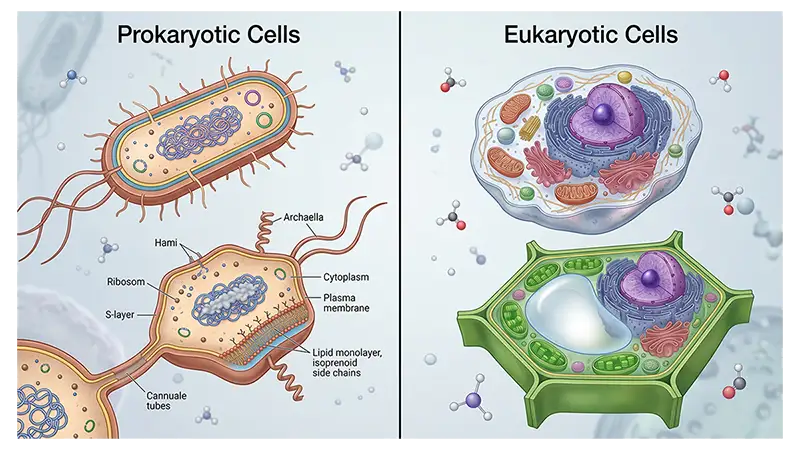
Cells are commonly divided into prokaryotic and eukaryotic cells. This distinction is based mainly on their internal organization.
Prokaryotic Cells
Prokaryotic cells include bacteria and archaea. They are generally smaller and have a simpler internal organization than eukaryotic cells.
Their DNA is not enclosed within a membrane-bound nucleus. Instead, it occupies a region of the cell called the nucleoid.
Prokaryotic cells can also contain structures such as:
- Cell membranes
- Ribosomes
- Cell walls
- Circular DNA molecules
- Flagella in some species
- Protective capsules in some organisms
Their relatively simple organization does not mean they are biologically unimportant. Prokaryotes perform essential roles in ecosystems and have existed for an extremely long period of Earth's history.
Eukaryotic Cells
Eukaryotic cells occur in animals, plants, fungi, and many other organisms. They have a nucleus surrounded by a membrane and contain specialized organelles.
Animal and plant cells share many structures but also have important differences.
| Feature | Prokaryotic Cells | Eukaryotic Cells |
|---|---|---|
| Nucleus | Absent | Present |
| Internal membrane-bound organelles | Generally absent | Present |
| Typical size | Smaller | Larger |
| DNA organization | Usually circular chromosome | Multiple linear chromosomes |
| Examples | Bacteria and archaea | Animals, plants, fungi, many protists |
Plant cells have additional structures such as chloroplasts, which perform photosynthesis, and a cell wall that provides structural support.
Animal cells lack chloroplasts and cell walls but contain specialized structures suited to their particular functions.
What Do Cells Do to Support Life?
Cells are active systems rather than static structures. They continuously perform chemical and physical processes that allow organisms to survive.
One major activity is metabolism, which includes the chemical reactions involved in obtaining, transforming, and using energy and materials.
Cells also perform several other essential functions:
- Energy use: Cells convert available energy into forms that can power biological processes.
- Nutrient processing: Cells take in materials and transform them into useful molecules.
- Protein production: Cells manufacture proteins needed for structure, transport, chemical reactions, and regulation.
- Waste removal: Unwanted substances are processed or transported away from the cell.
- Growth: Cells produce additional materials and increase in size before dividing or performing specialized functions.
- Environmental response: Cells detect changes and adjust their activities accordingly.
- Internal regulation: Cells maintain conditions that allow their chemical reactions to function properly.
Different cells specialize in different tasks. For example, muscle cells are adapted for contraction, nerve cells transmit signals, and photosynthetic cells capture light energy.
In multicellular organisms, this specialization allows many different cell types to work together as tissues and organs.
How Do Cells Preserve and Pass On Genetic Information?
DNA is the main molecule responsible for storing hereditary information in cellular life. Its sequence contains instructions that influence how cells build molecules and regulate their activities.
Before many cells divide, their DNA must be copied. This process is called DNA replication. Accurate replication allows daughter cells to receive genetic information from the original cell.
DNA also provides information used to produce RNA and proteins. Proteins perform a huge variety of cellular functions, including catalyzing chemical reactions, forming structures, transporting substances, and transmitting signals.
Cell Division
Cell division allows genetic information to be passed into new cells.
Mitosis generally produces two daughter cells with genetic information closely matching that of the parent cell. It is important for growth, tissue maintenance, and many forms of asexual reproduction.
Meiosis is associated with the production of reproductive cells in organisms that reproduce sexually. It reduces chromosome number and creates genetic variation through processes such as recombination and the independent assortment of chromosomes.
Genetic information is not always copied perfectly. Mutations can change DNA sequences. Some have little or no effect, while others can influence biological traits. Over many generations, inherited genetic variation provides material on which evolutionary processes can act.
This connection between DNA, variation, inheritance, and natural selection is one reason cell biology is essential to understanding evolution.
How Did Cells Evolve on Early Earth?
The earliest history of cells is closely connected to the history of life itself. Earth formed about 4.54 billion years ago, while the geological record provides evidence that life existed by at least the early part of the Archean Eon.
The exact pathway by which the first living cells arose remains an active scientific question. Scientists investigate this problem using evidence from geology, chemistry, biology, and laboratory experiments.
Early Cellular Life
The earliest organisms were microscopic. Evidence for ancient microbial activity comes from structures and chemical signatures preserved in some very old rocks.
Early cellular organisms were much simpler than most modern eukaryotic cells. Prokaryote-like organisms dominated the early history of life, and microorganisms played important roles in Earth's developing ecosystems.
Evolution of Complex Cells
A major transition occurred with the emergence of eukaryotic cells. These cells contain a nucleus and specialized internal compartments.
One leading explanation for the origin of some eukaryotic organelles is the endosymbiotic theory. According to this theory, mitochondria originated from bacteria that became permanently associated with an ancestral host cell. Chloroplasts are also thought to have evolved through an endosymbiotic relationship involving photosynthetic bacteria.
Evidence supporting this idea includes the presence of their own DNA, bacterial-like ribosomes, and other characteristics shared with bacteria.
Later, some eukaryotic organisms evolved multicellularity and increasingly specialized cells. These developments eventually contributed to the extraordinary diversity of plants, animals, fungi, and other complex organisms.
The evolution of cells therefore represents a series of major biological transitions rather than a simple progression from a single primitive cell to modern organisms.
What Can Fossils Reveal About Ancient Cells?
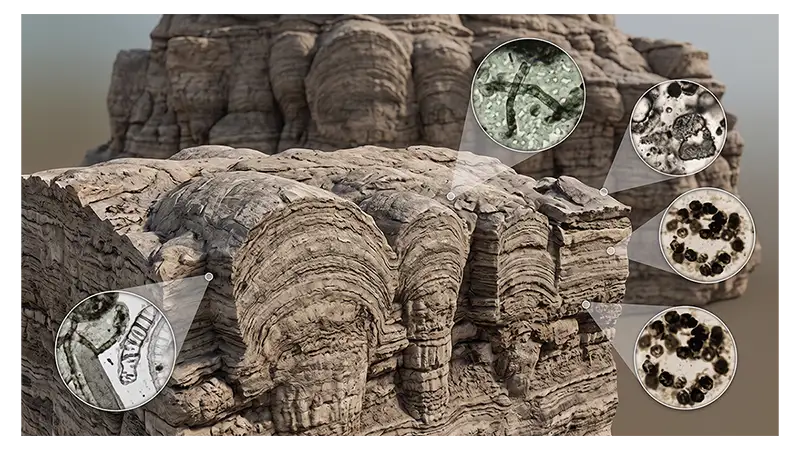
Most individual ancient cells are extremely small and delicate, so they are rarely preserved in recognizable form. Nevertheless, some rocks contain evidence of ancient microorganisms and their activities.
Microfossils
Microfossils are microscopic structures preserved in geological materials. Some are interpreted as remains or traces of ancient microorganisms.
Scientists examine their shape, size, distribution, and geological setting. Because similar structures can sometimes form through non-biological processes, identifying an ancient structure as a true fossil requires careful investigation.
Stromatolites
Stromatolites are layered structures produced through the activities of microbial communities, often involving microorganisms that trap, bind, or promote the precipitation of sediments.
Ancient stromatolites are important geological evidence because they demonstrate that microbial communities influenced sediment formation and environments in the distant past.
Chemical Evidence
Ancient rocks can also preserve chemical signatures associated with biological activity. Isotopic patterns and organic compounds may provide additional clues about ancient life.
Scientists rarely rely on a single observation when evaluating evidence for early life. They compare fossil structures, sedimentary environments, mineral composition, geochemical signals, and other lines of evidence.
This approach is particularly important because distinguishing biological structures from unusual mineral formations can be difficult.
How Did Cellular Life Change Earth?
Life has not simply adapted to Earth's environment; living organisms have also changed the planet.
One of the most significant examples involves photosynthesis. Certain microorganisms evolved the ability to use light energy to produce organic matter and release oxygen as a byproduct.
Over geological time, oxygen produced by photosynthetic organisms accumulated in Earth's environments. The Great Oxidation Event, beginning around 2.4 billion years ago, represents a major increase in atmospheric oxygen, although oxygen levels changed over a much longer and more complex history.
Oxygen transformed Earth's chemistry and created opportunities for organisms capable of using aerobic respiration.
Microorganisms also influence major biogeochemical cycles.
Carbon Cycle
Cells take up, transform, and release carbon through processes such as photosynthesis, respiration, decomposition, and other forms of metabolism.
Nitrogen Cycle
Microorganisms perform several transformations that make nitrogen available in different chemical forms. These processes are essential to ecosystems and influence the availability of nutrients.
Sulfur and Other Elements
Microbial activity also affects sulfur, iron, and other elements in sediments and water.
Because of these activities, microscopic life has played a major role in shaping Earth's atmosphere, oceans, sediments, and chemical cycles. Studying ancient cellular life therefore helps Earth scientists understand how biological activity interacted with geological processes.
Why Is Cell Biology Important to Paleontology and Earth Science?
Cell biology provides tools for understanding life across enormous spans of geological time. While paleontology often focuses on visible fossils such as bones, shells, leaves, and footprints, the history of life also extends into the microscopic world.
For paleontology, cellular research helps scientists:
- Investigate the earliest evidence of life.
- Interpret microbial fossils and stromatolites.
- Understand how complex organisms evolved.
- Compare living organisms with ancient forms.
- Examine evolutionary relationships using molecular evidence.
- Reconstruct biological changes through geological time.
Cell biology is equally valuable in Earth science because microorganisms have influenced sediments, minerals, atmospheric chemistry, and nutrient cycles.
It can also help explain major transitions in Earth's history. The evolution of photosynthetic microorganisms, for example, contributed to changes in atmospheric chemistry that affected later forms of life.
Modern molecular biology adds another source of evidence. DNA and protein comparisons can reveal relationships among living organisms and help scientists test evolutionary hypotheses that complement the fossil record.
Together, cell biology, paleontology, geology, and evolutionary science provide a broader picture of how life developed and interacted with Earth.
Conclusion
Cell biology reveals how the smallest units of life can influence the development of entire ecosystems and even the planet itself. The organization of cells, the storage of genetic information, cellular metabolism, and reproduction explain how living systems operate, while cellular evolution helps trace major transitions in the history of life.
For paleontology and Earth science, the microscopic world is especially valuable. Microfossils, stromatolites, and geochemical evidence preserve clues about ancient organisms and their environments. Studying these records alongside modern cellular and molecular biology allows scientists to connect ancient life, biological evolution, and Earth's changing environment across billions of years.
Cells are the fundamental units of life. They perform the processes necessary for organisms to survive, grow, reproduce, and respond to their environments.
The exact origin of the first cells is not fully known. Scientists study ancient rocks, chemistry, molecular biology, and experimental models to investigate possible pathways for the emergence of early life.
Fossils and geological structures can provide evidence about ancient microbial communities, their environments, and their effects on sediments and Earth's chemistry.
Endosymbiotic theory proposes that mitochondria and chloroplasts originated from bacterial cells that became permanent partners inside ancestral eukaryotic cells.
Microorganisms influenced Earth's atmosphere, oceans, sediments, and chemical cycles. Photosynthetic organisms were especially important in the long-term rise of oxygen.