
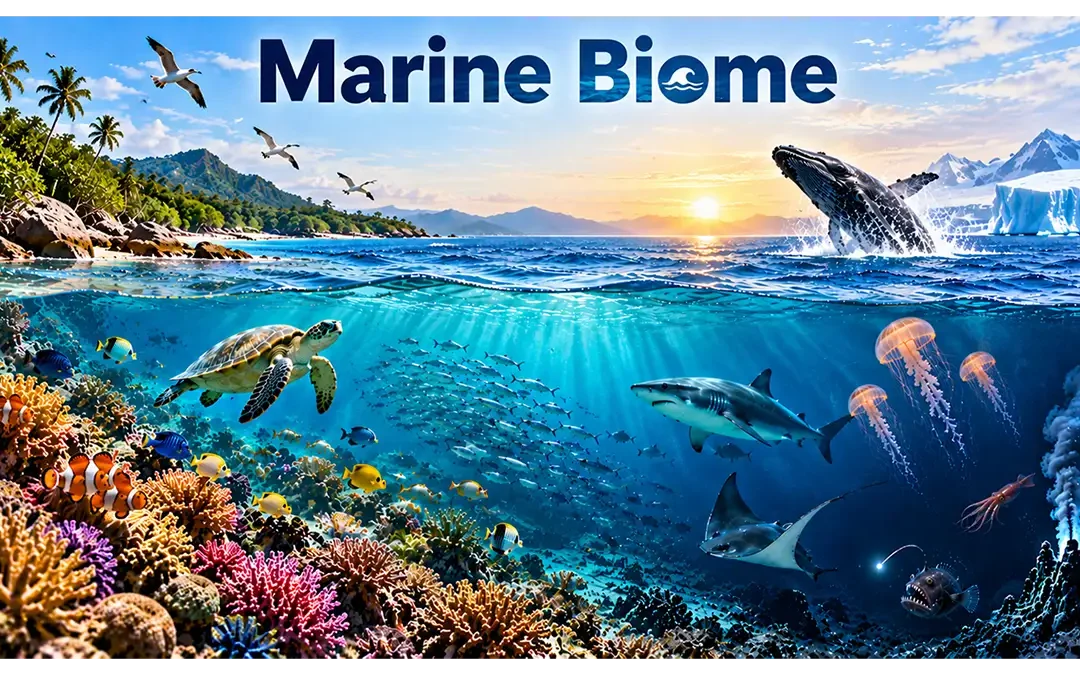
Marine Biome is the largest biome on Earth, covering most of the planet’s surface and supporting an extraordinary range of organisms. It includes the vast open ocean as well as coastal environments such as coral reefs, estuaries, mangroves, salt marshes, and tidal shores. Conditions vary greatly from warm, sunlit tropical waters to freezing polar seas and dark, high-pressure environments thousands of meters below the surface.
Marine environments also play major roles in Earth's climate, carbon cycle, nutrient movement, and food systems. Understanding the marine biome therefore means looking at both its physical environments and the organisms that depend on them.
What Is a Marine Biome?
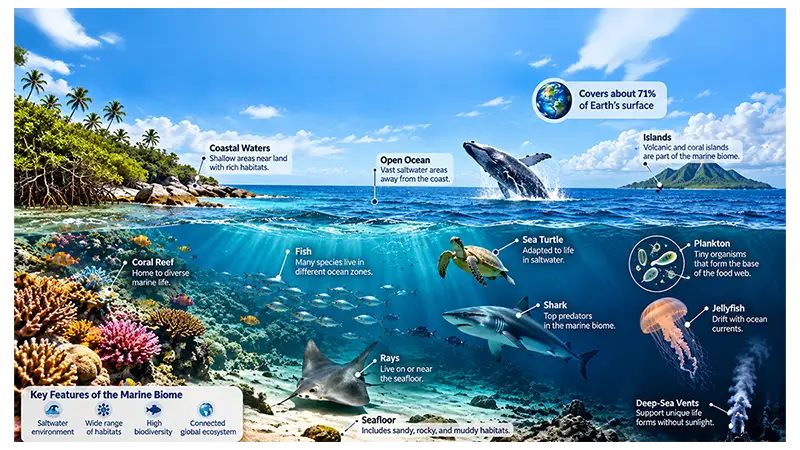
A marine biome is a broad ecological region dominated by saltwater and shaped by the physical, chemical, and biological conditions of the ocean. Unlike a terrestrial biome, which is primarily defined by land-based climate and vegetation, a marine biome is strongly influenced by factors such as salinity, water temperature, depth, light penetration, currents, tides, and pressure.
The marine biome is not a single uniform habitat. It contains many interconnected environments with very different conditions. A shallow tropical reef can receive abundant sunlight and support dense communities of organisms, while a deep-ocean floor may be permanently dark and experience extremely high pressure.
Marine ecosystems can also occur where seawater interacts with land or freshwater. Estuaries, for example, develop where rivers meet the sea, creating areas in which salinity changes with tides and freshwater flow. Coastal wetlands and mangrove systems have their own distinctive environmental conditions while remaining part of the broader marine realm.
One important feature of the marine biome is its connectivity. Water movement transports heat, dissolved substances, nutrients, and organisms between different parts of the ocean. Because of this connection, changes in one marine region can sometimes influence ecological processes far beyond the original location.
The marine biome also contains organisms ranging from microscopic plankton to enormous whales. Some species spend their entire lives in the water, while others depend on marine environments for feeding, reproduction, or shelter.
Where Is the Marine Biome Found?
The marine biome occurs across the world's oceans, seas, and coastal saltwater environments. It extends from shallow water along continental margins to remote areas of the open ocean and reaches down into the deepest ocean trenches.
Its geographic distribution is global rather than limited to particular continents. Marine environments occur around tropical islands, temperate coastlines, polar regions, and isolated oceanic areas. However, the conditions within these locations can be dramatically different.
Near the equator, seawater generally receives strong solar heating throughout the year. Tropical waters support ecosystems such as coral reefs where temperature, sunlight, and water chemistry are suitable. At high latitudes, seasonal sea ice, low temperatures, and changing daylight create very different ecological conditions.
Coastal areas form another important part of the marine biome. They are often highly productive because nutrients from rivers, land runoff, tides, and ocean currents can become concentrated in relatively shallow waters. These areas include beaches, rocky shores, mudflats, tidal wetlands, estuaries, and mangrove forests.
The continental shelf is particularly important because it consists of relatively shallow seabed extending outward from continents. Sunlight can reach much of this region, allowing productive biological communities to develop. Many commercially important fisheries are associated with continental shelf environments.
Farther offshore, the open ocean covers enormous areas with fewer physical boundaries. Although some regions may appear biologically empty from the surface, microscopic organisms and animals occupy different depths throughout the water column.
What Are the Main Types of Marine Biomes?
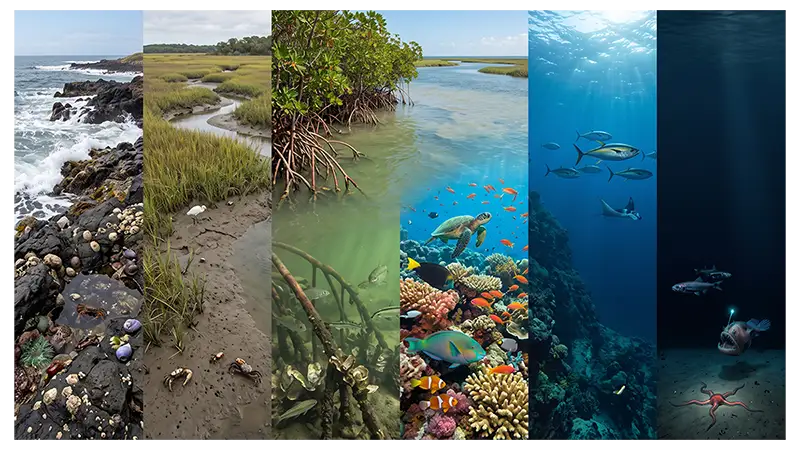
The marine biome contains several distinct environments, each shaped by its depth, location, water movement, salinity, temperature, and relationship with nearby land. Some are shallow and highly productive, while others extend across deep offshore waters.
The main types include:
- Open Ocean
- Coral Reefs
- Estuaries
- Mangrove Ecosystems
- Salt Marshes
- Intertidal Zones
- Deep-Sea Ecosystems
Open Ocean
The open ocean is the vast area of saltwater located away from the immediate influence of coastlines. It includes enormous areas of surface water and deeper regions of the water column. Plankton, fish, squid, sharks, whales, and many other organisms live in different parts of this environment.
Coral Reefs
Coral reefs are shallow marine ecosystems built primarily by reef-forming corals. They usually develop in warm, clear waters where sufficient sunlight reaches the seafloor. Reefs provide shelter, feeding areas, and breeding sites for a remarkable variety of marine organisms.
Estuaries
Estuaries form where rivers or streams meet the sea. Freshwater mixes with saltwater, producing changing salinity conditions. These areas are often highly productive and provide important nursery habitats for many fish, shellfish, and other aquatic species.
Mangrove Ecosystems
Mangrove ecosystems occur along suitable tropical and subtropical coastlines. Salt-tolerant trees grow in muddy or waterlogged sediments and develop complex root systems. These roots create sheltered spaces for young fish, crustaceans, and other organisms while helping stabilize coastal sediments.
Salt Marshes
Salt marshes are coastal wetlands regularly flooded by seawater. They are especially common along temperate coastlines and are dominated by grasses and other salt-tolerant plants. Their dense vegetation provides habitat for aquatic animals, birds, and numerous small organisms.
Intertidal Zones
The intertidal zone is the coastal area between the normal high-tide and low-tide limits. It is repeatedly exposed to air and covered by seawater. Organisms living here must cope with changing moisture, temperature, wave action, and tidal conditions.
Deep-Sea Ecosystems
Deep-sea ecosystems occur far below the sunlit surface waters. They are generally cold, dark, and subject to intense pressure. Many organisms rely on sinking organic material from upper waters, while specialized communities around hydrothermal vents obtain energy through chemical processes.
Quick Comparison
| Marine Biome Type | Main Characteristic |
|---|---|
| Open Ocean | Vast offshore saltwater environment |
| Coral Reefs | Warm, shallow ecosystems with high biodiversity |
| Estuaries | Mixing zone between freshwater and seawater |
| Mangroves | Salt-tolerant coastal forests |
| Salt Marshes | Tidal wetlands with salt-tolerant vegetation |
| Intertidal Zones | Coastal areas alternately exposed and submerged |
| Deep-Sea Ecosystems | Dark, cold habitats at great depth |
Important distinction: These are broad marine environments, while the ocean depth zones discussed in the next section—such as the epipelagic, mesopelagic, and bathypelagic zones—classify the ocean mainly by depth and light availability. This keeps the two sections from repeating the same information.
What Are the Major Ocean Zones?
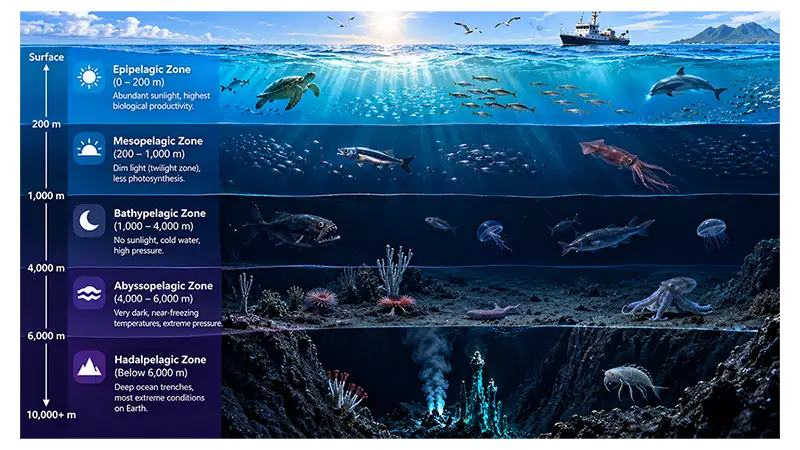
Ocean zones describe how the marine environment changes with depth and available light. As sunlight decreases downward, organisms encounter progressively different conditions.
The water column is commonly divided into several pelagic zones:
| Ocean Zone | Approximate Depth | Main Feature |
|---|---|---|
| Epipelagic | Surface to about 200 m | Strongest sunlight |
| Mesopelagic | About 200–1,000 m | Very limited light |
| Bathypelagic | About 1,000–4,000 m | Complete darkness |
| Abyssopelagic | About 4,000–6,000 m | Extremely deep, cold water |
| Hadalpelagic | Below about 6,000 m | Deep ocean trenches |
The epipelagic zone receives enough sunlight for photosynthesis. This makes it the main region where microscopic marine producers capture solar energy.
Below it lies the mesopelagic zone, sometimes called the twilight zone. Light still penetrates this region, but it is generally insufficient for significant photosynthesis. Many animals migrate vertically between this zone and shallower waters.
The bathypelagic zone is permanently dark. Pressure increases substantially with depth, and temperatures are generally low. Animals living here have specialized adaptations for finding food and communicating in darkness. The abyssopelagic zone extends across much of the deep ocean, while the hadalpelagic zone occurs within the deepest trenches.
Ocean habitats can also be described according to where organisms live. The pelagic realm refers to open water, while the benthic realm includes the seafloor. These terms provide another way to distinguish habitats without relying only on depth.
What Conditions Shape the Marine Biome?
Marine organisms live in an environment controlled by several interacting physical and chemical factors. These conditions determine where species can survive and how ecosystems develop.
Temperature
Water temperature varies with latitude, depth, season, and ocean circulation. Surface waters in tropical regions can remain warm, while deep waters are generally much colder.
Temperature affects metabolism, reproduction, growth, and the distribution of marine organisms. Some species tolerate only a narrow temperature range, while others can survive considerable variation.
Salinity
Salinity refers to the concentration of dissolved salts in seawater. Average ocean salinity is roughly 35 parts per thousand, although actual values vary geographically.
Evaporation can increase salinity, while rainfall, river discharge, and melting ice can lower it. Estuaries therefore experience much greater salinity variation than many areas of the open ocean.
Water Pressure
Pressure rises rapidly as depth increases. Deep-sea organisms have physiological adaptations that allow them to function under pressures that would be extremely challenging for most shallow-water animals.
Sunlight
Light availability decreases rapidly with depth. This creates a major ecological boundary because photosynthetic organisms require sufficient light to produce organic matter.
Ocean Currents
Currents move water across large distances and redistribute heat, nutrients, and dissolved substances. They can also transport organisms and influence regional productivity.
Waves and Tides
Waves affect exposed coastal habitats through repeated physical disturbance. Tides periodically raise and lower sea level, creating constantly changing conditions in coastal environments.
Dissolved Oxygen and Nutrients
Oxygen concentration affects the organisms that can occupy particular waters. Nutrients such as nitrogen and phosphorus are essential for biological production, but their availability varies considerably between marine regions.
What Plants and Producers Live in the Marine Biome?
Marine food production begins largely with primary producers, organisms capable of converting inorganic substances into organic matter using energy from sunlight or, in certain environments, chemical reactions.
The most widespread marine producers are phytoplankton. These microscopic organisms drift with ocean currents and include groups such as diatoms and other photosynthetic microorganisms.
Phytoplankton are especially important because their enormous combined productivity supports food webs throughout the upper ocean. They are too small to see individually with the naked eye, yet their collective activity has a major influence on marine ecosystems and global carbon cycling.
Larger algae also contribute to marine production. Seaweeds occur in many coastal environments, from small forms attached to rocks to enormous kelp that can create underwater forests.
Seagrasses are different from algae because they are flowering plants. They grow in shallow coastal sediments where enough light reaches the seabed. Their underwater leaves provide habitat and feeding grounds for numerous organisms while their roots help stabilize sediments.
Mangroves are another group of flowering plants adapted to saline coastal environments. Their specialized roots allow them to survive conditions that would be difficult for most terrestrial plants.
Together, phytoplankton, algae, seagrasses, and mangroves provide the primary biological production that supports many marine food webs.
What Animals Live in the Marine Biome?
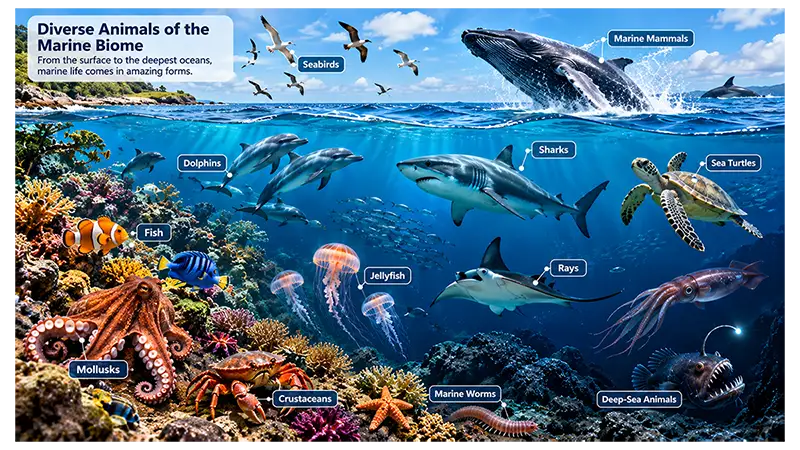
Marine animals belong to many different evolutionary groups and occupy nearly every available marine habitat. Their body forms and lifestyles reflect the particular conditions in which they live.
Fish are among the most diverse marine vertebrates. They range from small reef-associated species to enormous open-water species and deep-sea forms.
Sharks and rays are cartilaginous fishes with a long evolutionary history in marine environments. Their feeding strategies range from active predation to filtering microscopic organisms.
Marine mammals include whales, dolphins, seals, sea lions, walruses, and other groups that evolved from terrestrial ancestors but became highly specialized for aquatic life.
Sea turtles spend much of their lives in marine environments, although many return to land to lay eggs.
Among invertebrates, mollusks include animals such as octopuses, squids, clams, oysters, and many snails. Their forms range from soft-bodied predators to organisms protected by shells.
Crustaceans include crabs, lobsters, shrimp, krill, and numerous smaller species. They occupy habitats ranging from shallow reefs to the deep seafloor.
Jellyfish and related animals use stinging cells to capture prey or defend themselves. Their simple body organization allows them to thrive in various marine conditions.
Marine worms and other invertebrates occupy sediments, reefs, rocky surfaces, and open water. Seabirds also depend heavily on marine ecosystems for feeding, even though they spend part of their lives above the water.
This extraordinary variety means that marine animal life is not concentrated in a single habitat. Different species specialize in different depths, temperatures, substrates, and feeding conditions.
How Does Energy Move Through a Marine Food Web?
Energy enters many marine food webs through photosynthesis. Producers use sunlight to convert carbon dioxide and water into organic matter, creating the initial energy source for organisms at higher trophic levels.
A simplified marine food pathway can be represented as:
Phytoplankton → Zooplankton → Small Fish → Larger Predators
Phytoplankton are consumed by organisms such as zooplankton. These small consumers become food for fish and other predators, which can then be eaten by progressively larger animals.
Not every marine food web follows this simple sequence. Some ecosystems depend heavily on organic material sinking from surface waters. Others, particularly hydrothermal vent communities, can obtain their primary energy from chemosynthesis rather than sunlight.
At every stage, some energy is used for metabolism and lost as heat, so only a fraction becomes available to the next trophic level.
When organisms die or release waste, decomposers and other organisms process the remaining organic material. This returns nutrients to the environment, allowing elements to be reused by producers.
The result is a complex network rather than a single chain. One species may have several food sources and may itself be prey for multiple predators.
Why Is the Marine Biome Important to Earth?
The marine biome performs functions that extend far beyond the boundaries of individual ocean ecosystems.
Marine organisms participate in the global carbon cycle by absorbing, storing, transporting, and releasing carbon. Carbon can move between seawater, organisms, sediments, and the atmosphere through biological and chemical processes.
Ocean ecosystems also influence Earth's climate by absorbing and redistributing heat. Ocean circulation transports energy around the planet, helping moderate temperature differences between regions.
Marine environments are important for nutrient cycling as well. Biological activity transforms and redistributes elements needed for life, while processes in sediments return nutrients to aquatic systems.
The ocean also provides important resources for people. Fisheries support food supplies and livelihoods in many coastal communities. Marine environments contribute to tourism, transportation, recreation, and numerous economic activities.
Coastal ecosystems provide additional physical benefits. Wetlands and vegetated shorelines can trap sediments and reduce the force of waves and storms, helping protect some coastal areas.
Perhaps most importantly, the marine biome contains enormous biological diversity. Its species represent unique evolutionary histories and ecological functions that would be difficult or impossible to replace if lost.
What Threats Affect the Marine Biome?
Marine ecosystems face multiple pressures, and several can occur simultaneously in the same region.
Climate Change
Increasing global temperatures are changing marine conditions. Ocean warming can shift species distributions and place additional stress on organisms adapted to particular temperature ranges.
Ocean Acidification
As seawater absorbs additional carbon dioxide from the atmosphere, its chemistry changes and becomes less favorable for some organisms that build shells or skeletons from calcium carbonate.
Overfishing
Removing marine animals faster than populations can replenish themselves can alter food webs, reduce breeding populations, and change the structure of ecosystems.
Plastic Pollution
Plastic debris can persist for long periods and enter marine environments through rivers, coastal activity, fishing operations, and other pathways. Animals may become entangled in larger debris or ingest smaller particles.
Chemical Pollution
Oil, industrial chemicals, agricultural runoff, and other pollutants can enter marine systems. Some substances accumulate in organisms and may become more concentrated at higher trophic levels.
Habitat Destruction
Coastal construction, destructive fishing practices, dredging, and other activities can physically damage important habitats such as reefs, wetlands, seagrass beds, and mangrove forests.
Deoxygenation
Changes in nutrient inputs, warming, and water circulation can contribute to areas with unusually low dissolved oxygen. Severe oxygen depletion can make affected waters unsuitable for many marine animals.
Because these pressures interact, protecting marine ecosystems often requires addressing several causes at the same time.
How Can We Protect the Marine Biome?
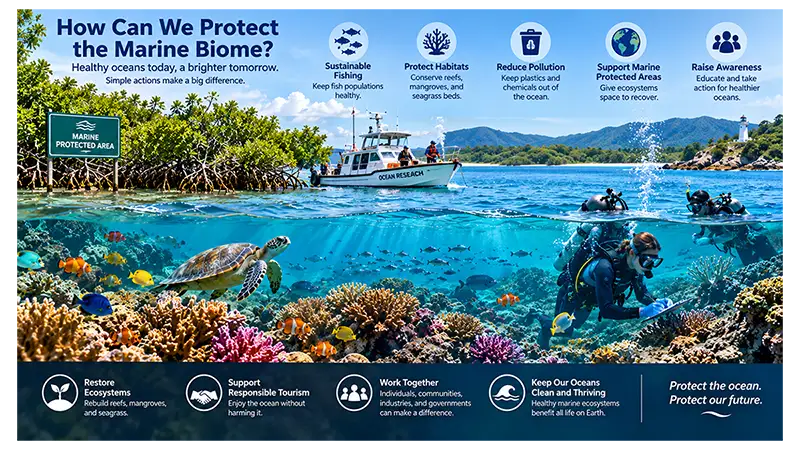
Marine conservation combines habitat protection, responsible resource use, pollution control, and long-term scientific management.
Marine protected areas can restrict particular activities in designated regions, allowing sensitive habitats and populations to receive greater protection. Their effectiveness depends on appropriate design, enforcement, and management.
Sustainable fisheries aim to keep harvesting within levels that marine populations can withstand. Better monitoring, science-based catch limits, selective fishing methods, and protection of important breeding areas can help reduce pressure on fish populations.
Reducing pollution at its source is also essential. Preventing plastic waste, untreated wastewater, agricultural runoff, and hazardous chemicals from entering waterways can reduce the amount of pollution reaching the sea.
Damaged habitats can sometimes be restored. Projects may involve rebuilding oyster reefs, restoring mangrove forests, replanting seagrass, or supporting coral recovery where environmental conditions allow.
Protecting marine environments also requires understanding how ecosystems are changing. Scientists use field observations, satellites, underwater instruments, biological surveys, and long-term monitoring programs to track marine conditions.
Finally, many ocean problems require cooperation among countries because marine systems cross national boundaries. Effective conservation therefore depends on coordinated policies, scientific research, responsible industries, and informed communities.
Conclusion
The marine biome is a vast and interconnected system containing an extraordinary range of environments, from sunlit coastal waters to the deepest ocean trenches. Its physical conditions change with location, depth, temperature, salinity, light, and water movement, creating opportunities for highly specialized forms of life.
Marine producers support complex food webs, while animals occupy nearly every available ecological niche. At the same time, ocean processes influence carbon cycling, climate regulation, nutrient movement, biodiversity, and human societies.
Its scale does not make the marine biome immune to environmental change. Pollution, unsustainable harvesting, habitat loss, warming, and chemical changes can affect marine ecosystems at local and global scales. Long-term protection therefore depends on understanding these systems and managing human activities in ways that maintain their ecological functions.
The marine biome covers roughly 71% of Earth's surface, making it the largest major biome on the planet.
Marine conditions vary widely. Tropical waters are generally warm, while polar waters are cold, and temperature usually decreases with increasing depth.
The major pelagic depth zones are the epipelagic, mesopelagic, bathypelagic, abyssopelagic, and hadalpelagic zones.
Major pressures include climate change, ocean warming, acidification, overfishing, pollution, habitat destruction, and declining oxygen levels in some regions.
Protection can involve marine reserves, sustainable fishing, pollution reduction, habitat restoration, scientific monitoring, and coordinated international conservation.