
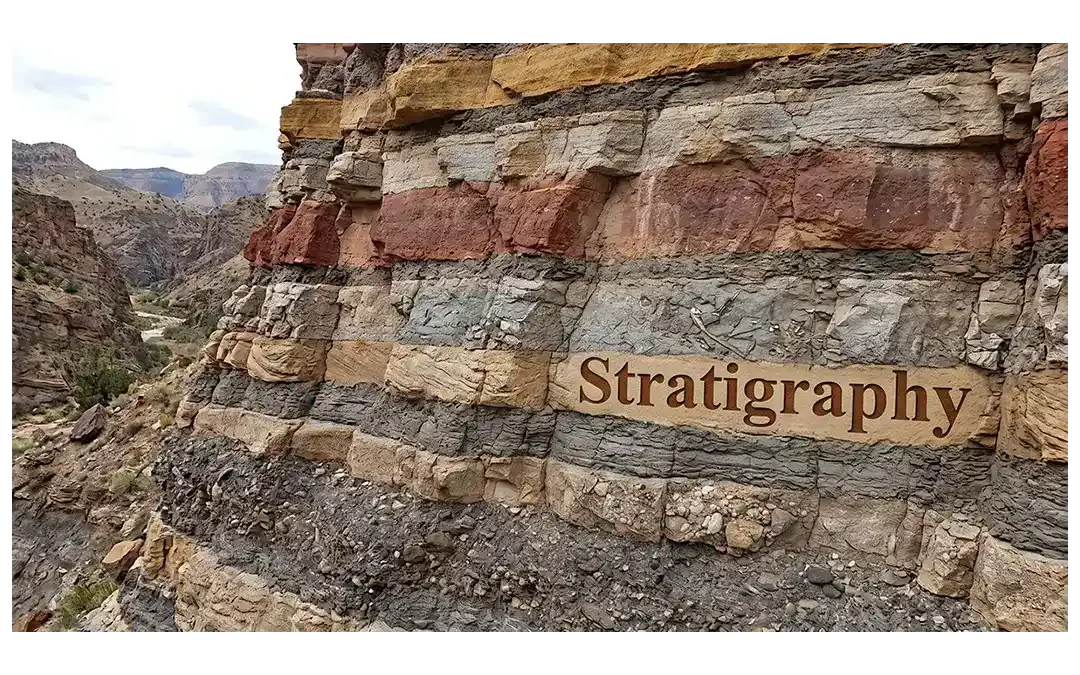
Stratigraphy is an important branch of geology that focuses on the study of rock layers, their sequence, age, composition, and relationships. By examining these layers, geologists can reconstruct how Earth's surface changed through time and understand the environments in which rocks formed.
The subject is especially important for studying sedimentary rocks because sediments are commonly deposited in layers over long periods. These layers can preserve fossils, minerals, chemical signals, and other evidence of past environments.
In simple terms, stratigraphy helps geologists read the history of Earth from its layers of rocks. By comparing layers from different locations, scientists can determine which rocks are older or younger, identify changes in ancient environments, and establish relationships between geological events.
What Is Stratigraphy?
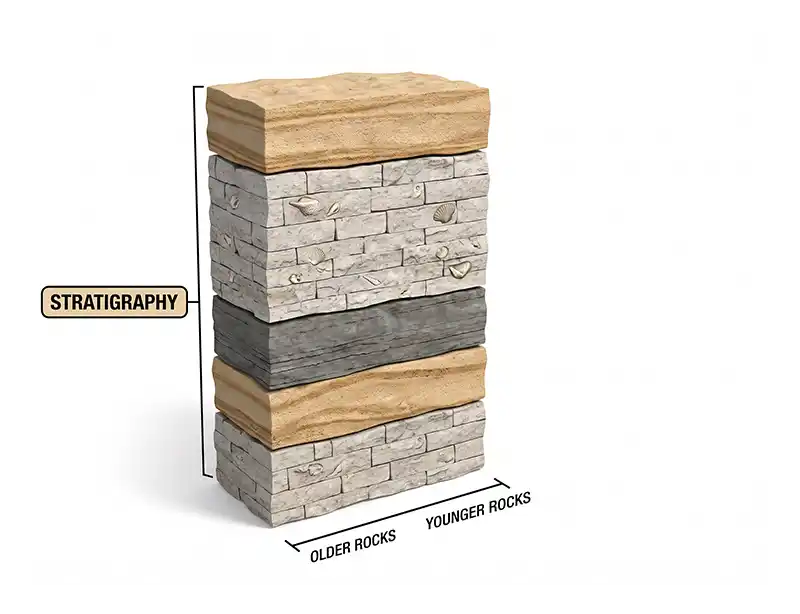
Stratigraphy is the branch of geology concerned with the study and interpretation of rock strata, or layers. The word comes from the Latin stratum, meaning layer, and the Greek graphia, meaning writing or description.
Stratigraphy examines several important characteristics of rock layers, including their:
- Composition
- Thickness
- Age
- Distribution
- Sequence
- Fossil content
- Physical characteristics
- Chemical characteristics
- Relationship with surrounding rocks
Although stratigraphy is strongly associated with sedimentary rocks, its principles can also help scientists understand volcanic and other layered geological materials.
A sequence of rock layers can be thought of as a geological record. Each layer represents conditions that existed when the material was deposited or formed. Therefore, studying the sequence can provide clues about ancient rivers, oceans, deserts, glaciers, volcanic activity, climate changes, and biological evolution.
For example, imagine a cliff containing several sedimentary layers. A geologist may find coarse sandstone near the bottom, finer mudstone above it, and fossil-rich limestone near the top. These differences can indicate that the environment changed over time.
Stratigraphy therefore does more than describe individual layers. It helps geologists understand how different layers are related and what those relationships reveal about Earth's past.
Main Principles of Stratigraphy
To read rock layers correctly, geologists use several fundamental laws and principles:
- Law of Superposition: Formulated by Nicolas Steno, this law states that in an undisturbed sequence of sedimentary rocks, the oldest layer sits at the bottom, and each overlying layer is progressively younger.
- Principle of Original Horizontality: Sediments settle out of water under the pull of gravity in flat, horizontal sheets. If rock layers are found tilted, folded, or faulted, tectonic forces moved them after their original deposition.
- Principle of Lateral Continuity: Layers of sediment initially extend sideways in all directions until they gradually thin out, pinch out against a basin barrier, or grade into a different sediment type.
- Principle of Cross-Cutting Relationships: Introduced by James Hutton and Charles Lyell, this principle states that any geological feature (such as a fault, igneous dike, or erosional canyon) that cuts across another rock body must be younger than the rock it cuts through.
- Principle of Inclusions: Any rock fragment (xenolith or clast) contained inside another rock must be older than the host rock enclosing it (e.g., pebbles inside a conglomerate are older than the conglomerate itself).
- Principle of Faunal Succession: Formulated by William Smith, this principle states that fossil organisms succeed one another in a definite, recognizable, and irreversible vertical order throughout the rock record.
Types of Stratigraphy
Stratigraphy is divided into specialized subdisciplines, each examining a different physical, biological, or chemical characteristic of rock strata:
1. Lithostratigraphy
Focuses on the physical and petrographic properties of rock strata (such as grain size, mineral composition, color, and rock type) without direct regard to absolute age. It organizes rocks into physical units like formations, members, and beds.
2. Biostratigraphy
Organizes and correlates rock layers based on the fossil assemblages they contain. It relies heavily on index fossils (species that were widespread, lived for a short geologic duration, and are easy to identify) to establish biozones.
3. Chronostratigraphy
Organizes rock bodies according to the relative time interval during which they formed. It deals directly with rock-time units (such as systems, series, and stages) that correspond to geochronologic time units (periods, epochs, and ages).
4. Sequence Stratigraphy
Analyzes genetically related packages of sedimentary strata bounded by unconformities (surfaces of erosion or non-deposition). It focuses on how cyclic changes in relative sea level, sediment supply, and basin accommodation shape sedimentary deposits.
5. Magnetostratigraphy
Measures the remnant magnetic signatures preserved inside iron-bearing minerals in sedimentary and volcanic rocks. As Earth's magnetic field periodically flips between normal and reversed polarity, these magnetic reversals create global stratigraphic bar-code patterns.
6. Chemostratigraphy
Evaluates variations in the chemical composition and stable isotope ratios (such as Carbon-13, Strontium-87/86, and Oxygen-18) within sedimentary sequences to correlate rock layers globally and identify past climate disruptions.
Stratigraphic Units and Classification
Geologists divide rock sequences into units so that they can describe, compare, and map them more effectively.
A stratigraphic unit is a recognizable body or interval of rock that can be distinguished from surrounding rocks based on specific characteristics.
Formation
A formation is a fundamental lithostratigraphic unit. It consists of rock with recognizable characteristics that allow geologists to distinguish it from adjacent units. Formations can vary greatly in thickness and geographic extent.
Member
A member is a formally recognized subdivision of a formation. A formation may contain different rock types or distinct intervals that can be separated into members.
Bed
A bed is a relatively thin and recognizable layer of sedimentary rock. Beds may differ from adjacent layers in color, grain size, composition, fossil content, or sedimentary structures.
Group
A group is a collection of related formations that share important geological characteristics.
These units allow geologists to organize complex sequences into a hierarchical system.
Methods Used in Stratigraphy
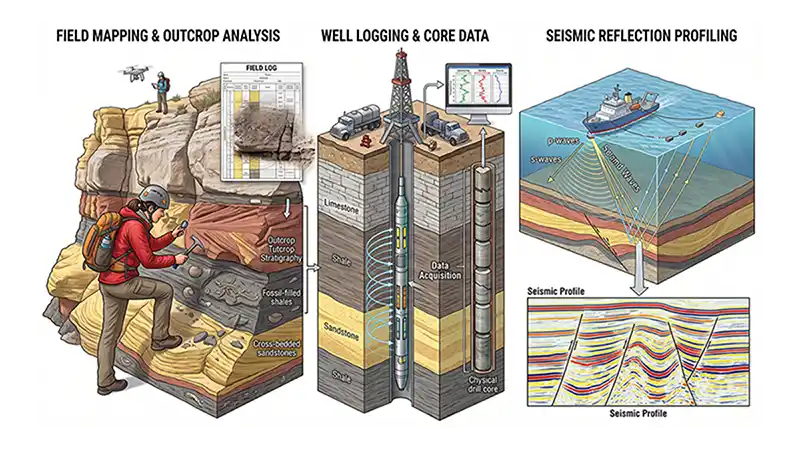
Geologists use field observations, laboratory analyses, fossils, geophysical techniques, and geological dating methods to investigate stratigraphic sequences.
Field Mapping
Field mapping is one of the most important methods in stratigraphy.
Geologists examine exposed rock layers and record their:
- Thickness
- Orientation
- Composition
- Contacts
- Fossils
- Sedimentary structures
- Geographic distribution
These observations help scientists construct geological maps and stratigraphic sections.
Stratigraphic Sections
A stratigraphic section is a representation of the vertical sequence of rock layers at a particular location. It may show the order, thickness, rock type, fossil content, and other characteristics of each layer. Stratigraphic sections allow geologists to compare sequences from different locations.
Fossil Analysis
Fossils provide valuable information about the relative age and environment of rock layers. Scientists can identify particular fossil species and determine where they occur within a stratigraphic sequence.
Radiometric Dating
Radiometric dating uses the predictable decay of radioactive isotopes to estimate the numerical age of rocks or geological materials. This method can provide an absolute or numerical age, unlike relative dating methods that mainly establish whether one layer is older or younger than another.
Radiometric dating is especially useful when volcanic ash layers or igneous rocks occur within sedimentary sequences.
Geophysical Methods
Geophysical techniques can help investigate rock layers that are not exposed at Earth's surface.
For example, seismic methods can reveal subsurface structures and help geologists interpret the arrangement of sedimentary layers beneath the ground.
Importance and Applications of Stratigraphy
Stratigraphy is important because it provides a framework for understanding the history and development of Earth.
Understanding Earth's History
Rock layers preserve evidence of geological processes that occurred over millions or billions of years. By studying their sequence and characteristics, scientists can reconstruct changes in landscapes, oceans, climates, and geological environments.
Geological Mapping
Stratigraphy plays an important role in geological mapping. By identifying and correlating rock units, geologists can create maps showing the distribution of different formations and geological structures.
Petroleum Exploration
Stratigraphic analysis is widely used in petroleum geology. Geologists study sedimentary basins to identify rock units that may contain source rocks, reservoirs, and seals. Understanding how these units formed and relate to one another can help evaluate potential petroleum systems.
Groundwater Studies
Stratigraphy is also useful in hydrogeology. Different rock layers can have different abilities to store and transmit groundwater. Permeable layers may act as aquifers, while less permeable layers can restrict groundwater movement.
Mineral Exploration
Stratigraphic relationships can help geologists identify rock units associated with economically important mineral deposits. Understanding the geological setting can therefore guide mineral exploration.
Paleontology
Because fossils occur within particular stratigraphic intervals, stratigraphy provides an important framework for studying the evolution and distribution of organisms through geological time.
Environmental and Engineering Studies
Stratigraphic information can also support environmental investigations and engineering projects. Knowledge of subsurface layers helps scientists and engineers understand soil and rock conditions, groundwater movement, and geological hazards.
Stratigraphy and Geological Time
Stratigraphy is closely connected with the geological time scale.
Earth's history is divided into hierarchical units such as eons, eras, periods, epochs, and ages. Stratigraphic studies help scientists establish the relationships between rocks and these intervals of geological time.
A simplified relationship can be represented as:
Rock layers → Relative relationships → Numerical ages → Geological time
For example, fossils may show that one layer is older than another, while radiometric dating may provide numerical ages for associated volcanic rocks.
By combining these types of evidence, geologists can construct a more accurate picture of Earth's geological history.
Stratigraphy is therefore essential for understanding major events such as mass extinctions, mountain building, volcanic episodes, changes in sea level, and long-term climate changes.
Stratigraphy and Fossils
Fossils are among the most valuable clues preserved in sedimentary rocks. When fossils occur in a predictable sequence, they can help geologists correlate layers between different locations. Fossils can also provide information about the environment in which the sediments were deposited.
For example, marine fossils found in sedimentary rocks far from today's coastline may indicate that the area was once covered by a sea.
Similarly, changes in fossil communities through a rock sequence may indicate environmental changes over time. This close relationship between fossils and rock layers makes stratigraphy an important tool in paleontology.
Stratigraphy vs. Sedimentology
Although stratigraphy and sedimentology are closely related, they are not exactly the same.
| Stratigraphy | Sedimentology |
|---|---|
| Studies the sequence and relationships of rock layers | Studies sediments and sedimentary processes |
| Focuses strongly on the organization of strata through time and space | Focuses on how sediments are produced, transported, and deposited |
| Helps correlate and classify rock units | Helps explain sedimentary environments and processes |
| Uses fossils, rock properties, age data, and other evidence | Uses grain size, sedimentary structures, textures, and depositional processes |
In simple terms, sedimentology focuses more on how sediments form and are deposited, while stratigraphy focuses more on how the resulting layers are organized, related, and interpreted through geological time.
The two fields often work together because understanding sedimentary processes helps geologists interpret stratigraphic sequences.
Stratigraphy is the study of rock layers and their sequence, age, characteristics, and relationships. It helps geologists understand Earth's geological history.
Stratigraphy helps scientists reconstruct Earth's past, correlate rocks between locations, study fossils, understand geological time, and investigate natural resources.
Important principles include superposition, original horizontality, lateral continuity, cross-cutting relationships, and faunal succession.
Major types include lithostratigraphy, biostratigraphy, chronostratigraphy, magnetostratigraphy, chemostratigraphy, and sequence stratigraphy.
Lithostratigraphy is the classification and correlation of rocks based mainly on their physical and lithological characteristics.
Conclusion
Stratigraphy is a fundamental branch of geology that studies rock layers and their relationships through space and geological time. By examining the order, composition, fossils, age, and characteristics of strata, geologists can reconstruct important parts of Earth's history.
The principles of superposition, original horizontality, lateral continuity, cross-cutting relationships, and faunal succession provide a foundation for interpreting geological sequences. Meanwhile, specialized approaches such as lithostratigraphy, biostratigraphy, chronostratigraphy, magnetostratigraphy, chemostratigraphy, and sequence stratigraphy provide different ways to investigate rocks.
Stratigraphy has applications far beyond simply identifying layers. It supports geological mapping, paleontology, petroleum exploration, groundwater studies, mineral exploration, environmental investigations, and the reconstruction of ancient environments.
Ultimately, stratigraphy allows geologists to treat Earth's rock record as a historical archive. By carefully studying its layers, scientists can better understand how the planet has changed from the distant past to the present.