
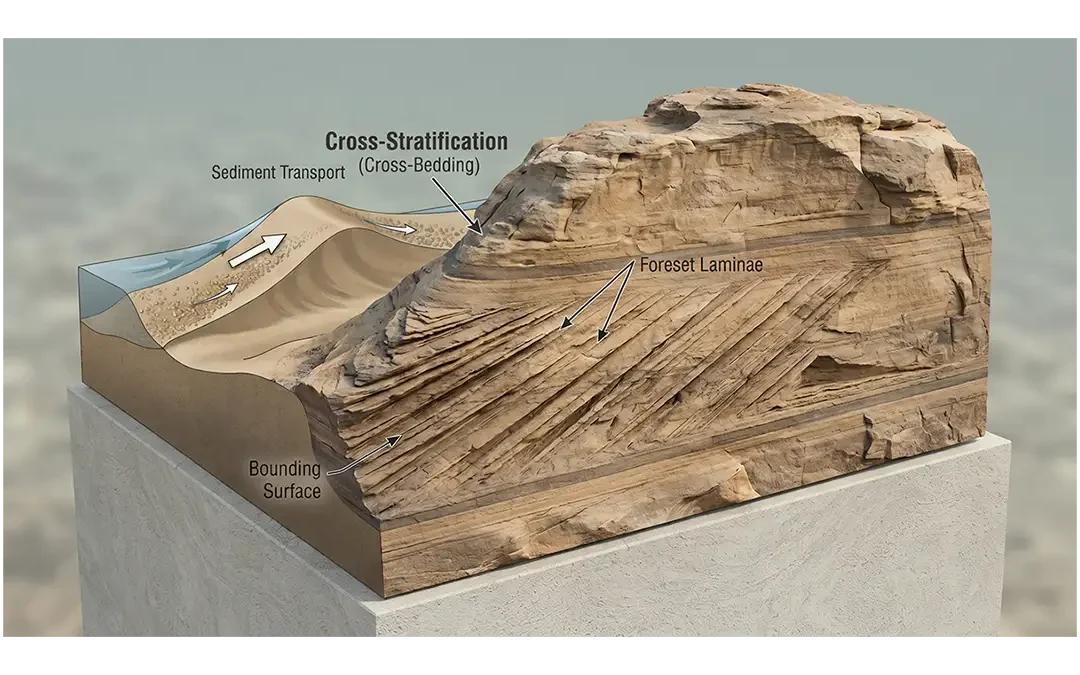
Cross-stratification is a sedimentary structure made of inclined layers that form when sediment moves and is deposited by flowing water, wind, waves, tides, or other sediment-transporting processes. It commonly develops as ripples, dunes, and other bedforms migrate across a sediment surface.
These inclined layers can later become preserved in sedimentary rocks, especially sandstone. Because they record the movement of sediment during deposition, cross-stratification in geology provides valuable clues about ancient currents, wind directions, depositional environments, and sediment transport.
Geologists study cross-stratified layers to understand how sedimentary rocks formed and to reconstruct environments that existed millions of years ago.
What Is Cross-Stratification?
Cross-stratification is a sedimentary structure in which internal layers are inclined relative to the main bedding surface. These inclined layers form as sedimentary bedforms, such as ripples and dunes, migrate under moving water, wind, waves, or tides.
As a bedform moves, sediment is transported toward its crest and then deposited mainly on its lee side. Repeated deposition creates inclined layers known as cross-strata or foreset beds.
Over time, additional sediment may cover these layers. Burial, compaction, and cementation can eventually turn the sediment into sedimentary rock while preserving the original structure.
Cross-stratification is therefore a record of sediment movement. Its geometry, size, and orientation can help geologists understand the processes that operated when the sediment was deposited.
In simple terms:
Sediment movement → bedform migration → inclined deposition → cross-stratification
Cross-stratification can occur at different scales. Small ripples may produce small cross-stratified structures, while large dunes can create much larger inclined sets.
Main Features of Cross-Stratification
Several features help geologists identify and interpret cross-stratification in sedimentary deposits and rocks.
1. Inclined Layers
The most obvious feature is the presence of inclined internal layers. These layers are commonly called foreset beds or foreset laminae. They form as sediment moves over a migrating bedform and accumulates on its downstream or lee side.
2. Cross-Strata
The individual inclined layers within a cross-stratified structure are called cross-strata. Their angle, thickness, and orientation can vary depending on the type of bedform and the conditions during deposition.
3. Sets of Cross-Strata
A group of related cross-strata forms a set. Several sets may occur together within a larger sedimentary deposit.
The size and shape of these sets can provide information about the bedforms that produced them.
4. Bounding Surfaces
Cross-stratified sets are commonly separated by surfaces known as bounding surfaces. These surfaces may form because of erosion, changes in sediment supply, changes in flow conditions, or migration of neighboring bedforms.
Their geometry can help geologists interpret the original depositional processes.
5. Bedform Migration
Bedform migration is one of the most important processes behind cross-stratification.
As ripples or dunes move, sediment is repeatedly eroded from one part of the bedform and deposited on another part. This repeated movement produces inclined layers.
6. Paleocurrent Information
The orientation of cross-strata can provide information about the direction of ancient sediment transport.
By measuring many cross-stratified layers, geologists can estimate paleocurrent direction and reconstruct the movement of ancient water or wind.
How Does Cross-Stratification Form?
Cross-stratification forms through the interaction between sediment transport and migrating bedforms. The exact process depends on the environment, but the general formation sequence is similar.
1. Sediment Becomes Available
Loose sediment, often sand-sized material, becomes available on the surface of a river bed, desert, shoreline, lake, or shallow-marine environment.
2. Sediment Is Transported
Moving water, wind, waves, tides, or other processes transport the sediment.
The strength of the transporting process affects how much sediment moves and what type of bedform develops.
3. Bedforms Develop
As sediment moves, it can accumulate into features such as ripples or dunes.
These bedforms have different shapes and sizes depending on factors such as sediment grain size, flow velocity, water depth, and sediment supply.
4. Bedforms Migrate
The bedforms gradually move as sediment is transported across their surfaces.
For example, grains may move up the gentler side of a dune and then fall or roll down its steeper lee side.
5. Inclined Layers Develop
As sediment accumulates on the lee side, it creates inclined layers.
Continued bedform migration produces additional layers, building a set of cross-strata.
6. Burial and Preservation
Later sediment may cover the cross-stratified deposit. With increasing burial, compaction and cementation can transform the sediment into rock.
If the structure survives erosion and later geological deformation, it may remain visible in the rock record.
The basic process can be summarized as:
Sediment transport → bedform formation → bedform migration → deposition on the lee side → inclined layers → burial and preservation
The resulting cross-stratification records the movement of sediment at the time of deposition.
Main Types of Cross-Stratification
Geologists classify cross-stratification based on the geometry of the bounding surfaces, the shape of the internal foresets, and the hydrodynamic conditions that produced them:
1. Planar (Tabular) Cross-Stratification
In planar cross-stratification, the bounding surfaces separating individual sets of cross-strata are flat, parallel, horizontal planes. The foresets inside are straight, planar sheets that meet the lower boundary at a relatively sharp angle.
- Origin: Formed by the migration of straight-crested, two-dimensional (2D) ripples and sand waves.
- Typical Setting: Shallow braided rivers, broad sand bars, and low-energy coastal sheet flows.
2. Trough Cross-Stratification
In trough cross-stratification, the bounding surfaces are curved, scoop-shaped, or spoon-like troughs. When viewed in three dimensions, the internal foreset layers are curved and scoop-shaped rather than straight.
- Origin: Formed by the migration of sinuous, curved, three-dimensional (3D) dunes and ripples. As one 3D dune migrates, its scouring front carves out a curved trough that is immediately filled by the trailing slip face of the next dune.
- Typical Setting: Fast-flowing meandering rivers, tidal channels, and high-energy riverbeds.
3. Herringbone Cross-Stratification
Herringbone cross-stratification is characterized by alternating, stacked sets of cross-beds that dip in completely opposite, zigzagging directions (e.g., one layer dips to the right, and the layer directly above it dips to the left).
- Origin: Formed by periodic, reversing bidirectional currents.
- Typical Setting: Shallow marine tidal environments where incoming flood tides push sand in one direction, and outgoing ebb tides reverse and push sand in the opposite direction every 6 to 12 hours.
4. Hummocky and Swaley Cross-Stratification (HCS / SCS)
Hummocky cross-stratification consists of gently undulating, low-angle, curved cross-strata that form convex-upward mounds ("hummocks") and concave-upward depressions ("swales").
- Origin: Formed by the combined action of strong, oscillatory storm waves and unidirectional currents on shallow continental shelves.
- Typical Setting: Marine shelf environments located between fair-weather wave base and storm wave base during violent oceanic storms.
5. Epsilon Cross-Bedding (Lateral Accretion)
Epsilon cross-bedding features massive, very low-angle ($< 15^\circ$) inclined strata that span across entire river channel depths.
- Origin: Formed not by downstream dune avalanches, but by the sideways (lateral) migration of point bars across the inside bends of meandering river channels.
- Typical Setting: Meandering river floodplains and delta plains.
Cross-Stratification Across Different Environments
Cross-stratification can develop in many depositional environments. However, its appearance, scale, and geometry can vary depending on the process responsible for sediment transport.
1. Cross-Stratification in Rivers
Rivers are important environments for cross-stratification. Flowing water transports sand and other sediment along the river bed. As underwater dunes and ripples migrate downstream, sediment is deposited on their lee sides and produces inclined layers.
When these deposits become preserved as sandstone, the cross-stratification can provide information about ancient river systems and sediment transport.
2. Cross-Stratification in Deserts
Wind can produce large-scale cross-stratification in desert environments. As wind moves sand across a dune, grains travel up the windward slope and accumulate on the lee side. Continued dune migration produces large inclined sets.
Ancient sandstone containing large-scale cross-stratification can therefore provide evidence of former desert dune systems.
3. Cross-Stratification in Coastal Environments
Coastal environments contain many processes capable of transporting sediment. Waves, tides, and coastal currents can move sand and produce ripples and dunes. These migrating bedforms can create cross-stratified layers.
Cross-stratification in coastal rocks may therefore help geologists reconstruct ancient shorelines, tidal systems, and nearshore environments.
4. Cross-Stratification in Deltaic Environments
Deltas develop where rivers deliver sediment into standing bodies of water such as lakes or seas. These environments can contain complex combinations of river currents, waves, tides, and sediment deposition. Cross-stratification can develop as sand is transported through different parts of the delta. Studying these structures helps geologists understand sediment pathways and ancient delta systems.
5. Cross-Stratification in Lake Environments
Cross-stratification can also develop in some lake environments. Waves and currents can move sediment across the lake floor, while other processes can transport sediment into deeper areas.
The resulting structures can preserve information about ancient lake conditions and sediment movement.
6. Cross-Stratification in Shallow-Marine Environments
Shallow marine environments are highly active sedimentary settings. Tides, waves, currents, and storms can transport sand across the seafloor. These processes can create different types of bedforms and cross-stratified structures.
As a result, cross-stratification can be an important clue when interpreting ancient marine deposits.
Cross-Stratification in Sedimentary Rocks
Cross-stratification is most prominently preserved and studied in clastic sedimentary rocks, particularly sandstones, siltstones, and pebble conglomerates. It also occurs in chemical and biochemical rocks, such as oolitic limestones, where wave action rolls tiny calcium carbonate ooids into underwater dunes across shallow tropical carbonate platforms.
Some of the world's most famous and spectacular geological landmarks owe their dramatic visual appearance directly to preserved cross-stratification:
- The Navajo Sandstone (Zion National Park, USA): Features massive, sweeping cross-bed sets over 20 meters tall. These represent giant fossilized sand dunes from a vast Jurassic desert (erg) system that once blanketed western North America around 180 million years ago.
- The Checkerboard Mesa (Utah, USA): A famous sandstone mountain where steep, sweeping cross-bedding lines intersect with vertical tectonic fracture joints, creating a distinctive natural grid or "checkerboard" pattern on the rock face.
- The Berea Sandstone (Appalachian Basin, USA): Displays extensive trough cross-bedding deposited within ancient Mississippian-age river deltas and barrier island complexes.
Why Is Cross-Stratification Important in Geology?
Cross-stratification is important because it preserves evidence about the physical processes that transported and deposited sediment.
It Reveals Sediment Transport Direction
The orientation of cross-strata can help geologists determine the direction in which sediment moved. By collecting multiple measurements from a rock exposure, researchers can identify a dominant transport direction and reconstruct ancient paleocurrents.
It Helps Identify Depositional Environments
Cross-stratification can help distinguish between different depositional settings. For example, large-scale cross-stratification may indicate ancient dune fields, while smaller structures may occur in river, tidal, or shallow-water environments.
Geologists consider the structure together with other evidence before identifying a depositional environment.
It Records Bedform Migration
Cross-stratified layers preserve evidence of moving ripples and dunes. This allows geologists to understand how bedforms developed and migrated across an ancient sediment surface.
It Helps Reconstruct Ancient Landscapes
Modern landscapes are constantly changing. Rivers migrate, coastlines move, deserts expand or contract, and seas rise and fall. Cross-stratification preserved in rocks provides a geological record of some of these ancient environments.
By studying these structures, geologists can reconstruct landscapes that disappeared millions of years ago.
It Supports Sedimentary Basin Analysis
Cross-stratification is also useful in sedimentology, stratigraphy, and basin analysis. When combined with other geological evidence, it helps researchers understand where sediment came from, how it moved, and where it accumulated.
It Helps Understand Earth's Geological History
Sedimentary rocks preserve evidence of past environments. Cross-stratification is one part of that record. Studying it allows geologists to connect visible structures in rocks with the physical processes that operated in the past.
Cross-stratification is a sedimentary structure consisting of inclined internal layers that form as sediment is deposited during the migration of bedforms such as ripples and dunes.
Cross-stratification forms when sediment moves under flowing water, wind, waves, tides, or combined flows. As ripples or dunes migrate, sediment is deposited on their lee sides, creating inclined layers.
They are closely related but can differ in how the terms are used. Cross-stratification is generally the broader term, while cross-bedding commonly refers to larger-scale cross-stratified structures or beds.
Cross-stratification can occur in rivers, deserts, beaches, deltas, lakes, tidal environments, and shallow-marine settings. The type and scale depend on the sedimentary processes involved.
It can provide information about sediment transport, bedform migration, paleocurrent direction, depositional environments, and ancient landscapes.
Conclusion
Cross-stratification is an important sedimentary structure that records the movement and deposition of sediment in Earth's geological past. It forms mainly as ripples, dunes, and other bedforms migrate under flowing water, wind, waves, tides, or combined flows.
The resulting inclined layers can become preserved in sedimentary rocks, especially sandstone. Their geometry, orientation, scale, and relationship with surrounding layers can provide valuable information about sediment transport, bedform migration, paleocurrent direction, and depositional environments.
Cross-stratification occurs in many settings, including rivers, deserts, coastal environments, deltas, lakes, and shallow-marine systems. Because different environments produce different structures, geologists can use cross-stratification together with other geological evidence to reconstruct ancient landscapes.
Although cross-stratification and cross-bedding are closely related, cross-stratification is commonly used as the broader term. Understanding this relationship is especially useful when studying sedimentary structures and interpreting sedimentary rocks.
Overall, cross-stratification is more than an inclined pattern preserved in a rock. It is a geological record of how sediment moved, accumulated, and interacted with its environment, helping scientists understand the changing surface of Earth through geological time.