
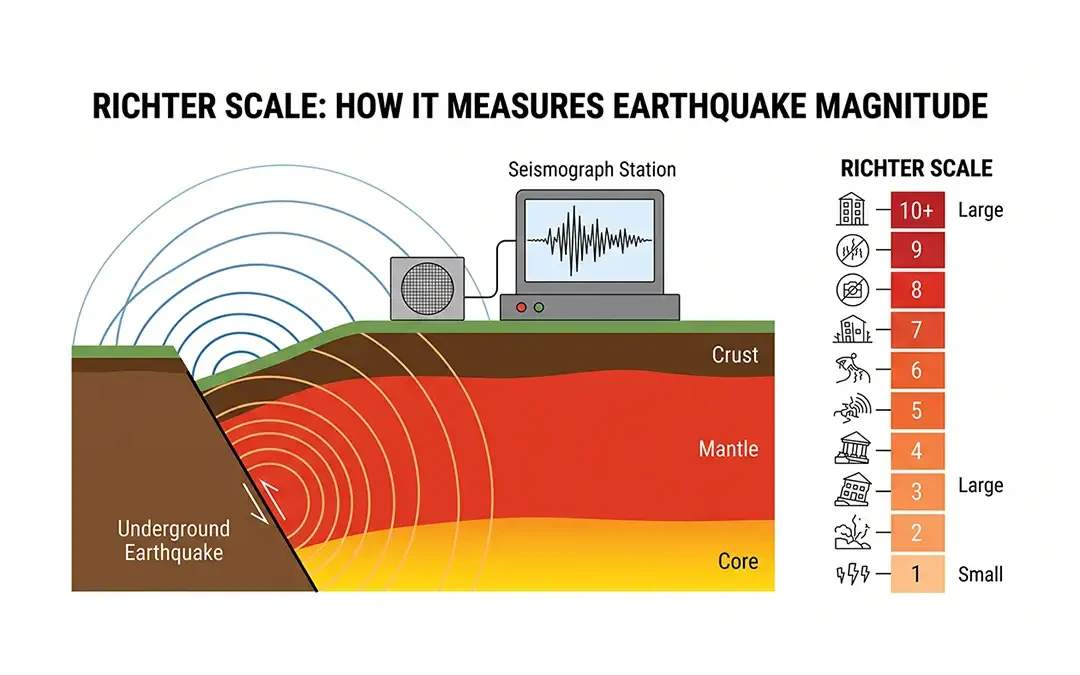
The Richter scale is a logarithmic scale originally developed to measure the size of earthquakes from the amplitude of seismic waves recorded by a seismograph. Charles F. Richter developed the scale in 1935 for earthquakes in Southern California. Today, the Richter scale is mainly associated with local magnitude (ML) and is still useful for some smaller, local earthquakes. For large earthquakes, scientists generally prefer the moment magnitude (Mw) scale because it provides a more reliable measure of earthquake size.
What Is the Richter Scale?
The Richter scale is a numerical scale used to describe the magnitude, or size, of an earthquake. It was developed to give scientists a consistent way to compare the sizes of earthquakes recorded by seismographs.
The scale is logarithmic, meaning that magnitude values do not increase in a simple linear way. A one-unit increase in magnitude represents a tenfold increase in the measured amplitude of seismic waves.
For example, a magnitude 6 earthquake produces seismic-wave amplitudes about 10 times greater than those of a magnitude 5 earthquake under the same measurement conditions.
The Richter scale measures magnitude, not the amount of damage caused by an earthquake. Damage and shaking at a particular location are described using earthquake intensity.
Who Developed the Richter Scale?
American seismologist Charles F. Richter developed the Richter scale in 1935 while working at the California Institute of Technology.
Richter developed the scale with the help of seismologist Beno Gutenberg. The original method was designed for earthquakes in Southern California and used recordings from a Wood-Anderson torsion seismograph.
Before the Richter scale, scientists had difficulty comparing earthquake sizes using a single numerical system. Richter's method provided a standardized way to compare earthquakes based on their recorded seismic-wave amplitudes.
The name "Richter scale" later became widely known around the world and is still commonly used in everyday discussions about earthquake magnitude.
How Does the Richter Scale Work?
When an earthquake occurs, it releases energy that travels through the Earth as seismic waves. A seismograph records the ground motion produced by these waves.
The original Richter method used the maximum amplitude of seismic waves recorded by a Wood-Anderson seismograph. Scientists also considered the distance between the earthquake and the recording station because seismic waves become weaker as they travel.
In simple terms, the process can be represented as:
Earthquake → Seismic waves → Seismograph → Wave amplitude → Magnitude
The original Richter scale was designed around a specific instrument and standard conditions. Modern seismic networks use digital instruments and more advanced methods to calculate local magnitude.
The term local magnitude (ML) is now more precise than simply calling every earthquake magnitude a "Richter magnitude."
Is the Richter Scale Logarithmic?
Yes. The Richter scale is logarithmic.
A one-unit increase in magnitude represents a 10-fold increase in measured seismic-wave amplitude.
For example:
- Magnitude 5 has about 10 times the wave amplitude of magnitude 4.
- Magnitude 6 has about 10 times the wave amplitude of magnitude 5.
- Magnitude 7 has about 10 times the wave amplitude of magnitude 6.
Therefore, a magnitude 7 earthquake has about 100 times the measured wave amplitude of a magnitude 5 earthquake.
However, amplitude and energy are different measurements. A one-unit increase in magnitude corresponds to approximately 32 times more energy released.
This means a magnitude 7 earthquake releases about 32 times more energy than a magnitude 6 earthquake and about 1,000 times more energy than a magnitude 5 earthquake.
How Is the Richter Scale Calculated?
The original Richter scale calculates earthquake magnitude using the maximum amplitude of seismic waves recorded by a Wood-Anderson seismograph, together with a correction for the distance between the earthquake and the recording station.
The basic concept can be represented as:
Magnitude = log₁₀(amplitude) − distance correction
The actual calculation is more specific than this simplified expression because the original Richter method uses a defined reference instrument and calibration system.
The distance correction is important because seismic waves lose amplitude as they travel away from the earthquake source. Without correcting for distance, a recording station farther from an earthquake could make the same earthquake appear smaller.
Modern instruments are different from the original Wood-Anderson seismograph, so modern local magnitude calculations use appropriate calibration and correction procedures.
Richter Scale Magnitude Examples
The Richter scale is often associated with general descriptions of earthquake size. However, magnitude alone does not determine exactly how much damage an earthquake will cause.
| Magnitude | General description |
|---|---|
| Less than 2.0 | Very small earthquakes, usually not felt |
| 2.0–3.9 | Small earthquakes, sometimes felt near the source |
| 4.0–4.9 | Light earthquakes that can be felt by many people |
| 5.0–5.9 | Moderate earthquakes that may cause damage near the source |
| 6.0–6.9 | Strong earthquakes that can cause significant damage |
| 7.0–7.9 | Major earthquakes that can cause widespread damage |
| 8.0 or higher | Great earthquakes capable of causing severe damage over large areas |
These categories are only general descriptions. The actual effects of an earthquake depend on factors such as depth, distance, local geology, building construction, and population density.
For modern earthquake reporting, large earthquakes are generally described using moment magnitude (Mw) rather than the original Richter method.
Limitations of the Richter Scale
The Richter scale was an important development in seismology, but it has several limitations.
Limited for Large Earthquakes
The original local magnitude scale can saturate when earthquakes become very large. This means that the magnitude value does not continue increasing in proportion to the actual size of the earthquake.
As a result, the Richter scale is not suitable for accurately distinguishing the sizes of very large earthquakes.
Developed for Local Earthquakes
Richter originally developed the scale for earthquakes in Southern California. The method was designed around local earthquake recordings and a particular type of seismograph.
Modern earthquake monitoring covers the entire world and includes earthquakes of many different sizes, so other magnitude scales are needed.
Depends on Seismic-Wave Amplitude
The Richter method is based on the amplitude of particular seismic waves. Different wave types and recording conditions can affect magnitude calculations.
Modern magnitude scales use different seismic signals and source characteristics depending on the earthquake and available data.
Does Not Measure Earthquake Damage
The Richter scale measures earthquake magnitude, not the damage or shaking experienced at a particular location.
Two earthquakes with similar magnitudes can produce very different levels of damage because of differences in depth, distance, local geology, building quality, and population density.
Richter Scale vs Moment Magnitude Scale
The Richter scale and moment magnitude scale (Mw) both describe earthquake magnitude, but they use different methods.
| Feature | Richter Scale / ML | Moment Magnitude / Mw |
| Main basis | Seismic-wave amplitude | Seismic moment |
| Main application | Local and smaller earthquakes | Earthquakes across a broad range, especially large events |
| Large-earthquake limitation | Can saturate | Much less affected by saturation |
| Modern importance | Still useful for some local earthquakes | Preferred for many large earthquakes |
The Richter scale is therefore historically important and remains useful in some situations. However, moment magnitude is generally preferred for large earthquakes because it provides a more consistent measure of earthquake size.
Moment magnitude is based on seismic moment, which is related to the rigidity of the rocks, the area of the fault that ruptures, and the amount of slip along the fault.
For a broader explanation of ML, mb, Ms, Mw, and other methods, readers can refer to your article on earthquake magnitude scales.
Is the Richter Scale Still Used?
Yes, but its role is more limited than it was in the past.
The original Richter scale is now more precisely referred to as local magnitude (ML). ML is still used for some smaller and local earthquakes.
However, scientists generally do not use the original Richter method as the primary magnitude scale for large earthquakes. Moment magnitude (Mw) is generally more appropriate for large earthquakes because it does not have the same saturation problem and is based on the physical characteristics of the earthquake source.
Therefore, it is not accurate to say that the Richter scale is completely obsolete. It is better to say that local magnitude remains useful for certain earthquakes, while Mw is preferred for many larger events.
Richter Scale vs Earthquake Intensity
The Richter scale measures earthquake magnitude, while intensity describes the effects of an earthquake at a particular location. Magnitude represents the size of the earthquake at its source. One earthquake has one overall magnitude. Intensity can vary from one location to another. Areas close to the earthquake source may experience stronger shaking, while areas farther away may experience weaker shaking.
Local geology, earthquake depth, distance from the rupture, and building characteristics can also affect the observed intensity. In the United States, earthquake intensity is commonly described using the Modified Mercalli Intensity (MMI) Scale.
The difference can be summarized simply:
Magnitude = size of the earthquake
Intensity = shaking and effects at a particular location
The Richter scale is a logarithmic scale originally developed by Charles F. Richter to measure earthquake magnitude using the amplitude of seismic waves recorded by a seismograph.
Charles F. Richter developed the Richter scale in 1935 while working at the California Institute of Technology. The original scale was designed for earthquakes in Southern California.
Yes. Local magnitude (ML), which is closely associated with the original Richter scale, is still used for some smaller and local earthquakes. Moment magnitude (Mw) is generally preferred for large earthquakes.
Yes. A one-unit increase in magnitude represents a tenfold increase in measured seismic-wave amplitude and approximately 32 times more energy release.
A magnitude 5 earthquake is generally considered a moderate earthquake. It can be felt over a considerable area and may cause damage near the source, depending on local conditions.
Conclusion
The Richter scale was a major development in earthquake science because it provided a standardized numerical method for comparing earthquake sizes. Developed by Charles F. Richter in 1935, the original method used seismic-wave amplitude recorded by a Wood-Anderson seismograph.
Because the scale is logarithmic, a one-unit increase in magnitude represents a tenfold increase in measured wave amplitude and approximately 32 times more energy release. However, the original Richter method has limitations, particularly when measuring large earthquakes.
Today, local magnitude (ML) remains useful for some smaller and local earthquakes, while moment magnitude (Mw) is generally preferred for large earthquakes. Understanding the Richter scale is therefore important for both its historical role in seismology and its place in modern earthquake measurement.
It is also important to remember that magnitude and intensity are not the same. Magnitude describes the size of an earthquake, while intensity describes the shaking and effects at a particular location.