
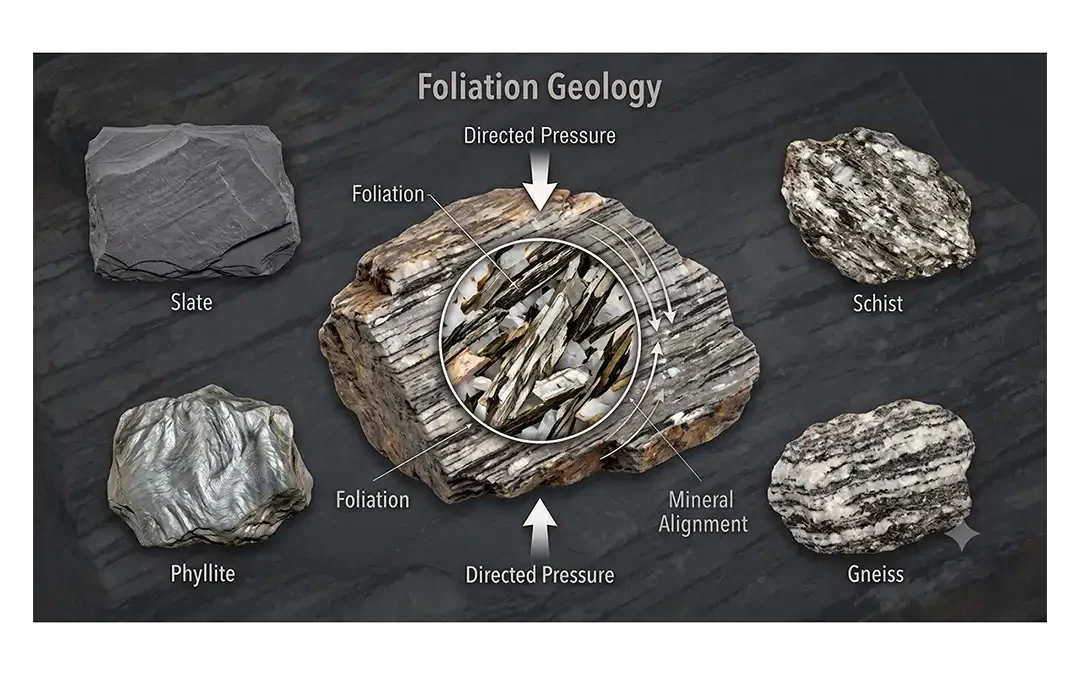
Foliation geology refers to the layered, banded, or planar arrangement of minerals in metamorphic rocks. It develops when rocks are exposed to heat, pressure, and directed stress during metamorphism. Under these conditions, minerals may recrystallize and become aligned in a preferred direction, creating a visible or microscopic planar structure called foliation.
Foliation is one of the most important features used to identify and understand metamorphic rocks. Rocks such as slate, phyllite, schist, and gneiss commonly show different forms of foliation. The appearance of foliation can provide clues about the pressure, temperature, and deformation that affected a rock during its geological history.
What Is Foliation in Geology?
Foliation is a planar or layered fabric in a metamorphic rock produced mainly by the alignment or segregation of minerals during metamorphism. The word comes from the Latin folium, which means "leaf." It commonly develops when a rock experiences directed stress, meaning that pressure or deformation is stronger in some directions than others.
Under these conditions, minerals can change their shape, rotate, recrystallize, or grow in a preferred orientation. Flat or elongated minerals, such as mica, may become aligned roughly perpendicular to the main direction of compressional stress. This alignment creates surfaces or planes within the rock.
Foliation can be very easy to see in some rocks and difficult to detect in others. In slate, it may appear as closely spaced planes along which the rock can split. In schist, large mica crystals may produce a shiny, layered appearance. In gneiss, differences in mineral composition can create alternating light and dark bands.
Foliation is mainly associated with regional metamorphism, which occurs over large areas during tectonic activity such as mountain building. However, the exact appearance of foliation depends on the original rock, mineral composition, temperature, pressure, and type of deformation.
How Does Foliation Form?
Foliation develops as a rock responds to changing temperature, pressure, and stress during metamorphism. The process can take place over long periods deep within Earth's crust.
Role of Heat, Pressure, and Differential Stress
Heat and pressure cause minerals in a rock to become unstable and react to new conditions. New minerals may form, while existing minerals can recrystallize without the rock completely melting.
Pressure alone does not always produce foliation. Differential stress, or directed stress, is especially important. When stress is stronger in one direction, minerals can rotate or grow in orientations that reduce the effects of that stress.
For example, sheet-like mica minerals may become arranged approximately perpendicular to the main direction of compression. When many minerals become aligned in this way, they create a planar fabric that can be recognized as foliation.
Tectonic forces are a major source of this directed stress. During mountain building, rocks can be buried, compressed, heated, and deformed. These conditions can produce strong foliation in the resulting metamorphic rocks.
Mineral Alignment and Recrystallization
Mineral alignment is one of the main processes responsible for foliation. Minerals with flat or elongated shapes are particularly likely to develop a preferred orientation.
Recrystallization also plays an important role. Existing minerals can grow into new shapes or new minerals can form under changing metamorphic conditions. As crystals grow under directed stress, they may develop a consistent orientation.
The result is a rock fabric that records part of the conditions under which the rock formed. Therefore, foliation is not simply a pattern on the surface of a rock; it can represent the effects of deformation and metamorphism within the Earth's crust.
Types of Foliation in Metamorphic Rocks
Foliation can develop in different forms depending on the intensity of metamorphism, mineral composition, grain size, and deformation. Four commonly discussed forms are slaty cleavage, phyllitic foliation, schistosity, and gneissic banding.
Slaty Cleavage
Slaty cleavage is a very fine type of foliation commonly found in slate. It develops when very small minerals become aligned during low-grade metamorphism.
The foliation planes in slate are usually so closely spaced that individual mineral grains may not be visible without magnification. Slate can therefore split into thin, relatively flat pieces along these planes.
Phyllitic Foliation
Phyllitic foliation occurs in phyllite, a metamorphic rock that forms at a higher metamorphic grade than slate.
Phyllite contains very fine-grained minerals, including mica, that have grown large enough to give the rock a characteristic silky or shiny appearance. Its foliation is often wavy rather than perfectly flat.
Schistosity
Schistosity is the prominent foliation found in schist. It develops during medium- to high-grade metamorphism when visible mineral grains, especially mica, become strongly aligned.
Because the mica crystals can be relatively large, schist commonly has a shiny appearance. The mineral alignment can often be seen easily with the naked eye.
Gneissic Banding
Gneissic banding is a coarse form of metamorphic fabric commonly found in gneiss. Instead of closely spaced planar surfaces, gneiss often contains alternating light and dark bands. The bands form because minerals become separated or concentrated into different layers during intense metamorphism and deformation.
Gneissic banding can therefore provide visible evidence of the rock's metamorphic history.
Foliated vs Non-Foliated Metamorphic Rocks
Metamorphic rocks can broadly be divided into foliated and non-foliated types based on their texture.
Foliated metamorphic rocks contain a visible or microscopic planar arrangement of minerals or mineral bands. Examples include slate, phyllite, schist, and gneiss.
Non-foliated metamorphic rocks generally do not have a strong planar mineral alignment. They commonly form when the original minerals recrystallize without developing a preferred orientation.
Two common examples are marble and quartzite.
Marble forms mainly from limestone or dolostone, while quartzite forms mainly from quartz-rich sandstone. Because their mineral grains are generally equidimensional and do not develop a strong preferred alignment under many metamorphic conditions, these rocks commonly lack obvious foliation.
However, the distinction is not always absolute. Metamorphic textures can vary depending on mineral composition, stress conditions, temperature, pressure, and deformation history.
Why Is Foliation Important in Geology?
Foliation is important because it provides information about the geological conditions that affected a rock.
Geologists can study the orientation, mineral composition, and intensity of foliation to reconstruct parts of a rock's metamorphic and tectonic history.
Understanding Tectonic Deformation
Foliation can record the effects of directed stress during tectonic activity. Its orientation can help geologists determine how rocks were compressed, folded, or deformed.
Interpreting Metamorphic Conditions
Different forms of foliation are associated with different metamorphic conditions. Comparing rocks such as slate, phyllite, schist, and gneiss can help geologists understand changes in temperature, pressure, and metamorphic grade.
Reconstructing Geological History
Foliation can preserve evidence of past geological events. In regions affected by mountain building, for example, the orientation of foliated rocks can help scientists understand the forces that shaped the area.
Foliation may also be folded, fractured, or intersected by later structures. Studying these relationships allows geologists to determine the sequence of deformation events that affected a rock.
Foliation is a planar or layered arrangement of minerals in a metamorphic rock. It usually develops when directed stress causes minerals to align or recrystallize in a preferred orientation.
Foliation forms mainly during metamorphism when rocks experience heat, pressure, and directed stress. Minerals can recrystallize, rotate, or grow in a preferred direction, creating a planar rock fabric.
Common foliated metamorphic rocks include slate, phyllite, schist, and gneiss. Each rock displays a different type or intensity of foliation.
Directed or differential stress is an important factor in forming foliation. Heat and chemical changes during metamorphism also help minerals recrystallize and develop preferred orientations.
Foliated metamorphic rocks have a planar or layered mineral fabric, while non-foliated metamorphic rocks generally lack a strong preferred mineral alignment. Slate and schist are foliated, whereas marble and quartzite are commonly non-foliated.
Conclusion
Foliation is an important feature of metamorphic rocks that records the effects of heat, pressure, and directed stress within Earth's crust. It develops when minerals align, recrystallize, or become arranged into planar or banded structures during metamorphism.
The main types of foliation include slaty cleavage, phyllitic foliation, schistosity, and gneissic banding. These structures are commonly seen in slate, phyllite, schist, and gneiss.
By studying foliation, geologists can learn about the pressure, temperature, deformation, and tectonic processes that affected rocks in the past. For this reason, foliation is more than a visible pattern in a metamorphic rock—it is an important record of Earth's geological history.