
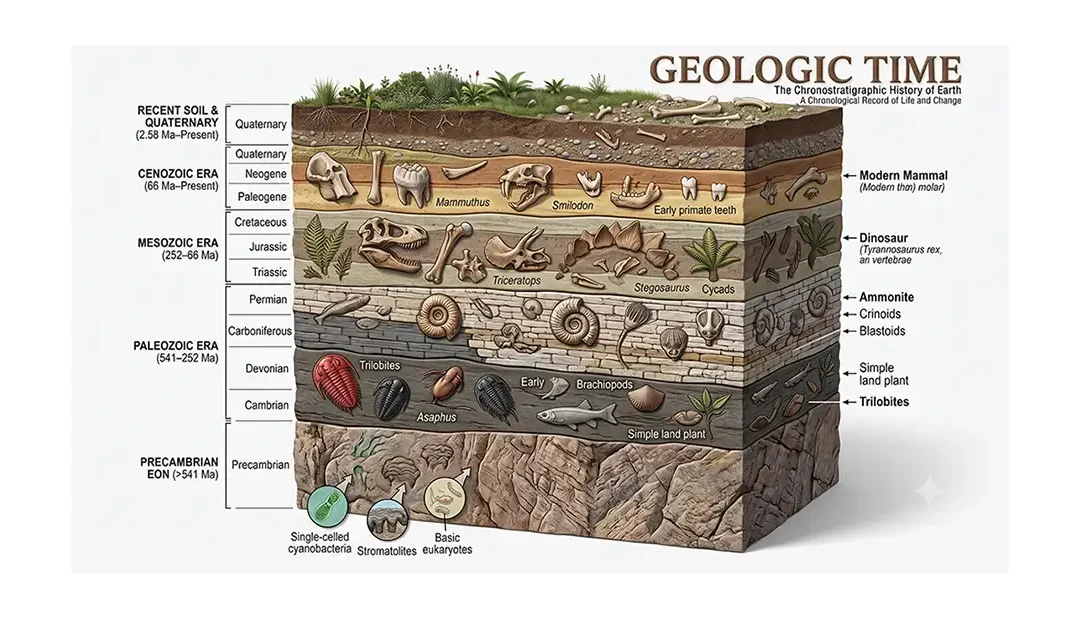
Geologic Time provides the timeline scientists use to track Earth’s 4.6-billion-year history. Humans measure time in years or centuries, but Earth’s story spans millions and billions of years. During this vast period, mountains form, oceans open, and new plants and animals appear and disappear.
To make this long history easier to understand, geologists divide it into smaller units called eons, eras, and periods. Scientists read rock layers and fossils like pages in a book to trace Earth’s journey from a hot, rocky ball to the world we live in today.
What Is Geologic Time?
Geologic Time is the vast calendar system that geologists and paleontologists use to describe the timing and relationships of events throughout Earth’s 4.6-billion-year history. Human history spans only a few thousand years, but understanding our planet’s evolution requires us to step into "deep time"—a concept that helps scientists examine planetary processes such as continental drift, mountain building, ocean creation, and mass extinctions over millions and billions of years.
Scientists created the Geologic Time Scale (GTS) to make this immense timeline easier to understand. The scale organizes Earth’s history into distinct units using rock strata (layers), fossil evidence, and radioactive decay data. Without geologic time, geologists would lack a unified framework for comparing the ages of rock formations across different continents.
How Geologists Measure Geologic Time
Scientists determine where historical events fit along the timeline of Earth's past using two complementary approaches:
- Relative dating
- Absolute dating.
Relative Dating (Rock Layers and Fossils)
Relative dating determines whether a rock or geological event is older or younger than another, without providing an exact numerical age in years. It relies on key laws of stratigraphy:
- Law of Superposition: In undisturbed sedimentary rock layers, the oldest layers are at the bottom and the youngest layers rest at the top.
- Principle of Original Horizontality: Layers of sediment are originally deposited horizontally under the action of gravity.
- Principle of Fossil Succession: Fossilized organisms succeed one another in a definite, recognizable order. Geologists use index fossils—species that were widespread globally but existed for a brief span of time—to correlate rock layers across distant continents.
Absolute Dating (Radiometric Isotopes)
Absolute dating provides an actual numerical age in years. Scientists calculate this using radiometric dating, which measures the steady decay of unstable radioactive isotopes trapped inside igneous and metamorphic minerals:
- Carbon-14 (14C): Used to date young organic materials (up to roughly 50,000 years old).
- Uranium-Lead (U-Pb): Used to measure ancient zircon crystals, pinpointing rock ages up to billions of years old.
- Potassium-Argon (K-Ar): Used to date volcanic ash layers sandwiched between fossil-bearing sedimentary rocks.
The Structure of the Geologic Time Scale
The geologic time scale organizes Earth's past into a nested hierarchy of time units: Eons → Eras → Periods → Epochs → Ages.
Eons: The Largest Divisions of Time
Eons represent the largest blocks of time, spanning hundreds of millions to billions of years. Earth's entire existence is divided into four eons: the Hadean, Archean, Proterozoic, and Phanerozoic. The first three eons are collectively referred to as Precambrian time.
Eras: Major Changes in Life and Crustal Geology
Eons are divided into eras, which reflect major, global changes in Earth's biosphere and geology. For example, boundaries between eras are frequently marked by planetary mass extinction events.
Periods and Epochs: Finer Divisions of Earth History
Eras are further subdivided into periods (such as the Triassic, Jurassic, and Cretaceous), which are divided into epochs for finer chronological detail in Earth's recent history.
| Eon | Era | Approximate Time Span | Key Biological & Geological Milestones |
| Phanerozoic | Cenozoic | 66 million years ago – Present | Diversification of mammals; modern continents take shape; human emergence |
| Phanerozoic | Mesozoic | 252 – 66 million years ago | Age of dinosaurs; break-up of Pangaea; appearance of flowering plants |
| Phanerozoic | Paleozoic | 541 – 252 million years ago | Cambrian explosion of life; first land plants & amphibians; Permian extinction |
| Proterozoic | (Precambrian) | 2.5 billion – 541 million years ago | Great Oxidation Event; emergence of complex multicellular soft-bodied life |
| Archean | (Precambrian) | 4.0 – 2.5 billion years ago | Formation of first stable continental crust; oceans form; early single-celled life |
| Hadean | (Precambrian) | 4.6 – 4.0 billion years ago | Earth forms from solar nebula; Moon creation; molten surface cools |
Major Eras Across Geologic Time

Precambrian Time: Earth’s Formation and Early Life
Precambrian time covers nearly 88% of all geologic time, beginning with Earth's formation about 4.6 billion years ago and ending roughly 541 million years ago. During this massive interval, Earth cooled from a molten sphere, oceans formed, photosynthetic cyanobacteria added oxygen to the atmosphere, and the first single-celled and soft-bodied organisms evolved.
Paleozoic Era: The Rise of Marine Life and Early Plants
Beginning 541 million years ago with the Cambrian Explosion, life diversified rapidly in shallow seas. During the Paleozoic Era, fish evolved, plants and insects colonized the land, and early amphibians and reptiles appeared. The era ended 252 million years ago when the Permian-Triassic extinction devastated life, wiping out nearly 95% of marine species—the most severe mass extinction in Earth’s history.
Mesozoic Era: The Age of Dinosaurs and Reptiles
Spanning from 252 to 66 million years ago, the Mesozoic Era is famous for the dominance of dinosaurs, marine reptiles, and pterosaurs. During this time, the supercontinent Pangaea rifted apart into modern landmasses. Flowering plants spread widely, and early mammals appeared. The era closed abruptly when a massive asteroid impact triggered the Cretaceous-Paleogene (K-Pg) extinction event.
Cenozoic Era: The Age of Mammals and Modern Continents
Starting 66 million years ago and continuing today, the Cenozoic Era saw mammals and birds rapidly evolve to fill ecological roles left open by extinct reptiles. Continents shifted into their current positions, mountain ranges like the Himalayas formed, global ice ages shaped modern terrain, and human ancestors emerged during the Quaternary period.
Why Understanding Geologic Time Matters Today
Studying geologic time isn't just about unlocking ancient history—it directly affects modern society and science:
- Predicting Climate Trends: Examining past warm periods and carbon cycles across geologic time helps scientists build accurate models for future climate shifts.
- Locating Natural Resources: Ore deposits, groundwater aquifers, mineral reserves, and fossil fuels are concentrated within specific rock strata formed during distinct periods of geologic time.
- Assessing Natural Hazards: Analyzing the historical timing between major volcanic eruptions, earthquakes, and tsunamis helps geologists evaluate long-term environmental risks.
Geologic time is the chronological framework used by geologists to sequence and date events, rock formations, and biological evolution throughout Earth's 4.6-billion-year history.
The largest unit of geologic time is an eon. Earth's history is divided into four eons: Hadean, Archean, Proterozoic, and Phanerozoic.
We live in the Phanerozoic Eon, the Cenozoic Era, the Quaternary Period, and the Holocene Epoch.
Relative dating determines whether a rock layer is older or younger than another based on its position and fossils. Absolute dating uses radioactive isotope decay to calculate an exact numerical age in years.
Precambrian time (comprising the Hadean, Archean, and Proterozoic eons) is the longest span, accounting for about 88% of Earth's entire existence.
Conclusion
Geologic Time offers a vital perspective on Earth's history, transforming how we interpret landscapes, rock strata, and life itself. By dividing 4.6 billion years into eons, eras, periods, and epochs using relative and absolute dating techniques, geologists can reconstruct how oceans opened, continents drifted, and life evolved. Mastering the geologic time scale gives us the context needed to understand Earth's dynamic past and navigate its future.