
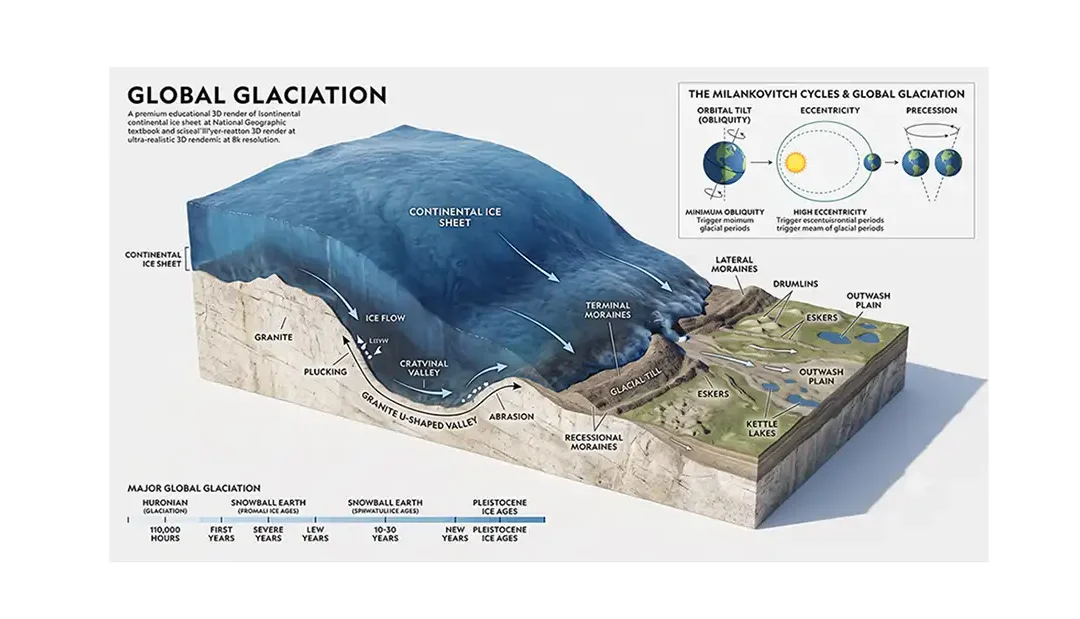
Glaciation is the massive expansion of glaciers and ice sheets across continents—a slow-motion geological force that reshapes mountains, lowers ocean levels, and alters global climates over tens of thousands of years. Stand at the bottom of Yosemite Valley today, look up at the sheer granite walls, and it is easy to forget that you are standing in a giant trench carved by solid ice. Driven by delicate wobbles in Earth’s orbit, shifting greenhouse gases, and ocean currents, periods of widespread ice advance lock up liquid water into continent-spanning reservoirs. Understanding how these massive ice bodies form, move, and retreat gives us a front-row seat to Earth’s dynamic climate history. In this guide, we will walk through how fallen snow turns into solid blue ice, the astronomical triggers behind ice ages, the telltale landforms left behind, and what past glaciations tell us about our world today.
What is Glaciation?
Glaciation refers to the overall geological process in which glaciers and continental ice sheets accumulate, advance, erode the underlying landscape, and eventually retreat as climate conditions warm. Unlike short-term seasonal snowpack that melts away each spring, glaciation represents a long-term planetary transformation where solid ice becomes the dominant force shaping Earth's surface geology and hydrologic systems.
At a fundamental level, glaciation acts as Earth's natural water lockup system. When global temperatures drop, vast volumes of water evaporate from the oceans, fall over landmasses as snow, and remain trapped on land for thousands of years. This mass transfer of water from the hydrosphere to the cryosphere fundamentally alters Earth's geography—lowering global sea levels by dozens to hundreds of meters and exposing continental margins that are normally submerged under coastal ocean waters.
How Glaciers Form and Move
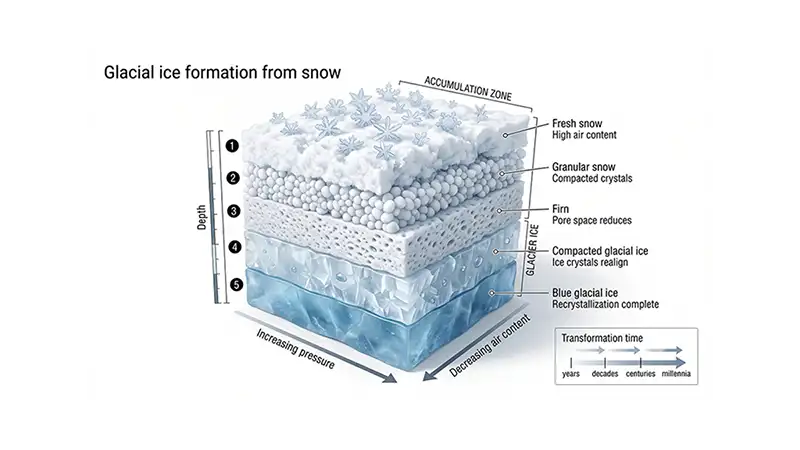
Glaciation starts with a simple rule: more snow must fall in the winter than melts during the summer. When that happens year after year, snow accumulates in high-mountain bowls or polar plains known as accumulation zones. But fresh snow is mostly trapped air. To turn that soft powder into a landscape-carving machine, you need time and intense weight.
Think of it as a natural pressure cooker. As new snow falls, its weight crushes the older snow underneath. The delicate, snowflake arms snap, compacting into dense, granular pellets. Over a few seasons, this material turns into firn—a waxy, semi-solid state that looks like hardened slush. Keep piling on the weight, and at around 30 to 50 meters deep, the crushing lithostatic pressure squeezes out almost all remaining air. What is left is true glacial ice. It appears deep blue because dense ice absorbs red light while scattering blue wavelengths. Once the ice gets thick and heavy enough, gravity takes over, forcing the entire mass to deform plastically and slide downhill.
Causes of Glaciation and Milankovitch Cycles
Why does Earth periodically freeze over? The answer lies in the sky. The primary drivers behind repeating periods of glaciation are Milankovitch cycles—subtle variations in Earth’s orbit and orientation that change how much solar energy hits the high latitudes.
First, Earth's orbit isn't a static circle. Over a 100,000-year cycle known as eccentricity, our orbit stretches into an ellipse and pulls back into a circle. Second is obliquity: Earth's axial tilt wobbles between 22.1 and 24.5 degrees every 41,000 years. Milder tilt means cooler summers at the poles, allowing winter ice to survive year-round. Third is precession, a 23,000-year wobble of Earth's axis, similar to a spinning top slowing down. When these three cycles align to create long, cool summers in the Northern Hemisphere, snow survives through July and August. That triggers a cooling snowball effect: reflective white ice bounces sunlight back into space (the albedo feedback), dropping global temperatures even further and kickstarting a new glacial advance.
Glacial Erosional and Depositional Landforms
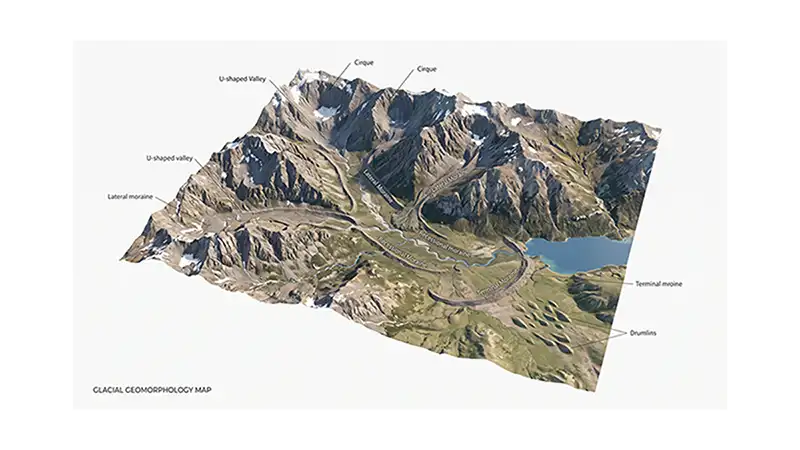
Glaciers are not passive masses of ice; they act like giant, relentless bulldozers. As a glacier crawls forward, it erodes bedrock through two main actions: plucking and abrasion. Plucking happens when meltwater freezes inside rock cracks, shattering the rock and allowing the moving ice to rip boulders straight out of the ground. Abrasion happens when those plucked rocks, now trapped at the bottom of the glacier, drag across the exposed bedrock floor like industrial-grade sandpaper, leaving long parallel scratches called glacial striations.
These processes leave unmistakable footprints on the land. Fast-flowing mountain streams carve sharp V-shaped valleys, but glaciers widen and deepen them into broad, flat-bottomed U-shaped valleys. Where a glacier starts near a peak, it scoops out an amphitheater-shaped bowl called a cirque. If multiple glaciers carve away at the same mountain peak, they leave behind a sharp, multi-sided horn—just like the iconic Matterhorn in the Swiss Alps. When the ice finally retreats, it dumps a messy pile of unsorted rocks, gravel, and clay known as till. These deposits form long ridges called moraines, streamlined teardrop-shaped hills called drumlins, and long winding gravel paths called eskers. In fact, places like Long Island and Cape Cod are nothing more than massive piles of terminal moraine debris left behind by the last ice sheet.
History of Major Earth Glaciations
Our planet’s history alternates between warm "greenhouse" periods and cold "icehouse" epochs. The oldest major freeze we know of is the Huronian Glaciation, which occurred around 2.4 billion years ago. It was triggered during the Great Oxidation Event, when newly evolved photosynthetic bacteria flooded the atmosphere with oxygen, destroying the planet’s insulating blanket of methane gas and plunging Earth into a deep freeze.
Later, during the Cryogenian Period (720 to 635 million years ago), Earth experienced what geologists call "Snowball Earth." Ice sheets extended all the way to the equator, turning the planet into a frozen cue ball. More recently, we entered the Quaternary Glaciation about 2.58 million years ago. During its last major advance—the Last Glacial Maximum (LGM) roughly 20,000 years ago—the massive Laurentide Ice Sheet buried almost all of Canada and reached down into North America as far as modern-day Chicago and New York, lowering global ocean levels by 120 meters (nearly 400 feet).
Environmental Impacts of Glaciation
When millions of cubic kilometers of ice pile onto a continent, the Earth actually responds to the weight. Heavy continental ice sheets press down on Earth’s crust, bending it into the softer, plastic mantle beneath—a process called crustal depression. When those ice sheets melt, that massive weight is lifted, and the crust slowly springs back up over thousands of years. This process, called post-glacial isostatic rebound, is still happening today across Canada, the northern United States, and Scandinavia, where the land rises a few millimeters every year.
Glaciation also reshapes the world’s freshwater supply and sea levels. During cold stages, ocean water evaporates, falls as snow, and stays locked on land as ice. Sea levels drop drastically, exposing shallow ocean floors and creating land bridges like Beringia, which allowed humans and animals to cross from Asia into North America. When interglacial warm periods return—like the Holocene epoch we live in today—that meltwater rushes back into the oceans, flooding coastal plains and driving ocean circulation patterns that regulate global climate.
A glacier is an individual, moving body of ice formed from accumulated snow. Glaciation is the broader geological process or period during which glaciers and ice sheets form, advance, erode the land, and reshape landscapes across a region.
Glaciation is usually triggered when long-term shifts in Earth’s orbit (Milankovitch cycles) reduce summer sunlight in polar regions. Cool summers prevent winter snow from melting, causing ice to build up year after year and cool the planet further.
Yes! Geologically speaking, we are currently in the Quaternary Glaciation, which started 2.58 million years ago. However, we are living through a warm interval between major ice advances, known as an interglacial period (the Holocene epoch).
During a glacial period, water evaporates from the oceans and falls over land as snow. Instead of returning to the sea, this water stays trapped on land as massive ice sheets, pulling huge volumes of water out of the ocean and lowering global sea levels.
Milankovitch cycles are natural, slow variations in Earth's orbital shape (eccentricity), axial tilt angle (obliquity), and rotational wobble (precession). Together, these astronomical cycles alter how much solar heat reaches different parts of the Earth.
Conclusion
Glaciation is one of the most transformative forces on Earth, carving landscapes and governing our planet's climate cycles over vast spans of geologic time. From a single snowflake compacting into dense blue ice to planetary orbital cycles that freeze entire continents, this system reveals how interconnected Earth's astronomical placement, ocean currents, and crust really are. The signs of past glaciations are everywhere around us—in the deep U-shaped valleys of Yosemite, the sharp peaks of the Alps, and the ongoing uplift of northern shorelines. Understanding how these ice sheets advance and retreat isn't just about reading the past; it gives us essential context for how our ocean levels, freshwater reservoirs, and climate systems will respond in the future.