
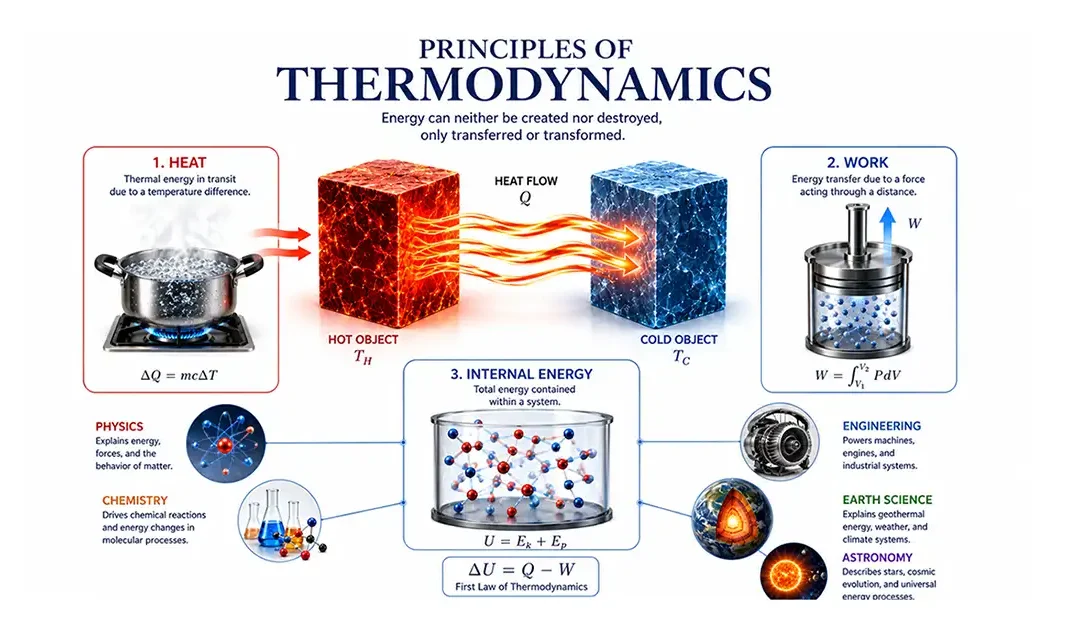
Every time you boil water, refrigerate food, drive a car, or even breathe, the principles of thermodynamics are at work. Although the term may sound highly technical, thermodynamics is simply the branch of science that explains how heat, energy, and work interact. These principles govern countless natural processes and technological systems, making them fundamental to physics, chemistry, engineering, Earth science, and even biology.
The principles of thermodynamics help scientists understand why heat flows from a hotter object to a colder one, how engines convert fuel into useful work, and why no machine can operate with perfect efficiency. They also explain the behavior of stars, Earth's internal heat, weather systems, and many industrial processes that shape modern society.
What Are the Principles of Thermodynamics?
The principles of thermodynamics are a set of fundamental scientific concepts that describe how heat, energy, and work behave within physical systems. They explain how energy is transferred, transformed, and conserved, providing the foundation for understanding everything from steam engines and refrigerators to Earth's climate and the evolution of stars.
At the heart of thermodynamics is the idea that energy cannot be studied in isolation. Whenever energy enters or leaves a system, it changes the system's temperature, pressure, volume, or internal energy. The principles of thermodynamics describe these changes using universal laws that apply to both natural and engineered systems.
For example, when a metal spoon is placed in a cup of hot tea, heat naturally flows from the hotter tea to the cooler spoon until both reach the same temperature. Similarly, a car engine converts the chemical energy stored in fuel into mechanical work, while a refrigerator transfers heat from its cold interior to the warmer surrounding environment. These everyday events all follow the same thermodynamic principles.
Thermodynamics revolves around three closely related concepts:
- Heat – Energy transferred because of a temperature difference.
- Work – Energy transferred when a force acts through a distance or when a system expands or contracts.
- Internal Energy – The total microscopic energy stored within a substance due to the motion and interactions of its molecules.
Together, these concepts explain how energy moves and changes form without violating the fundamental laws of nature. Because these principles apply universally, they are used in fields ranging from physics and chemistry to engineering, geology, environmental science, and astronomy.
Heat, Temperature, and Internal Energy
Although these terms are often used interchangeably in everyday conversation, they describe different physical quantities.
| Concept | Definition | Example |
|---|---|---|
| Heat | Energy transferred between objects because of a temperature difference. | A hot cup of coffee warming your hands. |
| Temperature | A measure of how hot or cold a substance is, related to the average kinetic energy of its particles. | Water boiling at approximately 100°C under standard atmospheric pressure. |
| Internal Energy | The total microscopic energy stored within a substance due to the motion and interactions of its molecules. | Thermal energy stored inside steam in a boiler. |
Understanding these concepts makes it much easier to learn the four laws of thermodynamics, because each law describes a different aspect of how heat and energy behave. Together, they provide a universal framework for explaining energy transformations in both natural systems and human-made technologies.
Overview of the Four Laws of Thermodynamics
The principles of thermodynamics are expressed through four fundamental laws that explain how heat and energy behave in all physical systems. Together, these laws describe how thermal equilibrium is established, how energy is conserved, why heat naturally flows in one direction, and what happens as matter approaches absolute zero.
These laws form the foundation of thermodynamics and are applied in physics, chemistry, engineering, Earth science, and many other scientific disciplines. Although each law focuses on a different aspect of energy, they work together to explain virtually every thermodynamic process observed in nature.
Zeroth Law of Thermodynamics
The Zeroth Law of Thermodynamics states that if two objects are each in thermal equilibrium with a third object, they are also in thermal equilibrium with each other. In simple terms, if all three objects have the same temperature, no heat will flow between them.
This principle provides the basis for temperature measurement. Thermometers work because they reach thermal equilibrium with the object being measured, allowing the object's temperature to be determined accurately.
First Law of Thermodynamics
The First Law of Thermodynamics is based on the principle of energy conservation. It states that energy cannot be created or destroyed; it can only be transferred or converted from one form to another.
For example, when fuel burns inside a car engine, its chemical energy is transformed into heat and mechanical work. Likewise, electrical heaters convert electrical energy into thermal energy without creating new energy.
Second Law of Thermodynamics
The Second Law of Thermodynamics explains the natural direction of heat transfer and introduces the concept of entropy, which measures the degree of disorder in a system.
According to this law, heat naturally flows from a hotter object to a colder one unless external work is applied. This is why a hot cup of coffee gradually cools to room temperature instead of becoming hotter on its own.
The second law also explains why no engine or machine can convert all of its heat energy into useful work. Some energy is always dispersed, making 100% efficiency impossible.
Third Law of Thermodynamics
The Third Law of Thermodynamics states that as the temperature of a perfect crystal approaches absolute zero (0 K or −273.15°C), its entropy approaches a minimum value.
This law establishes the theoretical lower limit of temperature and explains why absolute zero cannot be reached through a finite number of cooling processes. It plays an important role in cryogenics, low-temperature physics, and materials science.
Thermodynamic Systems
Before studying how heat and energy move, it is important to understand the thermodynamic system in which these processes occur. A thermodynamic system is simply a defined portion of the universe selected for analysis. Everything outside that system is known as the surroundings. Energy or matter may be exchanged between the system and its surroundings depending on the type of system being considered.
For example, when water is heated in a cooking pot, the water itself can be treated as the system, while the pot, stove, and surrounding air are considered the surroundings. By defining the system clearly, scientists and engineers can accurately study energy transfer and predict how the system will respond to changes in temperature, pressure, or volume.
Thermodynamic systems are generally classified into three main types: open systems, closed systems, and isolated systems.
Open System
An open system exchanges both energy and matter with its surroundings. This means that heat, work, and mass can enter or leave the system during a process.
Open systems are the most common in everyday life. For example, boiling water in an uncovered pot allows heat to enter from the stove while water vapor escapes into the air. Similarly, the human body is an open system because it exchanges energy through heat and matter through breathing, eating, and waste removal.
Examples of open systems include:
- Boiling water in an uncovered pot
- A steam turbine
- A flowing river
- The human body
- A running automobile engine
Closed System
A closed system can exchange energy with its surroundings but cannot exchange matter. The amount of mass within the system remains constant, although heat and work may cross the system boundary.
A common example is water sealed inside a pressure cooker. Heat enters through the cooker walls, increasing the water's temperature and pressure, but no water can escape while the cooker remains sealed.
Closed systems are widely used in engineering because they simplify the analysis of energy transfer without considering changes in mass.
Examples of closed systems include:
- A sealed pressure cooker
- Gas enclosed in a piston-cylinder
- A sealed water bottle
- A rechargeable battery during operation
Isolated System
An isolated system exchanges neither energy nor matter with its surroundings. In theory, such a system is completely insulated from external influences.
Although a perfectly isolated system does not exist in nature, scientists often use this concept as an ideal model. A well-insulated thermos flask is one of the closest everyday examples because it greatly reduces the transfer of heat and prevents the exchange of matter with the environment.
The universe itself is often considered the largest isolated system because nothing exists outside it with which it can exchange energy or matter.
Examples of isolated systems include:
- An ideal thermos flask
- A perfectly insulated experimental chamber (theoretical)
- The universe (in many thermodynamic models)
Heat, Work, and Internal Energy
The principles of thermodynamics are built around three closely related concepts: heat, work, and internal energy. These quantities explain how energy is transferred and transformed within a thermodynamic system. Although they are often mentioned together, each has a distinct meaning and plays a different role in thermodynamic processes.
Understanding these concepts makes it much easier to interpret the four laws of thermodynamics. Analyze how real-world systems such as engines, refrigerators, power plants, and Earth's natural processes operate.
Heat
Heat is the transfer of thermal energy from one object to another because of a difference in temperature. Heat always flows spontaneously from a hotter object to a colder one until both objects reach thermal equilibrium.
It is important to remember that heat is energy in transit, not energy stored within an object. Once the energy has been transferred, it becomes part of the object's internal energy.
For example, when a metal spoon is placed in a cup of hot coffee, heat flows from the coffee to the cooler spoon until both reach the same temperature.
Heat is commonly measured in joules (J) in the International System of Units (SI), although calories are still used in some fields.
Work
In thermodynamics, work is the transfer of energy that occurs when a force causes a system to move or change its volume. Unlike heat, which is driven by a temperature difference, work results from mechanical interactions.
A common example is a piston-cylinder system. When a gas expands after being heated, it pushes the piston upward and performs mechanical work. Conversely, compressing the piston requires external work to be done on the gas.
Work is also measured in joules (J) and represents one of the primary ways energy is transferred into or out of a thermodynamic system.
Internal Energy
Internal energy is the total microscopic energy stored within a substance. It includes:
- The kinetic energy of atoms and molecules due to their continuous motion.
- The potential energy resulting from the interactions between particles.
Internal energy cannot be observed directly, but it changes whenever a system gains or loses heat or performs work.
For instance, heating water increases the motion of its molecules, raising its internal energy. Similarly, compressing a gas increases molecular interactions, which also increases internal energy.
Scientists usually represent internal energy with the symbol U.
Thermodynamic Processes
A thermodynamic process is any change in the state of a thermodynamic system caused by the transfer of heat, the performance of work, or both. During a process, one or more properties of the system—such as temperature, pressure, volume, or internal energy—change as the system moves from one equilibrium state to another.
Thermodynamic processes are fundamental to understanding how engines generate power, refrigerators provide cooling, turbines produce electricity, and many natural phenomena occur. Depending on which property remains constant during the process, thermodynamic processes are classified into four main types: isothermal, adiabatic, isobaric, and isochoric.
Isothermal Process
An isothermal process is a thermodynamic process that occurs at a constant temperature. During this process, heat may enter or leave the system to maintain the same temperature even though pressure and volume change.
For an ideal gas, the internal energy remains constant because the temperature does not change.
A common example is the slow expansion or compression of a gas inside a cylinder that is in continuous thermal contact with its surroundings, allowing heat to flow in or out as needed.
Key characteristics:
- Temperature remains constant.
- Heat is exchanged with the surroundings.
- Pressure and volume change.
- Internal energy remains constant for an ideal gas.
Adiabatic Process
An adiabatic process occurs without any heat transfer between the system and its surroundings. In this case, all changes in the system's internal energy result solely from work being done by or on the system.
When a gas expands adiabatically, it performs work and its temperature decreases. Conversely, when a gas is compressed rapidly, its temperature increases because external work raises its internal energy.
Adiabatic processes are commonly observed in internal combustion engines, gas compressors, and atmospheric air movements.
Key characteristics:
- No heat exchange with the surroundings.
- Temperature usually changes.
- Internal energy changes because of work.
- Often occurs rapidly or in well-insulated systems.
Isobaric Process
An isobaric process takes place at constant pressure while other properties, such as volume and temperature, are allowed to change.
For example, heating water in an open container occurs at approximately constant atmospheric pressure. As heat is added, the temperature and volume of the water change while the pressure remains nearly constant.
Many industrial heating and cooling processes are analyzed as isobaric processes because they occur under atmospheric conditions.
Key characteristics:
- Pressure remains constant.
- Heat transfer usually occurs.
- Volume and temperature change.
- Work is performed if the volume changes.
Isochoric Process
An isochoric process, also called an isovolumetric or constant-volume process, occurs when the volume remains constant throughout the process.
Because the volume does not change, the system cannot perform mechanical work through expansion or compression. Therefore, any heat added to the system directly changes its internal energy and temperature.
A common example is heating a gas inside a rigid, sealed container where the container prevents any change in volume.
Key characteristics:
- Volume remains constant.
- No expansion or compression occurs.
- No mechanical work is performed.
- Heat transfer changes the system's internal energy.
Applications of Thermodynamics
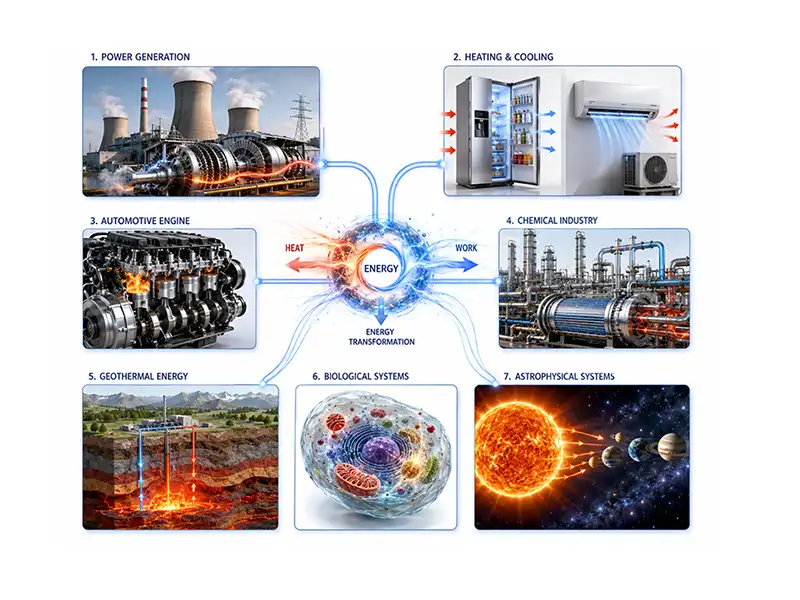
Although thermodynamics began as the study of heat and steam engines, its principles are now applied across nearly every branch of science and engineering. From generating electricity to understanding Earth's interior, thermodynamics helps explain how energy is transferred, transformed, and utilized in both natural and human-made systems.
Whether designing advanced industrial equipment or studying biological organisms, scientists rely on thermodynamic principles to predict how systems respond to changes in heat, pressure, temperature, and energy.
Power Generation
One of the most important applications of thermodynamics is power generation. Thermal power plants, nuclear power plants, and geothermal power stations all convert heat energy into electrical energy using thermodynamic cycles.
In a typical power plant, fuel or another heat source produces high-temperature steam that drives turbines connected to electrical generators. Thermodynamic principles help engineers maximize efficiency while minimizing energy losses during this conversion process.
Refrigeration and Air Conditioning
Refrigerators, freezers, and air conditioning systems operate according to the principles of thermodynamics by transferring heat from a cooler region to a warmer one.
Using a refrigerant and a series of compression and expansion processes, these systems absorb heat from indoor spaces or refrigerated compartments and release it to the outside environment. This controlled heat transfer keeps food fresh, preserves medicines, and provides comfortable indoor temperatures.
Automobiles and Transportation
Modern vehicles depend heavily on thermodynamics. Internal combustion engines convert the chemical energy stored in fuel into mechanical work that powers the vehicle.
Thermodynamic principles are also used to improve engine efficiency, reduce fuel consumption, and lower harmful emissions. Electric vehicles benefit as well, using thermodynamics to manage battery temperatures and optimize overall performance.
Chemical and Industrial Engineering
Many industrial manufacturing processes rely on thermodynamic principles to control heat transfer, pressure, and energy conversion.
Chemical, pharmaceutical, fertilizer, cement, steel, and food industries use thermodynamics to improve efficiency and product quality. Heat exchangers, boilers, reactors, and industrial furnaces all operate according to thermodynamic laws.
Earth Science and Geology
Thermodynamics plays a vital role in Earth science, where it helps explain geological and environmental processes occurring within and beneath Earth's surface.
Geologists use thermodynamic principles to study:
- Formation of igneous and metamorphic rocks
- Movement of magma beneath volcanoes
- Heat flow within Earth's interior
- Plate tectonics
- Geothermal energy resources
- Stability of minerals under different temperatures and pressures
Understanding how heat and energy move through Earth's interior allows scientists to interpret many geological processes that have shaped our planet over billions of years.
Biology and Living Organisms
Living organisms constantly convert energy to survive, making thermodynamics essential to biology.
Processes such as cellular respiration, photosynthesis, and metabolism all involve energy transformations governed by thermodynamic principles. The human body converts chemical energy from food into mechanical work, body heat, and other forms of energy required for growth and daily activities.
Space Science and Astronomy
Thermodynamics also helps scientists understand the behavior of stars, planets, and galaxies.
Nuclear fusion inside the Sun converts mass into enormous amounts of energy, while thermodynamic principles explain heat transfer, planetary atmospheres, and the evolution of celestial bodies. Spacecraft thermal control systems also rely on thermodynamics to protect instruments from the extreme temperatures of space.
Importance of Thermodynamics
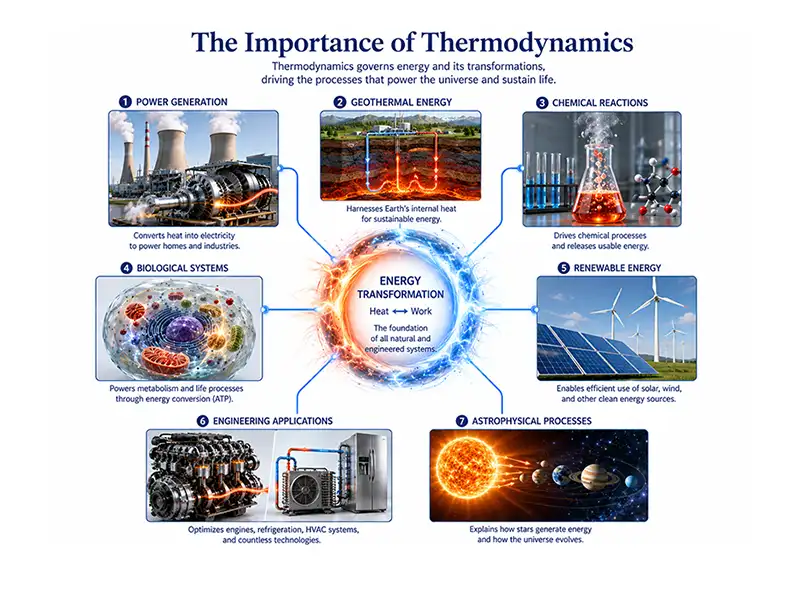
Thermodynamics is one of the most fundamental branches of science because it explains how energy is transferred, transformed, and conserved in both natural and engineered systems. From the smallest biological cells to the largest stars in the universe, virtually every physical process involves the principles of thermodynamics. Without these principles, modern technology, industrial development, and many scientific discoveries would not be possible.
One of the greatest contributions of thermodynamics is its ability to help scientists and engineers predict the behavior of energy. By understanding how heat, work, and internal energy interact, engineers can design more efficient engines, safer power plants, improved refrigeration systems, and advanced manufacturing processes. This not only reduces energy waste but also lowers operating costs and minimizes environmental impacts.
Thermodynamics is equally important in Earth science and geology. The movement of magma beneath Earth's surface, the formation of igneous and metamorphic rocks, geothermal energy production, volcanic activity, and the transfer of heat from Earth's interior are all governed by thermodynamic principles. Geologists also use thermodynamics to understand mineral stability under different temperatures and pressures, helping explain how rocks evolve over geological time.
In chemistry, thermodynamics helps determine whether a chemical reaction can occur spontaneously and how much energy it releases or absorbs. In biology, it explains how living organisms obtain, store, and use energy through processes such as cellular respiration and photosynthesis. Even astronomy relies on thermodynamics to understand the life cycles of stars, planetary atmospheres, and the immense energy generated by nuclear fusion inside the Sun.
As the world moves toward cleaner and more sustainable energy solutions, thermodynamics has become increasingly important. Renewable energy technologies such as solar power, geothermal energy, wind energy, hydrogen production, and advanced battery systems all depend on efficient energy conversion and heat management. By applying thermodynamic principles, scientists continue to develop technologies that improve energy efficiency while reducing greenhouse gas emissions.
Beyond its scientific and industrial importance, thermodynamics also helps explain many everyday experiences. Whether boiling water, driving a car, charging a battery, or using an air conditioner, the same fundamental principles govern how energy behaves. Understanding thermodynamics therefore provides not only a foundation for scientific education but also a deeper appreciation of the natural processes and technologies that shape our daily lives.
Conclusion
The principles of thermodynamics provide the foundation for understanding how heat, work, and energy behave in every physical system. These universal principles explain how energy is transferred, transformed, and conserved, making them essential in fields ranging from physics and chemistry to engineering, Earth science, and biology. Whether studying a steam engine, a refrigerator, Earth's geothermal activity, or the life cycle of a star, thermodynamics offers the scientific framework needed to understand these processes.
In this guide, we've explored the fundamental concepts of thermodynamics, the different types of thermodynamic systems, the four thermodynamic processes, and the practical applications that influence modern technology and everyday life. We've also introduced the four laws of thermodynamics, which serve as the cornerstone of this scientific discipline. Together, these concepts help explain why energy behaves predictably and why no natural process can violate these fundamental laws.
As technology continues to evolve, the importance of thermodynamics will only increase. Advances in renewable energy, electric vehicles, sustainable manufacturing, aerospace engineering, and climate science all rely on a solid understanding of thermodynamic principles. By mastering these concepts, students, researchers, and professionals gain valuable insight into the science behind energy and the systems that power our world.
Whether you're beginning your journey in science or expanding your knowledge of Earth systems and engineering, understanding the principles of thermodynamics provides a strong foundation for exploring countless natural phenomena and technological innovations.
Thermodynamics is the branch of science that studies the relationships between heat, work, temperature, and energy, explaining how energy moves and changes in natural and engineered systems.
Heat is the transfer of thermal energy between objects because of a temperature difference, whereas temperature measures how hot or cold a substance is by indicating the average kinetic energy of its particles.
Thermodynamics is involved in many everyday activities, including cooking, refrigeration, air conditioning, driving vehicles, charging batteries, generating electricity, and even the way the human body converts food into energy.
This article provides a general overview of the four laws. For a more detailed explanation of each law, including their formulas, scientific significance, and practical examples, read our dedicated guide on the Four Laws of Thermodynamics.