
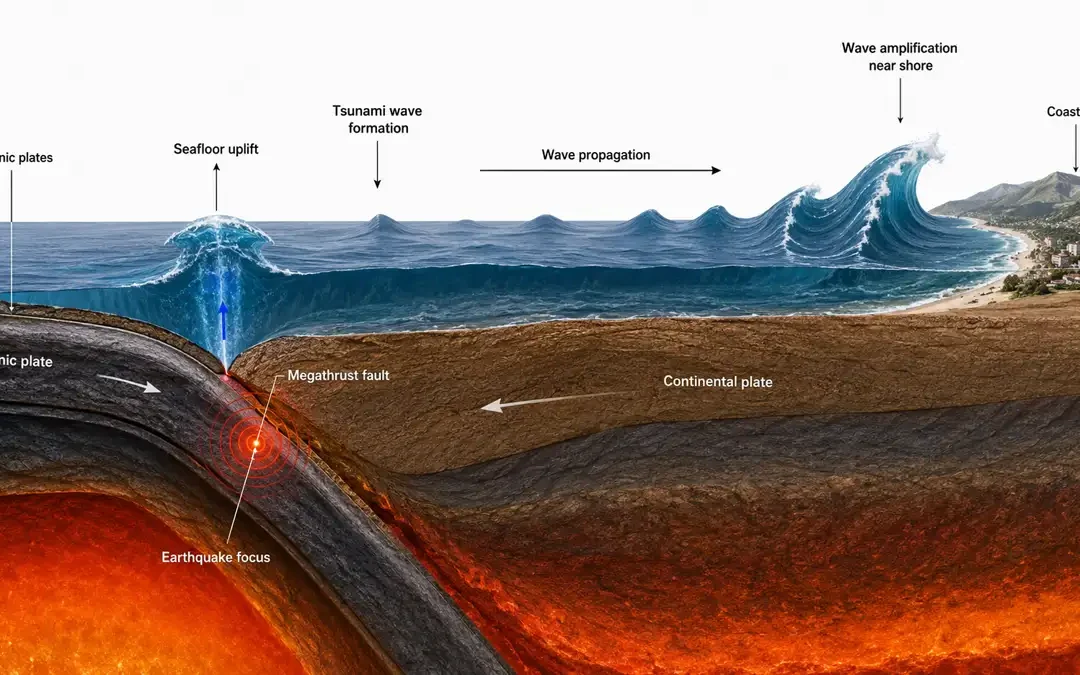
A tsunami is primarily caused by the sudden displacement of a large volume of seawater. Around 80% of destructive tsunamis are triggered by powerful underwater earthquakes occurring at subduction zones, where one tectonic plate slips beneath another. Other causes include volcanic eruptions, underwater landslides, glacier collapses, and, in extremely rare cases, asteroid impacts. Once the ocean floor suddenly moves, it pushes the overlying water upward or downward, creating powerful waves that travel across the ocean and grow dramatically taller as they approach shallow coastal areas.
The Complete Scientific Explanation
Imagine standing on a peaceful beach when the ocean suddenly begins to retreat hundreds of meters from the shoreline. Fish are left flopping on the exposed seabed, boats tilt on the sand, and curious people walk toward the water. Minutes later, a towering wall of water rushes inland, destroying everything in its path.
This is how many devastating tsunamis begin.
If you've ever wondered what's the cause of tsunami, the answer lies deep beneath the ocean floor. Unlike ordinary waves created by wind, tsunamis are triggered when an enormous amount of seawater is suddenly displaced. In most cases, this happens during a powerful underwater earthquake, although volcanic eruptions, submarine landslides, glacier collapses, and even asteroid impacts can also generate tsunami waves.
Tsunamis are among Earth's most destructive natural hazards because they can travel across entire oceans at jet-airliner speeds while remaining almost invisible in deep water. By the time they reach the coast, these waves may rise several meters—or even tens of meters—high, causing catastrophic flooding and widespread destruction.
In this guide, you'll discover how tsunamis form, what causes them, why some earthquakes generate tsunamis while others do not, and how scientists monitor these dangerous waves to help protect coastal communities.
What Is a Tsunami?
A tsunami is a series of extremely long ocean waves generated when a massive amount of water is suddenly displaced.
Unlike regular waves created by wind blowing across the ocean surface, tsunami waves involve movement throughout the entire water column, from the seafloor to the ocean surface.
This difference makes tsunamis far more powerful than ordinary waves.
A tsunami is not a single giant wave. Instead, it usually arrives as a series of waves that can continue striking the coastline for several hours. In many cases, the first wave is not even the largest. Later waves may be stronger and more destructive.
Because tsunami waves have wavelengths that can exceed 100 kilometers (62 miles), they behave very differently from wind-generated waves.
| Feature | Regular Ocean Waves | Tsunami Waves |
|---|---|---|
| Main Cause | Wind | Sudden displacement of seawater |
| Wave Length | 50–200 meters | Up to 500 kilometers |
| Wave Speed | 10–60 km/h | Up to 800 km/h |
| Water Movement | Surface only | Entire water column |
| Frequency | Continuous | Rare |
| Destructive Potential | Usually low | Extremely high |
What's the Cause of Tsunami?
The direct cause of every tsunami is the sudden displacement of a massive volume of water.
That displacement can occur due to several natural events, but one mechanism dominates all others.
| Cause | Frequency | Can Produce Large Tsunami? |
|---|---|---|
| Underwater Earthquakes | Very Common | ✅ Yes |
| Volcanic Eruptions | Less Common | ✅ Yes |
| Underwater Landslides | Moderate | ✅ Yes |
| Glacier Collapse | Rare | Sometimes |
| Asteroid Impact | Extremely Rare | Yes |
Among these, underwater earthquakes are responsible for the overwhelming majority of destructive tsunamis worldwide.
The Most Common Cause of Tsunami: Underwater Earthquakes
Nearly every major tsunami in recorded history has been linked to powerful earthquakes occurring beneath the ocean floor.
However, not all underwater earthquakes produce tsunamis.
For a tsunami to form, the earthquake must meet several important conditions.
1. It Must Occur Underwater
Earthquakes that happen deep beneath continents generally cannot displace enough seawater to generate a tsunami.
The earthquake must occur beneath the ocean or very close to the coastline.
2. The Earthquake Must Be Powerful
Scientists generally consider earthquakes with magnitudes above 7.5 to have significant tsunami potential.
The largest tsunamis usually result from earthquakes measuring 8.5 or greater.
| Earthquake | Magnitude | Generated Tsunami? |
|---|---|---|
| 2004 Indian Ocean | 9.1–9.3 | Yes |
| 2011 Japan | 9.0 | Yes |
| 1960 Chile | 9.5 | Yes |
| Small Magnitude 5 Earthquake | 5.0 | Usually No |
3. The Seafloor Must Move Vertically
This is perhaps the most important requirement.
If two tectonic plates slide horizontally past each other, very little water is displaced.
However, when one side of the seafloor suddenly rises or falls by several meters, enormous volumes of water move with it.
Vertical movement is what creates tsunami waves.
How Plate Tectonics Create Tsunamis
Earth's outer shell, known as the lithosphere, is broken into massive tectonic plates that slowly move across the planet.
These plates move only a few centimeters each year, but over decades and centuries they accumulate tremendous stress.
Eventually, the rocks can no longer withstand the pressure.
They suddenly rupture.
This sudden release of energy creates an earthquake.
When that rupture occurs beneath the ocean and involves vertical movement, a tsunami may follow.
Understanding Subduction Zones
The most dangerous places for tsunami generation are called subduction zones.
These are locations where a dense oceanic tectonic plate slowly sinks beneath another tectonic plate.
As the plates become locked together, stress builds for decades or even centuries.
Eventually, the upper plate snaps upward while the lower plate slips downward.
This movement can lift huge sections of the ocean floor by several meters within seconds.
That sudden uplift displaces billions of tons of seawater, initiating tsunami waves.
Why the Pacific Ring of Fire Produces Most Tsunamis
The Pacific Ring of Fire is a horseshoe-shaped zone surrounding much of the Pacific Ocean where tectonic plates collide, subduct, and generate frequent earthquakes and volcanic eruptions.
Approximately 75% of the world's active volcanoes and many of its largest earthquakes occur within this region. As a result, it is also the source of most major tsunamis.
Countries frequently affected include:
- Japan
- Indonesia
- Chile
- Alaska (USA)
- Philippines
- Papua New Guinea
- New Zealand
- Russia's Kamchatka Peninsula
Because these regions experience regular seismic activity, they maintain advanced tsunami monitoring and early warning systems.
Why Some Earthquakes Don't Cause Tsunamis
One of the biggest misconceptions is that every underwater earthquake creates a tsunami.
In reality, most do not.
Several factors determine whether an earthquake can generate a tsunami:
| Factor | Needed for Tsunami? |
|---|---|
| Underwater location | ✅ Yes |
| Magnitude above ~7.5 | Usually |
| Vertical seafloor movement | Essential |
| Large rupture area | Yes |
| Deep ocean setting | Often |
For example, earthquakes along transform faults, where plates slide horizontally past one another, rarely produce significant tsunamis because they do not lift or lower the seafloor enough to displace large volumes of water.
Did You Know?
- Tsunami is a Japanese word meaning "harbor wave."
- In deep water, a tsunami may be less than 1 meter (3 feet) high, making it difficult for ships to notice.
- A tsunami can cross the Pacific Ocean in less than 24 hours.
- The first visible warning of a tsunami is sometimes the sea rapidly receding from the shore, exposing the seabed before the waves arrive.
Can Volcanoes Cause a Tsunami?
Yes. Although underwater earthquakes are responsible for most tsunamis, volcanic eruptions can also generate destructive tsunami waves. In some cases, volcanic tsunamis have caused severe damage even without a major earthquake.
A tsunami forms when volcanic activity suddenly displaces a large volume of seawater. This can happen in several ways, including explosive eruptions, the collapse of a volcano into the ocean, or underwater volcanic explosions.
Unlike earthquake-generated tsunamis, volcanic tsunamis are often localized, but they can still travel hundreds or even thousands of kilometers depending on the size of the event.
How Volcanic Eruptions Trigger Tsunamis
There are several mechanisms by which volcanoes can produce tsunami waves.
1. Explosive Underwater Eruptions
When a submarine volcano erupts violently, the explosion rapidly pushes seawater outward. The displaced water forms waves that spread across the surrounding ocean.
This type of tsunami is relatively uncommon but can be extremely powerful near the eruption site.
2. Collapse of a Volcanic Island
Sometimes, part of a volcanic island suddenly collapses into the sea after an eruption.
Millions of cubic meters of rock plunge into the ocean, displacing enormous amounts of water.
This process creates tsunami waves similar to dropping a giant boulder into a lake—but on a much larger scale.
3. Pyroclastic Flows Entering the Ocean
Fast-moving mixtures of hot gas, ash, and volcanic rock, known as pyroclastic flows, can rush down volcanic slopes and enter the sea.
The sudden entry of this material pushes seawater outward, generating tsunami waves.
Real-World Example: Hunga Tonga Eruption (2022)
In January 2022, the underwater Hunga Tonga–Hunga Haʻapai volcano erupted with extraordinary force.
The eruption:
- Generated tsunami waves across the Pacific Ocean
- Produced atmospheric pressure waves detected around the world
- Caused coastal flooding in Tonga, Japan, Peru, and several Pacific nations
- Demonstrated that volcanoes can trigger tsunamis even without a major earthquake
It remains one of the most powerful volcanic eruptions recorded in the satellite era.
Can Underwater Landslides Cause a Tsunami?
Yes.
Large submarine landslides are another important cause of tsunamis.
Instead of the seafloor moving because of an earthquake, huge masses of sediment, rock, or volcanic material suddenly slide down underwater slopes.
As this material moves, it displaces seawater and generates waves.
Although these tsunamis usually affect smaller areas than earthquake-generated tsunamis, they can produce extremely high waves near the source.
What Causes Underwater Landslides?
Several natural processes can destabilize the ocean floor.
These include:
- Earthquakes
- Volcanic eruptions
- Rapid sediment accumulation
- Coastal cliff collapse
- Gas hydrate failure beneath the seabed
Sometimes a relatively small earthquake can trigger an enormous submarine landslide, which then produces a tsunami much larger than expected.
Historic Example: Grand Banks Tsunami (1929)
One of the best-known submarine landslide tsunamis occurred near Newfoundland, Canada.
A magnitude 7.2 earthquake triggered a massive underwater landslide.
The landslide generated tsunami waves that struck nearby coastlines, causing widespread destruction and numerous fatalities.
Scientists later discovered that much of the tsunami's energy came from the landslide rather than the earthquake itself.
How Tsunami Waves Travel Across the Ocean
One of the most fascinating aspects of a tsunami is how it moves through deep water.
Unlike ordinary waves, tsunami waves possess:
- Extremely long wavelengths
- Long wave periods
- Very high speeds
- Low wave heights in deep water
Because so much water is moving together, tsunamis lose very little energy while crossing entire ocean basins.
| Water Depth | Approximate Speed |
|---|---|
| 5,000 m | 700–800 km/h |
| 4,000 m | 650–720 km/h |
| 2,000 m | 500–560 km/h |
| Near Shore | 30–80 km/h |
In the deep ocean, a tsunami can travel nearly as fast as a commercial airplane.
Ships crossing the ocean often do not notice the passing wave because its height may be less than one meter.
Frequently Asked Questions
The primary cause of a tsunami is the sudden displacement of a large volume of seawater. Around 80% of destructive tsunamis are triggered by powerful underwater earthquakes occurring at subduction zones, where one tectonic plate moves beneath another.
Most small earthquakes do not generate tsunamis because they do not move enough of the seafloor. Larger earthquakes—typically magnitude 7.5 or greater—are much more likely to produce significant tsunami waves, especially if they involve vertical displacement beneath the ocean.
Besides earthquakes, tsunamis can be caused by:
Volcanic eruptions
Underwater landslides
Glacier collapses into water
Rare asteroid or meteorite impacts
Each of these events can suddenly displace seawater and generate tsunami waves
In deep ocean water, a tsunami can travel at speeds of 700–800 km/h (435–500 mph), comparable to a commercial jet. As it reaches shallow coastal waters, it slows down but grows much taller.
Tsunamis move the entire water column, not just the ocean surface. This allows them to carry enormous amounts of energy across long distances. When they reach shallow water, the waves rise dramatically and can cause catastrophic coastal flooding.
Yes. Although uncommon, volcanic eruptions, submarine landslides, glacier collapses, and asteroid impacts can all produce tsunamis without an earthquake.
Most tsunamis occur around the Pacific Ring of Fire, where tectonic plates frequently collide and produce powerful earthquakes and volcanic eruptions.
Myth vs. Fact
| Myth | Fact |
|---|---|
| Every earthquake creates a tsunami. | Most earthquakes do not produce tsunamis. |
| Tsunamis are giant tidal waves. | Tsunamis are unrelated to tides. |
| Only one tsunami wave arrives. | A tsunami usually consists of several waves. |
| Deep-ocean tsunami waves are enormous. | In deep water, tsunami waves are often less than one meter high. |
| You can safely watch a tsunami from the beach. | Tsunamis are unpredictable and can arrive faster than expected. Evacuate immediately. |
Tsunami Glossary
| Term | Definition |
|---|---|
| Tsunami | A series of long ocean waves caused by sudden water displacement. |
| Tectonic Plate | A large section of Earth's lithosphere that moves slowly over time. |
| Subduction Zone | A region where one tectonic plate sinks beneath another. |
| Megathrust Earthquake | A very large earthquake occurring at a subduction zone. |
| Seafloor Displacement | The upward or downward movement of the ocean floor that can generate a tsunami. |
| Shoaling | The process in which tsunami waves slow down and grow taller in shallow water. |
| Run-up Height | The maximum vertical height reached by tsunami water on land. |
| DART Buoy | A deep-ocean instrument used to detect tsunami waves by measuring pressure changes. |
Key Facts at a Glance
| Question | Answer |
|---|---|
| Main Cause | Underwater earthquakes |
| Other Causes | Volcanoes, landslides, glacier collapse, asteroid impacts |
| Fastest Speed | About 800 km/h (500 mph) in deep water |
| Most Active Region | Pacific Ring of Fire |
| Can They Be Predicted? | Not before they form, but warnings can be issued after detection |
| Biggest Recorded Earthquake | 1960 Chile (Magnitude 9.5) |
| Deadliest Modern Tsunami | 2004 Indian Ocean |
Conclusion
So, what's the cause of tsunami?
The answer is both simple and fascinating. A tsunami begins when a massive volume of seawater is suddenly displaced. In most cases, this happens because a powerful underwater earthquake lifts or drops the seafloor at a subduction zone. That rapid movement pushes the overlying water, creating long waves that race across the ocean. While they may be barely noticeable in deep water, these waves slow down and grow dramatically taller as they approach the coast, where they can cause devastating flooding.
Earthquakes remain the leading cause of tsunamis, but they are not the only trigger. Volcanic eruptions, submarine landslides, glacier collapses, and even rare asteroid impacts can generate tsunami waves under the right conditions. Understanding these processes allows scientists to improve hazard assessments, strengthen early warning systems, and help communities prepare for future events.
Although we cannot prevent tsunamis, knowledge, preparedness, and rapid response save lives. Recognizing natural warning signs, following official evacuation orders, and supporting resilient coastal planning are among the most effective ways to reduce tsunami risks.