
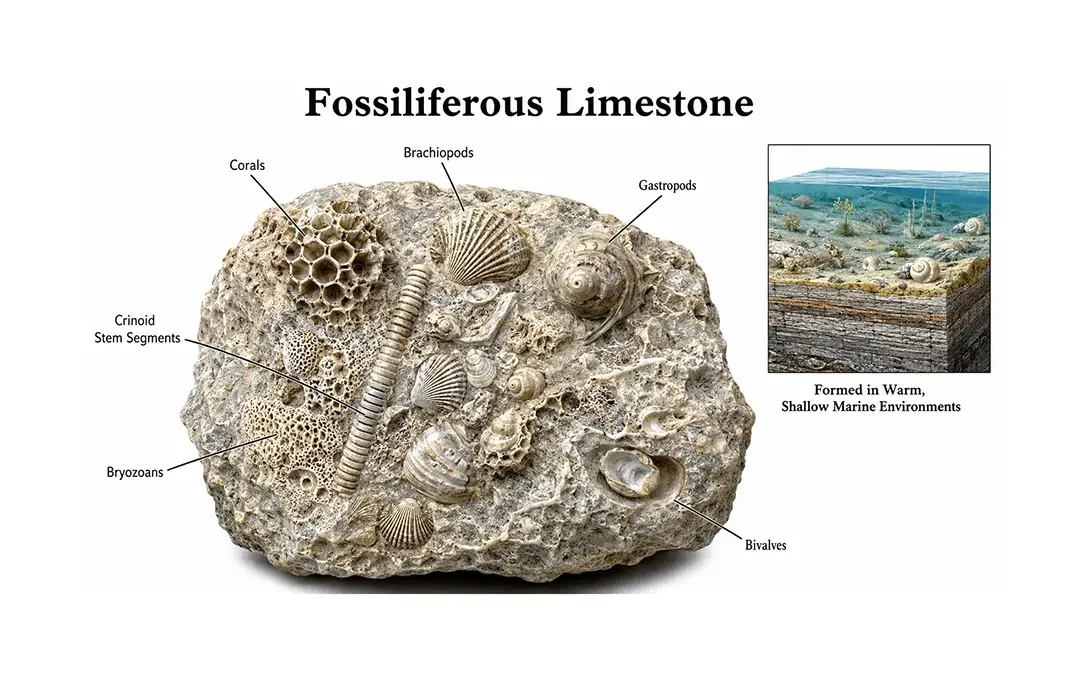
Imagine holding a rock that preserves an ancient coral reef, seashells from a vanished ocean, or the skeleton of a marine creature that lived over 300 million years ago. That is exactly what fossiliferous limestone offers—a remarkable glimpse into Earth's distant past.
Unlike many sedimentary rocks that appear uniform, fossiliferous limestone is filled with visible remains of ancient organisms. Every fossil embedded within the rock tells a story about prehistoric oceans, climate, biodiversity, and the environments where life once thrived.
Because of its abundance, fossil content, and scientific value, fossiliferous limestone is one of the most important carbonate rocks studied by geologists, paleontologists, and environmental scientists. It also plays a significant role in construction, groundwater storage, petroleum exploration, and understanding Earth's evolutionary history.
In this guide, we'll explore how fossiliferous limestone forms, what it's made of, how to identify it, and why it remains one of the most fascinating sedimentary rocks on our planet.
What Is Fossiliferous Limestone?
Fossiliferous limestone is a sedimentary carbonate rock composed primarily of calcite (CaCO₃) that contains abundant visible fossils or fossil fragments. These fossils may include shells, corals, crinoids, brachiopods, bryozoans, mollusks, echinoderms, and other marine organisms that lived millions of years ago.
Unlike pure chemical limestone, which forms mainly through mineral precipitation, fossiliferous limestone is largely biogenic, meaning it originates from the remains of living organisms.
After marine organisms die, their shells and skeletons accumulate on the seafloor. Over millions of years, these remains become buried beneath additional sediments. Pressure, compaction, and natural cementation gradually transform the loose biological material into solid limestone while preserving many of the fossils.
This makes fossiliferous limestone both a sedimentary rock and a natural fossil archive.
Quick Facts
| Property | Description |
|---|---|
| Rock Type | Sedimentary |
| Category | Carbonate Rock |
| Main Mineral | Calcite |
| Chemical Formula | CaCO₃ |
| Texture | Fine to coarse |
| Fossils | Common and abundant |
| Typical Color | White, cream, gray, tan, brown |
| Depositional Environment | Warm shallow marine seas |
| Geological Age | Mostly Paleozoic to Cenozoic |
Why Is It Called Fossiliferous Limestone?
The word fossiliferous literally means "containing fossils."
It comes from two Latin roots:
- Fossilis = dug up
- Ferre = to bear or carry
Therefore, fossiliferous limestone simply means "limestone that bears fossils."
Unlike ordinary limestone, the fossils are often large enough to be seen without a microscope. Some specimens contain hundreds of shells packed together, while others preserve entire corals, sea lilies, or ancient reef communities almost exactly as they existed millions of years ago.
How Does Fossiliferous Limestone Form?
The formation of fossiliferous limestone is a slow geological process that can take millions of years. It begins in warm, shallow oceans where marine life flourishes and ends with the lithification of accumulated skeletal material into solid rock.
Step 1: Marine Organisms Thrive
Most fossiliferous limestone forms in tropical or subtropical seas with:
- Warm water
- Clear conditions
- High sunlight
- Low sediment input
- Rich marine ecosystems
These conditions support organisms that build shells and skeletons from calcium carbonate, such as:
- Corals
- Clams
- Oysters
- Snails
- Brachiopods
- Crinoids
- Bryozoans
- Foraminifera
- Sea urchins
When these organisms die, their hard parts settle onto the seafloor.
Step 2: Accumulation of Skeletal Material
Over thousands to millions of years, countless shells, skeletal fragments, and coral pieces accumulate in thick layers.
Instead of decomposing, these hard calcium carbonate structures resist decay and begin forming carbonate sediment.
Some modern coral reefs produce several millimeters of carbonate sediment every year.
Step 3: Burial Beneath New Sediments
As more biological material accumulates, older layers become buried beneath newer deposits.
Increasing burial causes:
- Pressure
- Compaction
- Reduction of pore spaces
- Rearrangement of grains
This stage marks the beginning of lithification.
Step 4: Cementation
Groundwater carrying dissolved calcium carbonate flows through the sediments.
Calcite precipitates between shell fragments, acting as natural cement that binds the particles together.
This cementation transforms loose carbonate sediment into solid fossiliferous limestone.
Step 5: Preservation of Fossils
One remarkable feature of limestone is its ability to preserve delicate fossils.
Depending on burial conditions, the rock may preserve:
- Complete shells
- Coral colonies
- Crinoid stems
- Brachiopods
- Gastropods
- Internal molds
- External molds
- Original shell material
- Fine skeletal details
Some fossils remain nearly unchanged for hundreds of millions of years.
Geological Conditions Required for Formation
Fossiliferous limestone does not form everywhere. Several environmental conditions must come together for fossil preservation and limestone formation.
Warm, Shallow Marine Water
Most fossiliferous limestones formed on ancient continental shelves where sunlight reached the seafloor.
These environments encourage:
- Coral growth
- Shell production
- Carbonate accumulation
Examples include modern environments around:
- The Bahamas
- Persian Gulf
- Great Barrier Reef
- Caribbean Sea
These regions provide modern analogs for ancient fossiliferous limestone deposits.Low Siliciclastic Sediment Input
Too much sand, mud, or clay can bury carbonate-producing organisms before thick limestone develops.
Ideal environments receive relatively little sediment from nearby rivers.
This allows carbonate-producing organisms to dominate.
Stable Water Chemistry
Marine water must remain saturated with calcium carbonate.
Changes in:
- Temperature
- Ocean acidity
- Salinity
- Carbon dioxide
can strongly influence carbonate production.
Long-Term Geological Stability
Large limestone formations require millions of years of uninterrupted sediment accumulation.
Rapid tectonic activity or volcanic eruptions may interrupt limestone deposition.
Composition of Fossiliferous Limestone
Although fossils are its most obvious feature, fossiliferous limestone consists of several important components.
| Component | Typical Percentage |
|---|---|
| Calcite | 70–98% |
| Fossil Fragments | Highly variable |
| Micrite (lime mud) | Common |
| Sparry Calcite Cement | Common |
| Clay Minerals | Minor |
| Quartz | Minor |
| Dolomite | Sometimes present |
| Organic Matter | Trace amounts |
The exact composition depends on:
- Original organisms
- Water chemistry
- Burial history
- Diagenesis
- Degree of recrystallization
Why Fossils Are Preserved So Well in Limestone
Calcium carbonate shells are chemically similar to the calcite that cements limestone. Because of this similarity, fossiliferous limestone often preserves delicate biological structures that would be destroyed in many other rock types.
Several factors contribute to exceptional preservation:
- Rapid burial after death, reducing decay and scavenging.
- Low-oxygen conditions, which slow decomposition.
- Early calcite cementation that stabilizes shells and skeletal fragments.
- Minimal disturbance from waves or strong currents after burial.
As a result, geologists can sometimes identify tiny growth lines, coral structures, or shell ornamentation that formed hundreds of millions of years ago.
Types of Fossiliferous Limestone
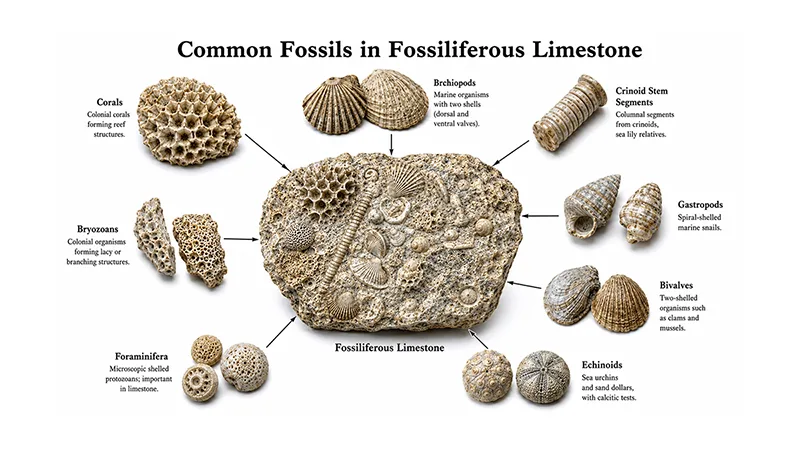
Not all fossiliferous limestones are the same. Geologists classify them according to the dominant fossil types, grain size, depositional environment, and texture.
Coral Limestone
Coral limestone is dominated by fossilized coral colonies that once formed ancient reefs.
Characteristics
- Massive reef structures
- Branching coral fossils
- Highly porous in places
- Common in tropical settings
These rocks often preserve entire reef ecosystems, including corals, algae, mollusks, and echinoderms.
Crinoidal Limestone
Crinoidal limestone consists mainly of broken crinoid stems and skeletal plates.
Crinoids, sometimes called sea lilies, lived attached to the seafloor where they filtered food from seawater.
Identifying Features
- Numerous circular fossil discs
- Medium to coarse texture
- Gray or cream color
- Excellent fossil preservation
Crinoidal limestone is particularly common in Paleozoic rock formations.
Brachiopod Limestone
This variety contains abundant brachiopod shells.
Brachiopods resemble clams but belong to an entirely different animal group. They were among the most successful marine organisms during the Paleozoic Era.
Brachiopod-rich limestone is commonly used by paleontologists to reconstruct ancient shallow seas.
Molluscan Limestone
Molluscan limestone is dominated by the shells of:
- Clams
- Oysters
- Snails
- Scallops
- Cephalopods
The abundance of mollusk fossils often reflects nutrient-rich shallow marine environments.
Bryozoan Limestone
Bryozoans are tiny colonial animals that build intricate calcium carbonate skeletons.
Although individual organisms are microscopic, entire colonies can become important limestone-forming components.
Under magnification, bryozoan fossils display beautiful honeycomb-like patterns.
Mixed Fossil Limestone
Many fossiliferous limestones contain a mixture of several fossil groups rather than a single dominant organism.
These rocks may preserve:
- Corals
- Brachiopods
- Crinoids
- Gastropods
- Trilobite fragments
- Bryozoans
- Foraminifera
Mixed fossil limestone often represents highly diverse marine ecosystems.
Depositional Environments
The fossils preserved in limestone provide valuable clues about the environment in which the rock formed. By studying fossil assemblages and sedimentary structures, geologists can reconstruct ancient marine settings with remarkable accuracy.
Shallow Continental Shelves
Most fossiliferous limestone formed on broad continental shelves where sunlight penetrated to the seafloor.
These environments supported:
- Coral reefs
- Shellfish
- Algae
- Crinoids
- Brachiopods
Modern examples include parts of the Bahamas and the Persian Gulf, where carbonate sediment continues to accumulate today.
Reef Environments
Coral reefs produce enormous amounts of calcium carbonate.
When reefs die and become buried, they often develop into thick fossiliferous limestone containing well-preserved reef organisms.
Ancient reef limestones are among the richest fossil deposits on Earth.
Lagoon Systems
Protected lagoons behind reefs experience calmer water conditions.
Fine carbonate mud settles alongside shells, algae, and other biological debris, creating fossil-rich limestone with excellent preservation.
Carbonate Platforms
Carbonate platforms are extensive, shallow marine regions where biological carbonate production exceeds the supply of sand and mud from land.
These environments generate some of the world's thickest limestone successions.
Shelf Margins
Shelf margins receive sediments transported from both reefs and deeper marine environments.
As a result, fossiliferous limestone here often contains mixed fossil communities and complex sedimentary structures.
How to Identify Fossiliferous Limestone
One of the easiest ways to recognize fossiliferous limestone is by examining its surface closely. Visible fossils usually distinguish it from most other sedimentary rocks.
Identification Checklist
✔ Visible shells or skeletal fragments
✔ Reacts strongly with dilute hydrochloric acid
✔ Usually light-colored
✔ Relatively soft compared to sandstone
✔ Contains calcite-rich cement
✔ Often breaks through fossils rather than around them
A hand lens is useful for identifying smaller fossils that may not be obvious to the naked eye.
How Geologists Study Fossiliferous Limestone
Fieldwork is only the beginning. In laboratories, geologists use a range of techniques to investigate fossiliferous limestone in greater detail.
Common methods include:
- Thin-section petrography under polarized microscopes
- Scanning electron microscopy (SEM)
- X-ray diffraction (XRD) for mineral identification
- Stable isotope analysis
- Cathodoluminescence imaging
- Fossil taxonomy and morphometric analysis
These techniques reveal details about mineral composition, fossil preservation, diagenesis, and ancient environments that cannot be seen with the naked eye.
Interesting Facts About Fossiliferous Limestone
- Some fossiliferous limestones are more than 500 million years old.
- Entire coral reefs can become fossiliferous limestone after burial and lithification.
- Fossils preserved in limestone are often far more detailed than those found in sandstone or shale.
- Many museum-quality fossils are collected from fossiliferous limestone formations.
- Numerous famous buildings around the world were constructed using fossil-rich limestone.
- Certain limestone quarries expose thousands of fossils on a single rock face.
- Some cave walls display marine fossils even though the caves are now hundreds of kilometers from the nearest ocean.
Frequently Asked Questions
Fossiliferous limestone is a sedimentary carbonate rock composed mainly of calcite that contains abundant visible fossils or fossil fragments from ancient marine organisms.
It forms when shells, corals, crinoids, brachiopods, and other marine organisms accumulate on the seafloor. Over millions of years, these remains are compacted and cemented into solid limestone.
It occurs worldwide in ancient shallow marine deposits. Major exposures can be found in the United States, United Kingdom, Canada, Germany, Morocco, Australia, and many other regions.
Yes. It belongs to the carbonate rock family because it consists primarily of calcium carbonate in the form of calcite.
It provides valuable information about ancient life, marine environments, Earth's climate history, and geological evolution. It is also widely used in construction, cement manufacturing, agriculture, groundwater storage, and petroleum exploration.
Yes. If it is subjected to high temperatures and pressures during regional or contact metamorphism, fossiliferous limestone recrystallizes into marble. In many cases, the original fossils become distorted or completely erased during this process.