
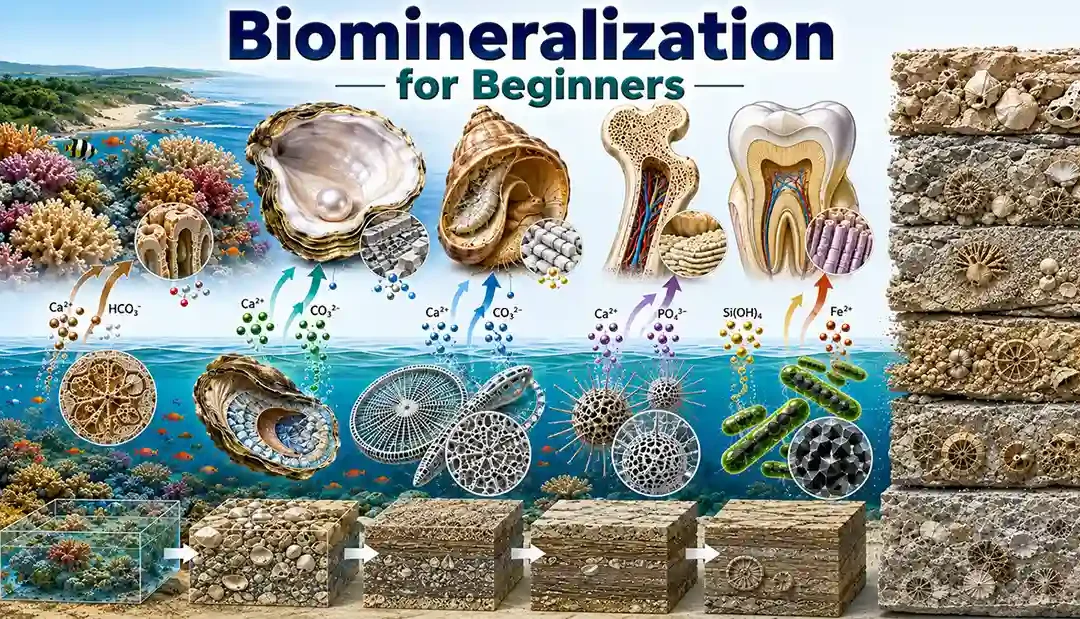
Biomineralization is the natural process by which living organisms produce minerals within or around their bodies. Through carefully controlled biological and chemical processes, organisms combine dissolved ions from water or body fluids to build hard structures such as shells, bones, teeth, coral skeletons, pearls, and microscopic silica skeletons.
Biomineralization has occurred on Earth for more than 3.5 billion years and has played a major role in shaping Earth's crust, oceans, atmosphere, and sedimentary rocks. Many limestones, chalk deposits, reefs, and marine sediments consist almost entirely of minerals originally produced by living organisms.
Understanding biomineralization connects mineralogy, biology, paleontology, sedimentology, geochemistry, environmental science, and materials science.
This topic should be studied together with Carbonate Minerals Explained, Sedimentary Mineral Formation Explained, Mineralogy Explained, and Crystal Chemistry Explained.
What Is Biomineralization?
Biomineralization is the biological production of minerals by living organisms.
The process involves:
- Absorption of dissolved ions
- Biological control of crystal growth
- Mineral precipitation
- Crystal organization
- Formation of hard tissues
Unlike inorganic mineral formation, biomineralization is directed by living cells and organic molecules.
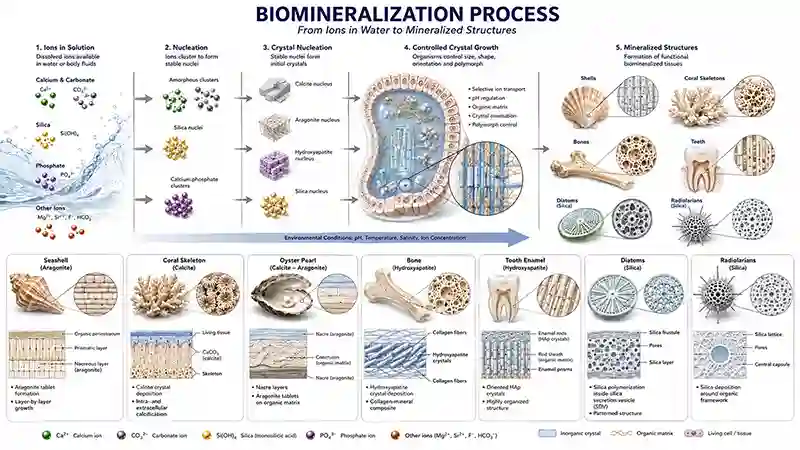
How Biomineralization Works
The process generally follows several stages.
- Organisms absorb dissolved ions.
- Specialized cells transport the ions.
- Organic molecules control crystal nucleation.
- Minerals grow in specific shapes and orientations.
- Hard biological structures develop.
Living organisms precisely control crystal size, shape, and composition.
Main Components of Biomineralization
Biomineralization depends on:
- Water
- Dissolved ions
- Organic proteins
- Polysaccharides
- Living cells
- Crystal nuclei
Organic molecules guide mineral growth with remarkable precision.
Major Types of Biomineralization
Carbonate Biomineralization
Organisms produce calcium carbonate.
Main minerals include:
- Calcite
- Aragonite
Common organisms:
- Corals
- Mollusks
- Foraminifera
- Coccolithophores
Phosphate Biomineralization
Produces calcium phosphate minerals.
Main mineral:
- Hydroxyapatite
Found in:
- Bones
- Teeth
- Fish scales
Silica Biomineralization
Some organisms produce silica skeletons.
Examples:
- Diatoms
- Radiolarians
- Sponges
These organisms contribute to siliceous marine sediments.
Iron Biomineralization
Certain bacteria produce iron minerals.
Common example:
- Magnetite
Magnetotactic bacteria use magnetite crystals for navigation.
Common Biominerals
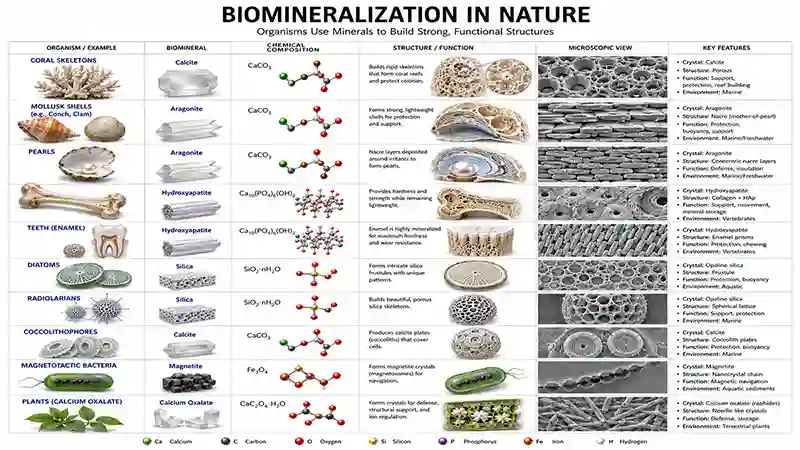
Calcite
Forms:
- Shells
- Marine sediments
- Limestone
Aragonite
Common in:
- Coral reefs
- Pearls
- Mollusk shells
May later transform into calcite during diagenesis.
Hydroxyapatite
The primary mineral of:
- Bones
- Teeth
Provides strength and durability.
Silica
Produced by:
- Diatoms
- Radiolarians
- Some sponges
Important source of siliceous sediments.
Magnetite
- Produced by magnetotactic bacteria.
- Helps organisms orient using Earth's magnetic field.
Accessory Biominerals
Other biologically produced minerals include:
- Vaterite
- Dolomite (microbially influenced in some environments)
- Pyrite (formed through microbial activity)
- Vivianite
- Struvite
- Calcium oxalate
These minerals occur in specialized biological or environmental settings.
Organisms That Produce Minerals
Many organisms perform biomineralization.
Examples include:
- Corals
- Mollusks
- Oysters
- Clams
- Diatoms
- Radiolarians
- Sponges
- Coccolithophores
- Foraminifera
- Vertebrates
- Magnetotactic bacteria
Each produces characteristic minerals adapted to its biological needs.
Biomineralization and Sedimentary Rocks
Biomineralization contributes significantly to sedimentary rock formation.
Examples include:
- Limestone
- Chalk
- Reef limestone
- Diatomite
- Radiolarite
Over millions of years, accumulated biominerals become lithified into rock.
Geological Importance
Biomineralization helps geologists:
- Understand ancient marine environments
- Reconstruct past climates
- Interpret fossil records
- Study ocean chemistry
- Investigate carbonate platforms
- Explain sediment formation
Biominerals preserve valuable evidence of Earth's history.
Biological and Economic Importance
Biomineralization is important for:
- Human bones and teeth
- Marine ecosystems
- Coral reef development
- Carbon cycling
- Fossil preservation
- Medical implants
- Biomaterials engineering
Scientists also study biomineralization to develop stronger synthetic materials.
Laboratory Investigation
Biominerals are studied using:
- Petrographic Microscopy
- Scanning Electron Microscopy (SEM)
- Transmission Electron Microscopy (TEM)
- X-Ray Diffraction (XRD)
- Electron Microprobe Analysis (EPMA)
- Raman Spectroscopy
- Stable Isotope Analysis
These techniques reveal crystal structures, growth patterns, and chemical composition.
Applications
Biomineralization research is widely used in:
- Mineralogy
- Paleontology
- Sedimentology
- Marine Geology
- Biology
- Medicine
- Biomaterials Science
- Environmental Science
Advantages of Studying Biomineralization
Studying biomineralization helps scientists:
- Understand fossil formation
- Reconstruct ancient environments
- Develop biomimetic materials
- Improve medical implants
- Study ocean chemistry
- Investigate biological evolution
Limitations
Studying biomineralization presents several challenges:
- Biological processes vary widely among organisms.
- Biominerals may be altered during diagenesis and metamorphism.
- Some original mineral structures are replaced during fossilization.
- Detailed biological, chemical, and mineralogical analyses are often required to distinguish primary biominerals from later alterations.
For comprehensive understanding, combine this topic with:
- Carbonate Minerals Explained
- Sedimentary Mineral Formation Explained
- Crystal Chemistry Explained
- Mineralogy Explained
- Geothermal Mineral Formation Explained
- Petrographic Microscopy
- X-Ray Diffraction in Mineralogy
- Mineral Chemistry Analysis
Comparison Table
| Biomineral | Chemical Composition | Common Organisms |
|---|---|---|
| Calcite | CaCO₃ | Corals, Foraminifera |
| Aragonite | CaCO₃ | Mollusks, Pearls |
| Hydroxyapatite | Ca₅(PO₄)₃OH | Vertebrates |
| Silica | SiO₂ | Diatoms, Radiolarians |
| Magnetite | Fe₃O₄ | Magnetotactic Bacteria |
Summary Table
| Feature | Biomineralization |
| Definition | Biological Formation of Minerals |
| Main Mineral Groups | Carbonates, Phosphates, Silica, Iron Minerals |
| Major Organisms | Corals, Mollusks, Diatoms, Vertebrates |
| Common Study Methods | SEM, TEM, XRD, EPMA |
| Geological Importance | Sedimentary Rocks, Fossils, Carbon Cycle |
Biomineralization is the natural process by which living organisms produce minerals to form structures such as shells, bones, teeth, coral skeletons, and microscopic skeletons.
The most common biominerals are calcite, aragonite, hydroxyapatite, silica, and magnetite.
Biomineralization contributes to the formation of limestone, chalk, reefs, diatomite, and many fossil-bearing sedimentary rocks while preserving evidence of ancient environments.
Corals, mollusks, oysters, clams, diatoms, radiolarians, coccolithophores, vertebrates, and magnetotactic bacteria are among the many organisms that produce minerals.
Scientists investigate biomineralization using petrographic microscopy, scanning electron microscopy (SEM), transmission electron microscopy (TEM), X-ray diffraction (XRD), electron microprobe analysis (EPMA), Raman spectroscopy, and stable isotope analysis.
Final Thoughts
Biomineralization is one of Earth's most remarkable natural processes, demonstrating how living organisms can precisely control the formation of minerals. From coral reefs and mollusk shells to bones, teeth, and microscopic plankton, biologically produced minerals influence ecosystems, sedimentary rocks, fossil preservation, and the global carbon cycle.
By integrating mineralogy, biology, geochemistry, and advanced analytical techniques, scientists continue to uncover how organisms build mineral structures and how these processes have shaped Earth's geological history for billions of years. Biomineralization remains a key topic in mineralogy, sedimentology, paleontology, environmental science, and biomaterials research.
Continue Learning
Continue exploring mineral formation with these related guides: