
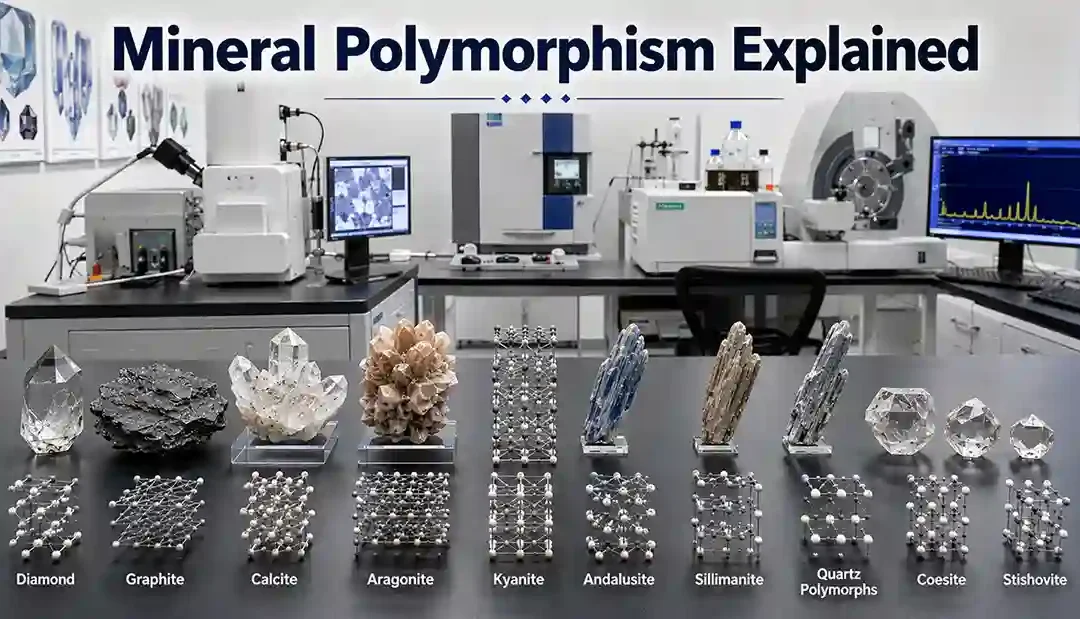
Mineral polymorphism is the phenomenon in which two or more minerals have the same chemical composition but different crystal structures. Because the arrangement of atoms differs, each polymorph has unique physical, chemical, and optical properties, even though the chemical formula remains identical.
Polymorphism develops because minerals crystallize under different combinations of temperature, pressure, and geological environment. Well-known examples include diamond and graphite, both composed entirely of carbon, and the aluminum silicate polymorphs kyanite, andalusite, and sillimanite, which all share the chemical formula Al₂SiO₅.
Understanding mineral polymorphism is essential in mineralogy, crystallography, metamorphic petrology, geochemistry, and materials science because it reveals the conditions under which rocks and minerals formed.
This topic should be studied together with Crystal Chemistry Explained, Atomic Structure of Minerals Explained, Crystal Structure of Minerals, and Metamorphism and Minerals.
What Is Mineral Polymorphism?
Mineral polymorphism is the ability of a single chemical composition to exist in multiple crystal structures.
Each polymorph has:
- The same chemical formula
- A different atomic arrangement
- Different crystal symmetry
- Different physical properties
- Different stability conditions
The crystal structure changes, but the chemical composition does not.
Why Does Polymorphism Occur?
Minerals seek the most stable crystal structure under specific geological conditions.
The major controlling factors are:
- Temperature
- Pressure
- Chemical environment
- Cooling rate
- Geological history
Changes in these conditions may transform one polymorph into another.
Crystal Structure and Polymorphism
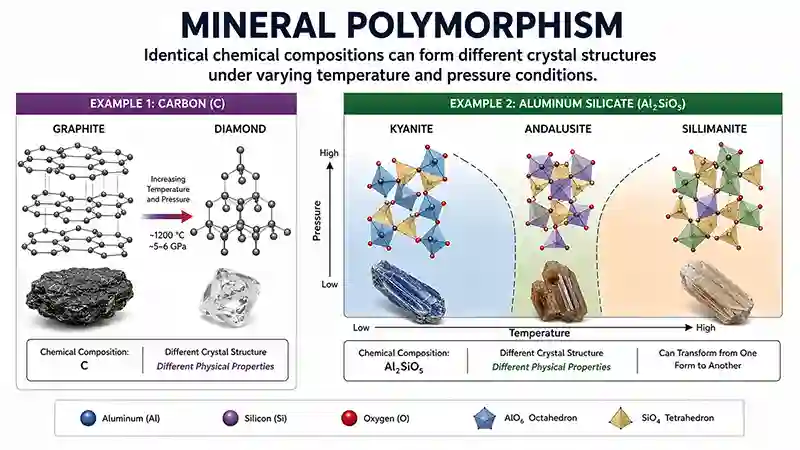
Although polymorphs contain identical atoms, those atoms are arranged differently.
These structural differences influence:
- Density
- Hardness
- Cleavage
- Optical properties
- Stability
- Crystal habit
Even small atomic rearrangements can produce major differences in mineral properties.
Types of Mineral Polymorphism
Temperature Polymorphism
Some minerals change structure as temperature changes.
Examples include:
- Quartz
- Tridymite
- Cristobalite
These silica polymorphs form under different temperature conditions.
Pressure Polymorphism
High pressure may produce entirely different crystal structures.
Examples include:
- Diamond
- Coesite
- Stishovite
These minerals commonly form deep within Earth or during meteorite impacts.
Temperature-Pressure Polymorphism
Some minerals depend on both temperature and pressure.
Examples:
- Kyanite
- Andalusite
- Sillimanite
These are important metamorphic index minerals.
Common Examples of Mineral Polymorphism
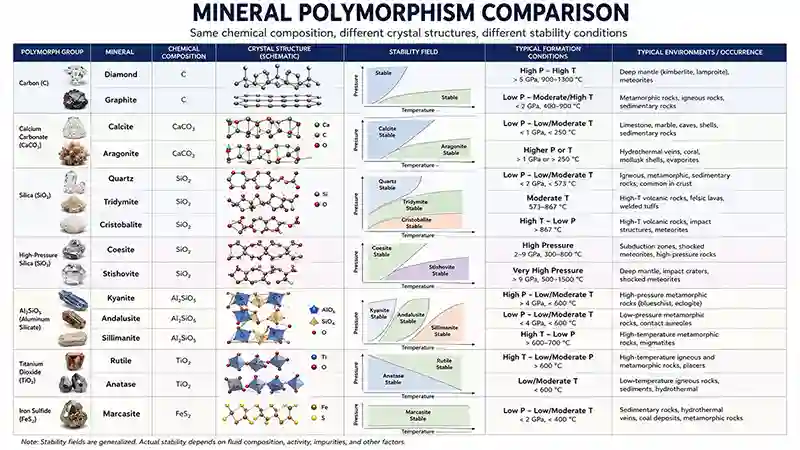
Diamond and Graphite
Chemical formula: Carbon (C)
Diamond:
- Cubic structure
- Extremely hard
- High density
Graphite:
- Layered structure
- Soft
- Excellent electrical conductor
Calcite and Aragonite
Chemical formula: CaCO₃
Calcite:
- Trigonal crystal system
- Stable at Earth's surface
Aragonite:
- Orthorhombic crystal system
- Stable at higher pressures
Quartz, Tridymite, and Cristobalite
Chemical formula: SiO₂
Each forms under different temperature conditions.
Coesite and Stishovite
Both are high-pressure polymorphs of quartz.
They occur in:
- Meteorite impact structures
- Deep mantle rocks
Kyanite, Andalusite, and Sillimanite
Chemical formula: Al₂SiO₅
Each mineral indicates different metamorphic conditions. They are widely used to determine pressure-temperature histories.
Accessory Polymorphs
Other important mineral polymorphs include:
- Rutile, Anatase, and Brookite (TiO₂)
- Pyrite and Marcasite (FeS₂)
- Diamond and Lonsdaleite (Carbon)
- Low Quartz and High Quartz (SiO₂)
These polymorphs develop under specific geological conditions and are valuable indicators of mineral stability.
Mineral Stability
Each polymorph is stable only within a specific range of:
- Temperature
- Pressure
Outside its stability field, it may transform into another polymorph.
This concept forms the basis of phase diagrams in mineralogy.
Phase Transformations
Polymorphic transformations occur through:
- Solid-state rearrangement
- Heating
- Cooling
- Compression
- Decompression
No melting is required. Atoms simply reorganize into a new crystal structure.
Geological Importance
Mineral polymorphism helps geologists:
- Determine metamorphic conditions
- Estimate burial depth
- Interpret tectonic settings
- Reconstruct geological history
- Study mantle processes
- Identify impact structures
Many polymorphs are important index minerals.
Laboratory Investigation
Mineral polymorphism is investigated using:
- X-Ray Diffraction (XRD)
- Single-Crystal XRD
- Electron Microprobe Analysis (EPMA)
- Scanning Electron Microscopy (SEM)
- Transmission Electron Microscopy (TEM)
- Raman Spectroscopy
- Differential Thermal Analysis (DTA)
These techniques identify crystal structures and stability relationships.
Applications
Mineral polymorphism is widely used in:
- Mineralogy
- Crystallography
- Metamorphic Petrology
- Geochemistry
- Economic Geology
- Materials Science
- Planetary Geology
- Engineering Geology
Advantages of Studying Mineral Polymorphism
Studying mineral polymorphism helps scientists:
- Understand mineral stability
- Interpret metamorphic conditions
- Reconstruct pressure-temperature histories
- Identify deep-Earth processes
- Explore ore deposits
- Develop advanced industrial materials
Limitations
Studying mineral polymorphism presents several challenges:
- Some polymorphs are metastable and may persist outside their stability fields.
- Extremely high-pressure polymorphs are rare at Earth's surface.
- Identifying polymorphs often requires crystallographic analysis rather than simple hand-specimen observation.
- Accurate interpretation depends on laboratory techniques such as XRD and Raman spectroscopy.
For comprehensive understanding, combine this topic with:
- Crystal Chemistry Explained
- Atomic Structure of Minerals Explained
- Crystal Structure of Minerals
- Metamorphism and Minerals
- Optical Mineralogy Explained
- X-Ray Diffraction in Mineralogy
- Mineral Chemistry Analysis
- Petrographic Microscopy
Comparison Table
| Polymorph Group | Chemical Formula | Major Difference |
|---|---|---|
| Diamond / Graphite | C | Crystal Structure |
| Calcite / Aragonite | CaCO₃ | Crystal System |
| Quartz / Tridymite / Cristobalite | SiO₂ | Temperature Stability |
| Coesite / Stishovite | SiO₂ | High-Pressure Structure |
| Kyanite / Andalusite / Sillimanite | Al₂SiO₅ | Pressure-Temperature Stability |
| Rutile / Anatase / Brookite | TiO₂ | Crystal Structure |
Summary Table
| Feature | Mineral Polymorphism |
| Definition | Same Composition, Different Crystal Structure |
| Main Controls | Temperature and Pressure |
| Common Examples | Diamond, Graphite, Quartz, Kyanite |
| Main Study Methods | XRD, Raman, SEM, EPMA |
| Geological Importance | Mineral Stability and Metamorphic Conditions |
Mineral polymorphism is the occurrence of two or more minerals that have the same chemical composition but different crystal structures and physical properties.
Polymorphism develops because minerals become stable under different temperatures, pressures, and geological environments, causing atoms to arrange themselves differently.
Diamond and graphite are the most famous polymorphs. Both are composed entirely of carbon, but their different crystal structures give them completely different properties.
Polymorphs help geologists determine the temperature and pressure conditions under which rocks formed, making them valuable indicators of metamorphic and tectonic environments.
Geologists use X-ray diffraction (XRD), Raman spectroscopy, electron microprobe analysis (EPMA), scanning electron microscopy (SEM), transmission electron microscopy (TEM), and petrographic analysis to distinguish different polymorphs.
Final Thoughts
Mineral polymorphism demonstrates how identical chemical compositions can produce remarkably different minerals through changes in atomic arrangement. From the extreme hardness of diamond to the softness of graphite, and from the Al₂SiO₅ polymorphs that record metamorphic conditions to high-pressure silica polymorphs that reveal deep-Earth processes, polymorphism is fundamental to understanding mineral stability and geological evolution.
By combining crystallography, crystal chemistry, mineralogy, and advanced analytical techniques, geologists can identify polymorphs, reconstruct pressure-temperature histories, and interpret the geological environments in which rocks formed. Mineral polymorphism remains a cornerstone of mineralogy, metamorphic petrology, geochemistry, and materials science.
Continue Learning
Expand your understanding of mineral structures with these related guides: