
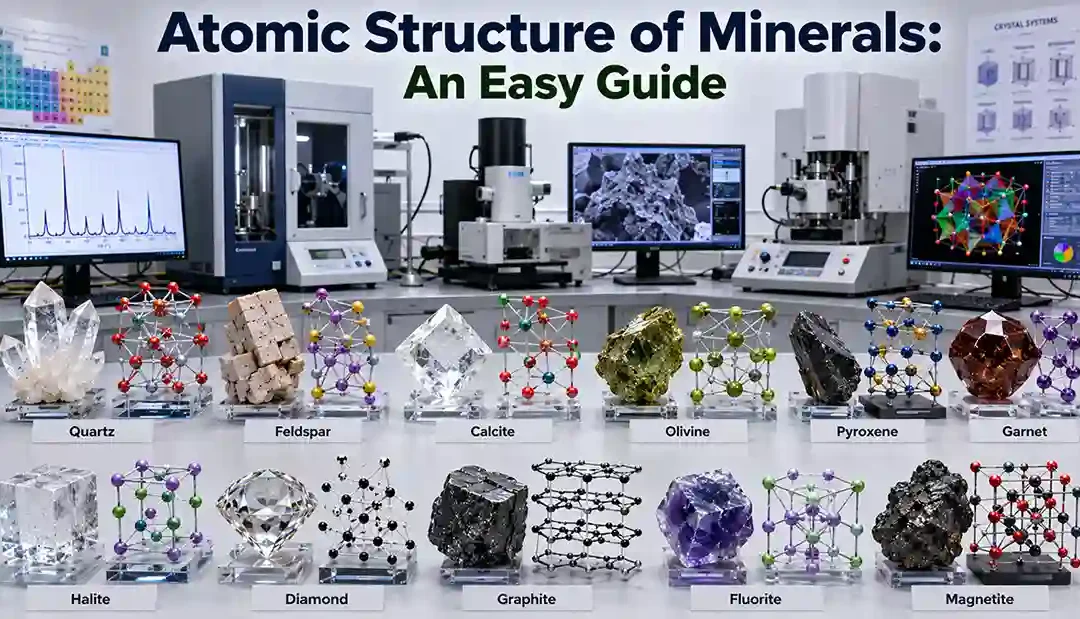
Every mineral is built from atoms arranged in a highly ordered three-dimensional pattern called a crystal lattice. This internal atomic arrangement determines nearly every property of a mineral, including its hardness, cleavage, density, crystal shape, color, optical behavior, electrical conductivity, and chemical stability. Although minerals may appear solid and uniform to the naked eye, they are composed of billions of atoms organized according to precise structural rules.
The atomic structure of minerals forms the foundation of mineralogy, crystallography, crystal chemistry, petrology, geochemistry, and materials science. Understanding how atoms bond and arrange themselves inside crystals allows geologists to explain why different minerals behave differently and how they form under various geological conditions.
This topic should be studied together with Crystal Chemistry Explained, Crystal Structure of Minerals, Mineralogy Explained, and Chemical Properties of Minerals.
What Is the Atomic Structure of Minerals?
The atomic structure of a mineral refers to the orderly arrangement of atoms and ions within its crystal lattice.
It includes:
- Atoms
- Ions
- Chemical bonds
- Crystal lattice
- Unit cell
- Coordination geometry
Each mineral has a unique atomic structure that distinguishes it from all others.
Building Blocks of Minerals
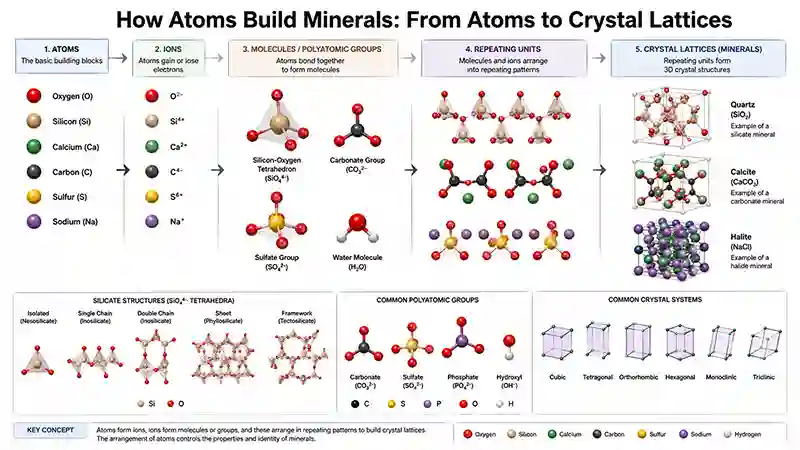
Minerals are built from extremely small particles.
These include:
Atoms
Atoms are the smallest units of chemical elements.
Examples:
- Silicon
- Oxygen
- Iron
- Magnesium
- Calcium
- Sodium
Ions
Most atoms exist as electrically charged ions inside minerals.
Examples:
- Si⁴⁺
- O²⁻
- Fe²⁺
- Fe³⁺
- Mg²⁺
- Ca²⁺
Positive and negative ions attract one another to build stable crystal structures.
Molecules
Some minerals contain molecular groups rather than individual atoms.
Examples include:
- Carbonate (CO₃²⁻)
- Sulfate (SO₄²⁻)
- Phosphate (PO₄³⁻)
Chemical Bonds in Minerals
Atoms remain connected through chemical bonds.
Ionic Bonds
Electrostatic attraction between positive and negative ions.
Examples:
- Halite
- Fluorite
- Calcite
Covalent Bonds
Atoms share electrons.
Examples:
- Quartz
- Diamond
These are among the strongest mineral bonds.
Metallic Bonds
Electrons move freely throughout the crystal.
Examples:
- Native Gold
- Native Silver
- Native Copper
Van der Waals Bonds
Weak attractions between atomic layers.
Examples:
- Graphite
- Molybdenite
These produce excellent basal cleavage.
Crystal Lattice
A crystal lattice is a repeating three-dimensional arrangement of atoms.
The lattice determines:
- Crystal shape
- Cleavage
- Hardness
- Density
- Optical properties
Every mineral possesses its own unique lattice geometry.
Unit Cell
The unit cell is the smallest repeating building block of a crystal lattice. By repeating the unit cell millions of times, a complete crystal develops.The size and symmetry of the unit cell determine the mineral's crystal system.
Coordination Number
The coordination number is the number of neighboring atoms or ions surrounding a central atom.
Common coordination numbers include:
- 4 (Tetrahedral)
- 6 (Octahedral)
- 8 (Cubic)
- 12 (Closest packing)
Coordination depends on ion size and charge.
Silicon-Oxygen Tetrahedron
The SiO₄ tetrahedron is the most important structural unit in silicate minerals.
It consists of:
- One silicon atom
- Four oxygen atoms
These tetrahedra join together in different ways to produce:
- Nesosilicates
- Sorosilicates
- Cyclosilicates
- Inosilicates
- Phyllosilicates
- Tectosilicates
Most rock-forming minerals are based on this structure.
Atomic Structure of Common Minerals
Quartz
- Framework silicate
- Continuous network of SiO₄ tetrahedra
- Strong covalent bonding
Feldspar
- Framework aluminosilicate
- Aluminum substitutes for silicon
- Potassium, sodium, or calcium balance electrical charge
Olivine
- Isolated SiO₄ tetrahedra
- Magnesium and iron occupy surrounding positions
Pyroxene
- Single-chain silicate
- Linked tetrahedra form continuous chains
Mica
- Sheet silicate
- Strong bonds within sheets
- Weak bonds between sheets
Excellent cleavage results from its layered structure.
Garnet
- Complex three-dimensional crystal framework
- Multiple cation sites allow solid solution
Halite
- Sodium and chlorine arranged in a cubic lattice
Diamond
- Carbon atoms linked by strong covalent bonds
Highest natural hardness.
Graphite
- Carbon atoms arranged in sheets
Weak bonding between layers gives graphite its softness.
Atomic Structure and Mineral Properties
The internal arrangement of atoms determines nearly every mineral property.
| Property | Atomic Structure Influence |
|---|---|
| Hardness | Bond Strength |
| Cleavage | Bond Orientation |
| Density | Atomic Packing |
| Color | Trace Elements |
| Conductivity | Electron Movement |
| Magnetism | Iron Distribution |
| Stability | Crystal Structure |
Small structural differences can produce major differences in mineral behavior.
Geological Importance
Understanding atomic structure helps geologists:
- Identify minerals
- Explain crystal growth
- Interpret metamorphism
- Study magma crystallization
- Understand weathering
- Predict mineral stability
Atomic structure links chemistry with geology.
Laboratory Investigation
Atomic structures are studied using:
- X-Ray Diffraction (XRD)
- Single-Crystal XRD
- Electron Microprobe Analysis (EPMA)
- Scanning Electron Microscopy (SEM)
- Transmission Electron Microscopy (TEM)
- Raman Spectroscopy
- X-Ray Fluorescence (XRF)
These techniques reveal atomic arrangements with remarkable precision.
Applications
The study of atomic structures is essential in:
- Mineralogy
- Crystallography
- Crystal Chemistry
- Petrology
- Geochemistry
- Materials Science
- Nanotechnology
- Economic Geology
Advantages of Studying Atomic Structures
Studying atomic structures helps scientists:
- Explain mineral properties
- Predict crystal behavior
- Understand mineral formation
- Discover new materials
- Improve mineral exploration
- Support advanced scientific research
Limitations
Studying atomic structures presents several challenges:
- Atomic arrangements cannot be observed directly with the naked eye.
- Complex minerals often contain defects, substitutions, and disorder.
- High-resolution analytical instruments are required.
- Interpretation usually combines crystallographic, chemical, and microscopic data.
For comprehensive understanding, combine this topic with:
- Crystal Chemistry Explained
- Crystal Structure of Minerals
- Mineralogy Explained
- Chemical Properties of Minerals
- Optical Mineralogy Explained
- X-Ray Diffraction in Mineralogy
- Electron Microprobe Analysis
- Petrographic Microscopy
Comparison Table
| Structural Unit | Description | Example Minerals |
| Isolated Tetrahedra | Independent SiO₄ groups | Olivine |
| Single Chains | Linked tetrahedra | Pyroxene |
| Double Chains | Two linked chains | Amphibole |
| Sheets | Layered tetrahedra | Mica |
| Framework | Three-dimensional network | Quartz, Feldspar |
| Cubic Ionic Lattice | Alternating ions | Halite |
Summary Table
| Feature | Atomic Structure of Minerals |
| Basic Components | Atoms, Ions, Chemical Bonds |
| Main Structural Unit | Crystal Lattice |
| Important Concepts | Unit Cell, Coordination Number, Tetrahedra |
| Common Study Methods | XRD, SEM, TEM, EPMA |
| Geological Importance | Controls Mineral Properties and Stability |
The atomic structure of minerals is the ordered arrangement of atoms and ions within a crystal lattice. This arrangement determines a mineral's physical and chemical properties.
Atomic structure explains why minerals have different hardness, cleavage, density, optical behavior, conductivity, and stability, even when they contain similar chemical elements.
A crystal lattice is a repeating three-dimensional arrangement of atoms or ions that forms the internal framework of a mineral crystal.
The silicon-oxygen tetrahedron (SiO₄) is the fundamental structural unit of silicate minerals. Different ways of linking these tetrahedra produce the major silicate mineral groups.
Geologists investigate atomic structures using X-ray diffraction (XRD), single-crystal XRD, electron microprobe analysis (EPMA), scanning electron microscopy (SEM), transmission electron microscopy (TEM), Raman spectroscopy, and X-ray fluorescence (XRF).
Final Thoughts
The atomic structure of minerals is the foundation of mineral science. Every mineral's hardness, cleavage, density, crystal habit, optical behavior, and chemical stability can be traced to the arrangement of atoms and the bonds that connect them. From the framework structure of quartz to the layered sheets of mica and the strong covalent network of diamond, atomic architecture governs the behavior of minerals across all geological environments.
By combining crystallography, crystal chemistry, mineralogy, and advanced analytical techniques such as X-ray diffraction, electron microscopy, and spectroscopy, geologists can understand how minerals form, evolve, and respond to geological processes. Atomic structure remains one of the most important concepts in mineralogy, petrology, geochemistry, and materials science.
Continue Learning
Expand your understanding of mineral structures with these related guides: