
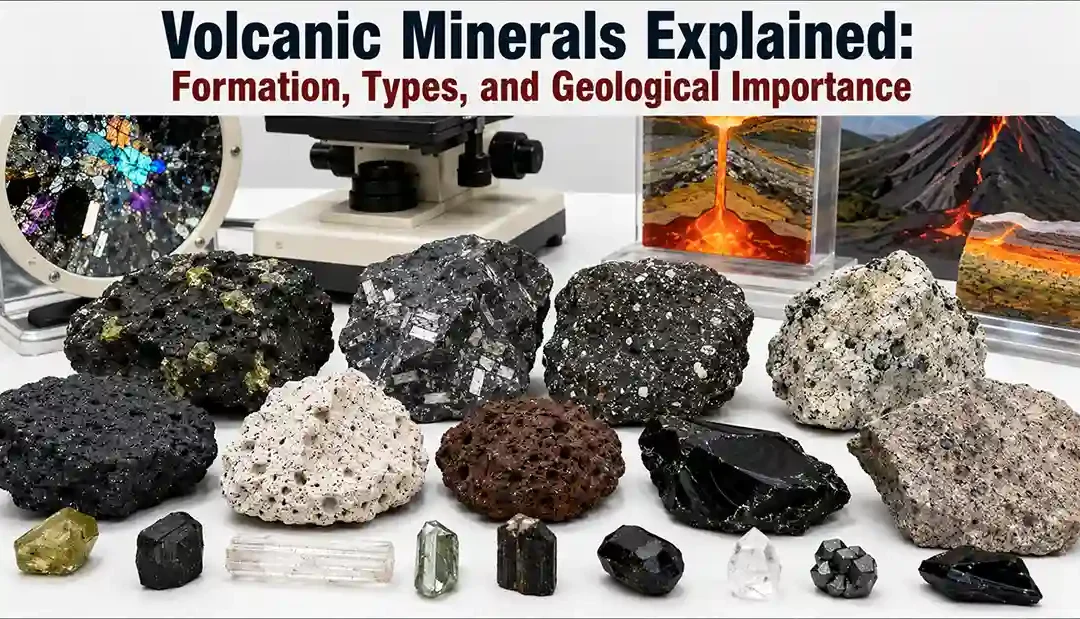
Volcanic minerals are the minerals that crystallize from lava during volcanic eruptions or from magma immediately before eruption. As molten rock rises toward Earth's surface, pressure decreases and cooling accelerates, causing minerals to crystallize in a predictable sequence. The resulting mineral assemblage depends on magma composition, cooling rate, volatile content, and eruption style.
Volcanic rocks commonly contain plagioclase feldspar, olivine, pyroxene, amphibole, biotite, quartz, magnetite, and volcanic glass. These minerals help geologists determine the origin of magma, volcanic processes, tectonic setting, and eruption history.
Volcanic minerals are studied extensively in volcanology, igneous petrology, mineralogy, economic geology, and planetary geology.
This topic should be studied together with Minerals in Igneous Rocks, Bowen's Reaction Series, and Plate Tectonics and Minerals.
What Are Volcanic Minerals?
Volcanic minerals are minerals that crystallize from lava or shallow magma before, during, or shortly after volcanic eruptions.
They record:
- Magma composition
- Cooling history
- Eruption conditions
- Magma evolution
- Volcanic environment
Their composition varies from basaltic to rhyolitic volcanic systems.
How Do Volcanic Minerals Form?
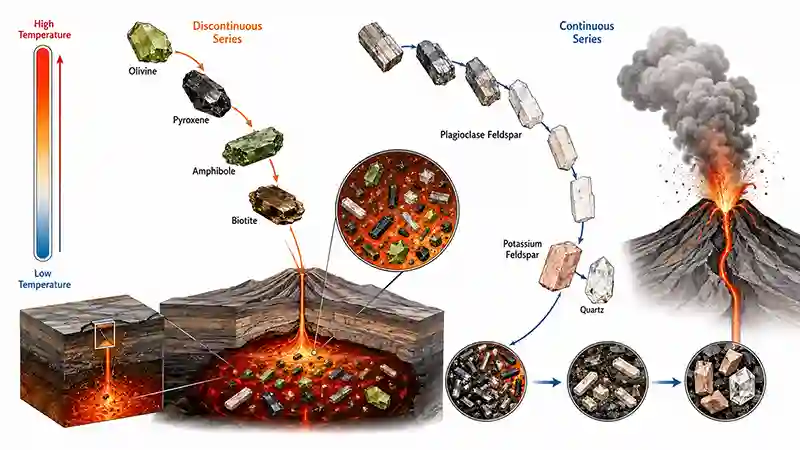
Minerals crystallize as magma cools according to Bowen's Reaction Series.
The process involves:
- Magma generation
- Ascent toward the surface
- Progressive cooling
- Crystal growth
- Volcanic eruption
- Rapid solidification
Some minerals crystallize deep underground, while others form immediately before or after eruption.
Factors Affecting Volcanic Mineral Formation
Several factors influence volcanic mineral assemblages.
Magma Composition
Silica-rich magma produces quartz and potassium feldspar.
Mafic magma produces olivine and pyroxene.
Cooling Rate
Rapid cooling produces:
- Fine-grained minerals
- Microscopic crystals
- Volcanic glass
Slow cooling allows larger crystals (phenocrysts) to develop.
Temperature
High-temperature minerals crystallize first, followed by lower-temperature minerals.
Pressure
Pressure influences mineral stability before eruption.
Water and Volatile Content
Water-rich magma promotes amphibole and biotite crystallization.
Common Volcanic Minerals
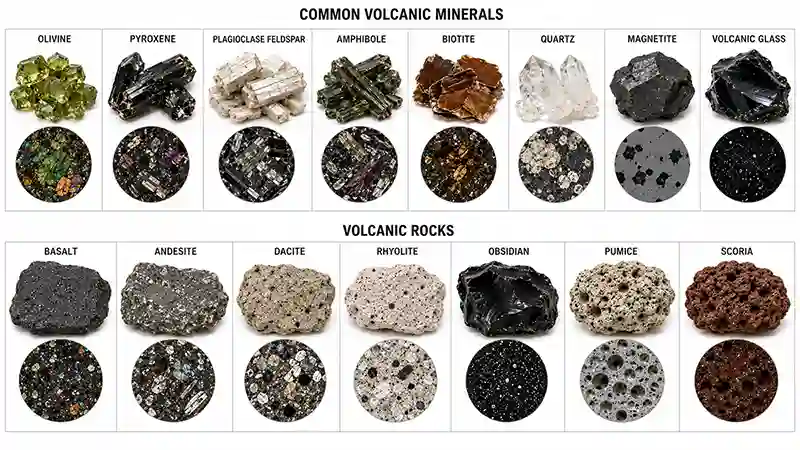
Plagioclase Feldspar
Plagioclase is the most abundant mineral in many volcanic rocks.
Characteristics:
- White to gray
- Two cleavages
- Common phenocrysts
Common rocks:
- Basalt
- Andesite
- Dacite
Olivine
Olivine crystallizes at very high temperatures.
Characteristics:
- Olive green
- High density
- Magnesium and iron rich
Common rocks:
- Basalt
- Basanite
- Picrite
Pyroxene
Pyroxene commonly forms after olivine.
Characteristics:
- Dark green to black
- Two cleavages near 90°
Common rocks:
- Basalt
- Andesite
Amphibole
Amphibole develops in water-rich intermediate magmas.
Characteristics:
- Dark green to black
- Cleavage at approximately 60° and 120°
Common rocks:
- Andesite
- Dacite
Biotite
Biotite forms in evolved volcanic magmas.
Characteristics:
- Brown to black
- Perfect basal cleavage
Common rocks:
- Rhyolite
- Dacite
Quartz
Quartz crystallizes during the final stages of silica-rich magma evolution.
Common rocks:
- Rhyolite
- Dacite
Magnetite
Magnetite is a common accessory mineral.
Characteristics:
- Black
- Strongly magnetic
Occurs in many volcanic rocks.
Volcanic Glass
When lava cools extremely rapidly, crystals cannot form.
Instead, volcanic glass develops.
Examples include:
- Obsidian
- Tachylite
Accessory Minerals
Other volcanic minerals include:
- Zircon
- Apatite
- Ilmenite
- Titanite
- Rutile
- Chromite
These minerals help determine magma evolution and crystallization history.
Volcanic Minerals in Common Rocks
| Volcanic Rock | Major Minerals |
|---|---|
| Basalt | Plagioclase, Pyroxene, Olivine |
| Andesite | Plagioclase, Amphibole, Pyroxene |
| Dacite | Plagioclase, Quartz, Amphibole, Biotite |
| Rhyolite | Quartz, Potassium Feldspar, Biotite |
| Obsidian | Volcanic Glass |
| Pumice | Volcanic Glass, Feldspar, Quartz |
| Scoria | Plagioclase, Pyroxene, Olivine |
Volcanic Textures
Rapid cooling produces characteristic volcanic textures.
Common textures include:
- Aphanitic
- Porphyritic
- Glassy
- Vesicular
- Pyroclastic
- Flow texture
These textures provide clues about eruption style and cooling history.
Volcanic Minerals and Plate Tectonics
Different tectonic settings produce distinctive volcanic minerals.
Mid-Ocean Ridges
- Olivine
- Pyroxene
- Plagioclase
Island Arcs
- Amphibole
- Biotite
- Plagioclase
Continental Volcanoes
- Quartz
- Potassium Feldspar
- Biotite
These mineral assemblages reflect magma composition and tectonic environment.
Laboratory Identification
Geologists identify volcanic minerals using:
- Hand specimen examination
- Petrographic Microscopy
- X-Ray Diffraction (XRD)
- Electron Microprobe Analysis (EPMA)
- Scanning Electron Microscopy (SEM)
- Mineral Chemistry Analysis
These methods reveal mineral composition, crystal structure, and cooling history.
Importance of Volcanic Minerals
Studying volcanic minerals helps geologists:
- Identify volcanic rocks
- Reconstruct magma evolution
- Estimate eruption temperatures
- Interpret volcanic history
- Understand tectonic settings
- Explore volcanic-hosted mineral deposits
Volcanic minerals preserve important information about Earth's interior.
Applications
Volcanic minerals are important in:
- Volcanology
- Igneous petrology
- Mineralogy
- Economic geology
- Geochemistry
- Planetary geology
- Hazard assessment
Advantages of Studying Volcanic Minerals
Studying volcanic minerals allows scientists to:
- Reconstruct eruption history
- Understand magma differentiation
- Classify volcanic rocks
- Predict volcanic behavior
- Explore mineral resources
- Interpret tectonic environments
Limitations
Volcanic mineral interpretation may be complicated because:
- Rapid cooling produces microscopic crystals.
- Weathering alters primary minerals.
- Volcanic glass may obscure mineral identification.
- Fine-grained rocks often require laboratory analysis.
For comprehensive interpretation, combine volcanic mineral studies with:
- Minerals in Igneous Rocks
- Bowen's Reaction Series
- Plate Tectonics and Minerals
- Petrographic Microscopy
- X-Ray Diffraction in Mineralogy
- Mineral Chemistry Analysis
- Hydrothermal Alteration
Comparison Table
| Mineral | Typical Crystallization Stage | Common Volcanic Rocks |
| Olivine | Early | Basalt, Picrite |
| Pyroxene | Early-Middle | Basalt, Andesite |
| Amphibole | Middle | Andesite, Dacite |
| Biotite | Late | Dacite, Rhyolite |
| Plagioclase Feldspar | Throughout | Most Volcanic Rocks |
| Quartz | Late | Rhyolite, Dacite |
| Magnetite | Throughout | Basalt to Rhyolite |
Summary Table
| Feature | Volcanic Minerals |
| Main Formation Process | Lava and Shallow Magma Crystallization |
| Dominant Minerals | Plagioclase, Pyroxene, Olivine, Quartz |
| Key Concept | Bowen's Reaction Series |
| Common Study Methods | Petrography, XRD, EPMA, SEM |
| Geological Importance | Volcanic Evolution and Tectonic Setting |
Volcanic minerals are minerals that crystallize from lava or shallow magma during or immediately before volcanic eruptions.
Common volcanic minerals include plagioclase feldspar, olivine, pyroxene, amphibole, biotite, quartz, magnetite, and volcanic glass.
Lava cools rapidly at or near Earth's surface, leaving little time for large crystals to develop. This produces fine-grained textures and, in some cases, volcanic glass.
Volcanic glass is a non-crystalline material that forms when lava cools so quickly that mineral crystals cannot develop. Obsidian is the best-known example.
Geologists identify volcanic minerals using hand specimens, petrographic microscopy, X-ray diffraction (XRD), electron microprobe analysis (EPMA), scanning electron microscopy (SEM), and mineral chemistry analysis.
Final Thoughts
Volcanic minerals provide a direct record of magma evolution, eruption conditions, and tectonic environments. From the early crystallization of olivine and pyroxene in basaltic magmas to the late formation of quartz and biotite in rhyolitic systems, these minerals reveal how volcanic rocks develop and evolve.
By integrating field observations with petrographic microscopy, X-ray diffraction, electron microprobe analysis, and mineral chemistry, geologists can reconstruct volcanic histories, classify volcanic rocks, and better understand Earth's dynamic interior. The study of volcanic minerals remains essential for volcanology, igneous petrology, mineral exploration, and geological hazard assessment.
Continue Learning
Continue exploring volcanic and igneous geology with these related guides: