
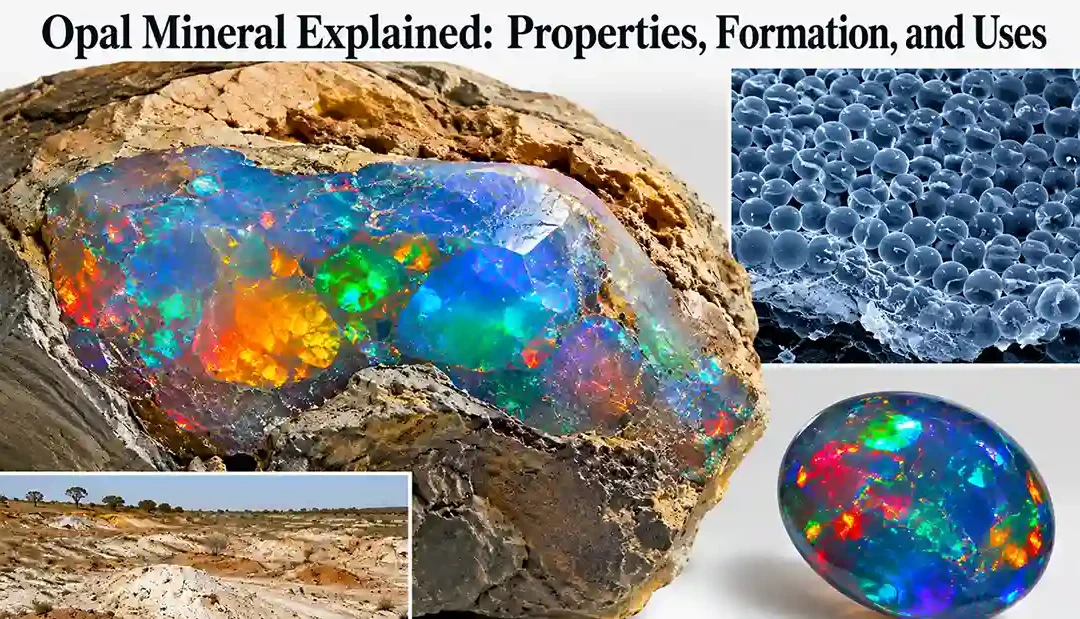
Opal is one of the most unique gemstones in the world, famous for its dazzling flashes of color known as play-of-color. Unlike most gemstones, opal is not a true mineral because it lacks a crystalline structure. Instead, it is classified as a mineraloid composed of hydrated silica.
Opal is valued for its:
- rainbow color effects
- rarity
- unique patterns
- gemstone beauty
Because no two opals are exactly alike, each specimen is considered unique.
Learn more → what is a mineral
What Is Opal?
Opal is a hydrated silica mineraloid. Its chemical formula is:
Opal contains:
- silicon
- oxygen
- water
Unlike quartz, opal does not possess an ordered crystal structure.
Basic Properties of Opal
| Property | Value |
|---|---|
| Chemical Formula | SiO₂·nH₂O |
| Classification | Mineraloid |
| Crystal System | Amorphous |
| Hardness | 5.5–6.5 |
| Streak | White |
| Luster | Vitreous to Waxy |
Why Is Opal Colorful?
The most famous property of opal is Play-of-Color. This phenomenon occurs when microscopic silica spheres inside the opal diffract light.
As light passes through the stone, different wavelengths are separated into:
- red
- orange
- yellow
- green
- blue
- violet
The result is a brilliant rainbow display that changes as the stone moves.
Internal Structure of Opal
Unlike crystalline minerals, opal consists of:
- microscopic silica spheres
- water molecules
- amorphous silica
The arrangement of these spheres determines whether the opal displays play-of-color.
Learn more → crystal structure in minerals
Is Opal a Mineral?
A mineral must have:
- a definite chemical composition
- a crystalline structure
Although opal has a chemical formula, it lacks a true crystal structure. Therefore, opal is classified as Mineraloid rather than a true mineral.
Physical Properties of Opal
| Property | Description |
|---|---|
| Color | White, black, blue, green, red, multicolored |
| Streak | White |
| Luster | Vitreous to waxy |
| Hardness | 5.5–6.5 |
| Cleavage | None |
| Transparency | Transparent to opaque |
| Specific Gravity | 1.9–2.3 |
Types of Opal
Precious Opal
Displays play-of-color.
Common Opal
Lacks play-of-color.
Black Opal
Dark body color with vivid flashes.
White Opal
Light-colored background.
Fire Opal
Orange to red transparent opal.
Boulder Opal
Forms attached to host rock.
Major Types of Opal
| Variety | Characteristics |
|---|---|
| Precious Opal | Play-of-color |
| Common Opal | No play-of-color |
| Black Opal | Dark body tone |
| Fire Opal | Orange-red color |
| Boulder Opal | Attached to rock |
How Opal Forms
Silica-Rich Groundwater
Dissolved silica moves through rocks.
Evaporation
Water evaporates and leaves silica behind.
Cavity Filling
Silica accumulates in fractures and voids.
Sedimentary Processes
Many opals form in sedimentary environments.
Over time, layers of silica build up and eventually form opal deposits.
Opal Formation Environment
Opal commonly forms in:
- sedimentary basins
- volcanic rocks
- weathered rock zones
- hydrothermal environments
Many deposits develop in regions with alternating wet and dry climates.
Famous Opal-Producing Countries
Major opal-producing regions include:
- Australia
- Ethiopia
- Mexico
- Brazil
- United States
Australia produces the majority of the world's precious opal.
Black Opal: The Most Valuable Variety
Black opal is considered the most valuable type of opal because:
- colors appear more vivid
- contrast is stronger
- deposits are limited
Many of the world's finest black opals come from Australia.
Opal vs Quartz
| Property | Opal | Quartz |
|---|---|---|
| Structure | Amorphous | Crystalline |
| Formula | SiO₂·nH₂O | SiO₂ |
| Water Content | Present | None |
| Hardness | 5.5–6.5 | 7 |
Although both contain silica, their structures are very different.
Learn more → quartz mineral explained
Uses of Opal
Jewelry
The most important use.
Mineral Collections
Highly prized by collectors.
Museum Displays
Popular exhibit specimens.
Decorative Stones
Used in carvings and art.
Major Uses of Opal
| Industry | Application |
|---|---|
| Jewelry | Gemstones |
| Collecting | Mineral specimens |
| Museums | Displays |
| Art | Decorative carvings |
Opal in Mineral Identification
Geologists identify opal using:
- play-of-color
- amorphous structure
- low density
- vitreous luster
- lack of crystal faces
Its colorful optical effects make it one of the easiest gemstones to recognize.
Learn more → mineral identification guide
Opal Identification Summary
| Property | Opal |
|---|---|
| Formula | SiO₂·nH₂O |
| Hardness | 5.5–6.5 |
| Structure | Amorphous |
| Color | Multicolored |
| Luster | Vitreous |
| Classification | Mineraloid |
Technically, opal is a mineraloid because it lacks a crystalline structure.
Its microscopic silica spheres diffract light, producing the play-of-color effect.
Precious opal is opal that displays play-of-color.
Australia is the world's leading producer of precious opal.
Opal is composed of hydrated silica with the formula SiO₂·nH₂O.
Final Thoughts
Opal is one of the most fascinating gemstones on Earth because of its unique internal structure and spectacular play-of-color. Unlike most gemstones, its beauty comes not from trace elements but from the interaction of light with microscopic silica spheres.
From Australia's famous black opals to Ethiopia's colorful deposits, opal remains one of the most visually stunning and scientifically intriguing mineraloids in the world.