
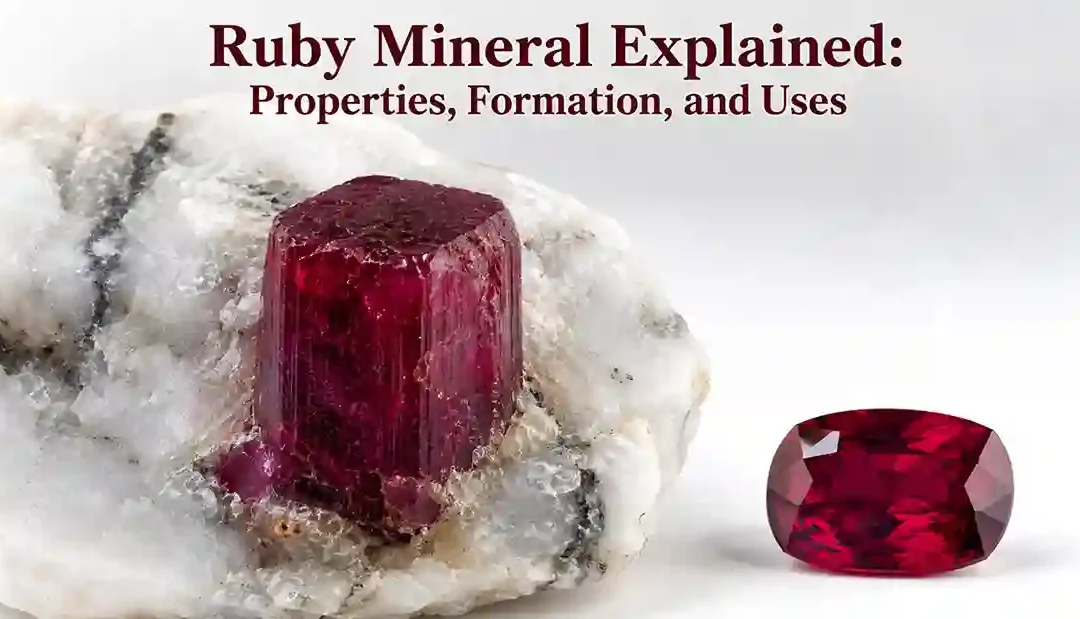
Ruby is one of the most famous and valuable gemstones in the world. It is the red variety of the mineral corundum and owes its striking color to trace amounts of chromium.
For thousands of years, ruby has symbolized:
- passion
- power
- wealth
- protection
Beyond its beauty, ruby is also scientifically important because it forms under specific geological conditions and is one of the hardest naturally occurring minerals.
Learn more → corundum mineral explained
What Is Ruby?
Ruby is the red gemstone variety of corundum. Its chemical formula is:
Ruby is composed primarily of:
- aluminum
- oxygen
Its red color comes from Chromium (Cr). Even tiny amounts of chromium can produce the famous ruby-red color.
Basic Properties of Ruby
| Property | Value |
|---|---|
| Chemical Formula | Al₂O₃ |
| Mineral Group | Oxide |
| Crystal System | Trigonal |
| Hardness | 9 |
| Streak | White |
| Luster | Vitreous |
Why Is Ruby Red?
Pure corundum is colorless. When chromium replaces small amounts of aluminum within the crystal structure, ruby develops its characteristic red color.
The coloration ranges from:
- pinkish red
- bright red
- deep crimson
- pigeon blood red
The most valuable rubies typically display intense, vivid red colors.
Crystal Structure of Ruby
Ruby shares the same crystal structure as corundum.
Its structure contains:
- aluminum atoms
- oxygen atoms
- trace chromium impurities
This tightly packed arrangement produces:
- exceptional hardness
- durability
- brilliant polish
Learn more → crystal structure in minerals
Crystal System of Ruby
Ruby belongs to the trigonal crystal system. Its symmetry is characterized by Threefold Rotational Symmetry.
Common crystal habits include:
- hexagonal barrels
- tabular crystals
- prismatic crystals
Learn more → trigonal crystal system
Physical Properties of Ruby
| Property | Description |
|---|---|
| Color | Red |
| Streak | White |
| Luster | Vitreous |
| Hardness | 9 |
| Cleavage | None |
| Transparency | Transparent to translucent |
| Specific Gravity | 3.9–4.1 |
Ruby and the Mohs Hardness Scale
Ruby ranks hardness 9 on the Mohs Hardness Scale. Only diamond ranks higher.
This exceptional hardness makes ruby highly resistant to scratching and wear.
Learn more → mohs-hardness-scale
How Ruby Forms
Metamorphic Processes
Many rubies form within marble deposits.
Igneous Processes
Some occur in igneous rocks rich in aluminum.
Pegmatites
Occasionally found in pegmatitic environments.
Alluvial Deposits
Weathering releases rubies into stream sediments.
Ruby in Marble Deposits
Some of the world's finest rubies form in:
- metamorphosed limestone
- marble-hosted deposits
- regional metamorphic environments
These deposits often produce intensely colored gem-quality crystals.
Ruby vs Sapphire
Ruby and sapphire are both varieties of corundum.
| Property | Ruby | Sapphire |
|---|---|---|
| Formula | Al₂O₃ | Al₂O₃ |
| Color Source | Chromium | Iron & Titanium |
| Color | Red | Blue (usually) |
| Mineral | Corundum | Corundum |
If corundum is red, it is called ruby. Other colors are generally classified as sapphire.
Learn more → corundum mineral explained
World's Most Famous Ruby Sources
Major ruby-producing regions include:
- Myanmar
- Thailand
- Sri Lanka
- Madagascar
- Mozambique
- Afghanistan
Many of the world's finest rubies originate from Myanmar's marble-hosted deposits.
Industrial Uses of Ruby
Jewelry
The most valuable use of ruby.
Precision Instruments
Synthetic rubies are used in watches and measuring devices.
Lasers
Ruby crystals were used in the first laser systems.
Scientific Equipment
Used in specialized optical applications.
Major Uses of Ruby
| Industry | Application |
|---|---|
| Jewelry | Gemstones |
| Optics | Lasers |
| Engineering | Precision bearings |
| Science | Optical devices |
Ruby as a Gemstone
Ruby belongs to the traditional group of precious gemstones:
- Ruby
- Sapphire
- Emerald
- Diamond
Large, high-quality natural rubies can be more valuable than diamonds of similar size.
Ruby in Mineral Identification
Geologists identify ruby using:
- red color
- hardness of 9
- trigonal crystal structure
- absence of cleavage
- association with corundum
Chromium fluorescence under ultraviolet light is another important identification feature.
Learn more → mineral identification guide
Ruby Identification Summary
| Property | Ruby |
|---|---|
| Formula | Al₂O₃ |
| Hardness | 9 |
| Crystal System | Trigonal |
| Color | Red |
| Luster | Vitreous |
| Mineral Group | Oxide |
Ruby is the red variety of corundum and consists primarily of aluminum oxide (Al₂O₃).
Ruby gets its red color from trace amounts of chromium within the crystal structure.
Yes. Ruby is the gemstone variety of the mineral corundum.
Ruby belongs to the trigonal crystal system.
Ruby has a hardness of 9 on the Mohs scale, making it one of the hardest natural minerals.
Final Thoughts
Ruby is one of the world's most valuable gemstones and a remarkable variety of the mineral corundum. Its vivid red color, exceptional hardness, and geological significance have made it prized for thousands of years.
From deep metamorphic environments to luxury jewelry and advanced optical technologies, ruby demonstrates the extraordinary relationship between mineral chemistry, geological processes, and human culture.