
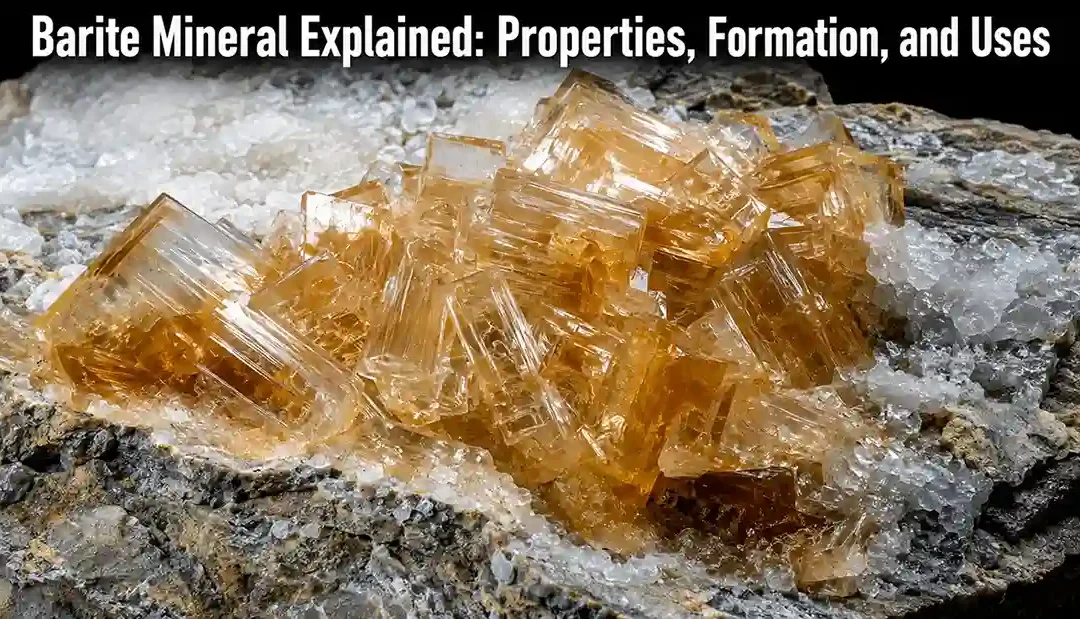
Barite is a barium sulfate mineral best known for its exceptionally high density. It is one of the heaviest common non-metallic minerals and is widely used in oil and gas drilling, manufacturing, medicine, and scientific research.
Barite commonly occurs in:
- hydrothermal veins
- sedimentary deposits
- limestone formations
- metallic ore deposits
Because of its high specific gravity and widespread industrial use, barite is one of the world's most important industrial minerals.
Learn more → what is a mineral
What Is Barite?
Barite is a barium sulfate mineral. Its chemical formula is:
Barite contains:
- barium (Ba)
- sulfur (S)
- oxygen (O)
It belongs to the sulfate mineral group and is the primary source of barium used worldwide.
Basic Properties of Barite
| Property | Value |
|---|---|
| Chemical Formula | BaSO₄ |
| Mineral Group | Sulfate |
| Crystal System | Orthorhombic |
| Hardness | 3–3.5 |
| Streak | White |
| Luster | Vitreous to Pearly |
Why Is Barite So Heavy?
One of the densest common minerals, barite, contains Barium, which is a relatively heavy chemical element. This gives barite an unusually high density compared to most minerals. Its specific gravity is SG≈4.5
For comparison:
| Mineral | Specific Gravity |
|---|---|
| Quartz | 2.65 |
| Feldspar | 2.6 |
| Calcite | 2.7 |
| Barite | 4.5 |
This high density is one of barite's most distinctive identification features.
Crystal Structure of Barite
Barite contains:
- sulfate tetrahedra
- barium ions
- oxygen atoms
Its atomic arrangement produces:
- high density
- tabular crystals
- moderate hardness
- excellent crystal development
Learn more → crystal structure in minerals
Crystal System of Barite
Barite belongs to the orthorhombic crystal system. Its crystallographic relationship is
Common crystal habits include:
- tabular crystals
- blade-shaped crystals
- rosette aggregates
- massive forms
Learn more → orthorhombic crystal system
Physical Properties of Barite
| Property | Description |
|---|---|
| Color | White, yellow, brown, blue |
| Streak | White |
| Luster | Vitreous to pearly |
| Hardness | 3–3.5 |
| Cleavage | Perfect |
| Transparency | Transparent to opaque |
| Specific Gravity | ~4.5 |
Common Crystal Forms of Barite
Tabular Crystals
The most common crystal habit.
Bladed Crystals
Thin elongated crystal growth.
Desert Roses
Rosette-shaped crystal clusters.
Massive Aggregates
Dense compact masses.
Barite often forms exceptionally beautiful mineral specimens.
How Barite Forms
Hydrothermal Activity
Mineral-rich fluids deposit barite in veins.
Sedimentary Processes
Barite precipitates from seawater and groundwater.
Evaporite Environments
May form in restricted marine basins.
Ore Deposits
Often occurs with lead, zinc, and silver minerals.
Hydrothermal Vein Formation
Many barite deposits form when:
- hot mineral-rich fluids rise through fractures
- temperature decreases
- dissolved minerals precipitate
This process creates large crystal-lined veins and cavities.
Barite in Sedimentary Rocks
Barite commonly occurs in:
- limestone
- dolostone
- shale
- marine sediments
Sedimentary barite deposits are important economic resources around the world.
Learn more → dolomite mineral explained
Industrial Uses of Barite
Oil and Gas Drilling
Barite is the primary weighting agent in drilling mud.
Paint Industry
Used as a filler and pigment extender.
Plastics Manufacturing
Improves density and durability.
Medical Imaging
Used in barium contrast studies.
Radiation Shielding
Provides protection from X-rays and gamma rays.
Major Uses of Barite
| Industry | Application |
|---|---|
| Oil & Gas | Drilling mud |
| Medical | Contrast agents |
| Paint | Fillers |
| Plastics | Density enhancer |
| Construction | Radiation shielding |
Barite and Drilling Mud
Barite is widely added to drilling fluids because:
- it is dense
- chemically stable
- inexpensive
- non-toxic
The added density helps control underground pressure during drilling operations.
Barite in Medical Applications
Barium Contrast Imaging
Specially prepared barium compounds derived from barite are used in:
- digestive tract imaging
- X-ray studies
- medical diagnostics
These compounds help improve image visibility.
Barite in Mineral Identification
Geologists identify barite using:
- very high density
- white streak
- tabular crystals
- orthorhombic crystal forms
- relatively low hardness
Its unusually heavy weight is usually the easiest identification clue.
Learn more → mineral identification guide
Barite Identification Summary
| Property | Barite |
|---|---|
| Formula | BaSO₄ |
| Hardness | 3–3.5 |
| Crystal System | Orthorhombic |
| Streak | White |
| Specific Gravity | ~4.5 |
| Mineral Group | Sulfate |
Barite is composed of barium sulfate with the chemical formula BaSO₄.
Its high density comes from the presence of the heavy element barium.
Barite belongs to the orthorhombic crystal system.
The largest use of barite is as a weighting agent in oil and gas drilling mud.
Barite occurs in hydrothermal veins, sedimentary rocks, evaporite deposits, and metallic ore systems.
Final Thoughts
Barite is one of the world's most important industrial minerals and a key member of the sulfate mineral group. Its exceptional density, beautiful crystal forms, and widespread industrial applications make it valuable in geology, energy production, medicine, and manufacturing.
From hydrothermal mineral veins to modern drilling operations, barite demonstrates how unique mineral properties can create significant scientific and economic importance.