
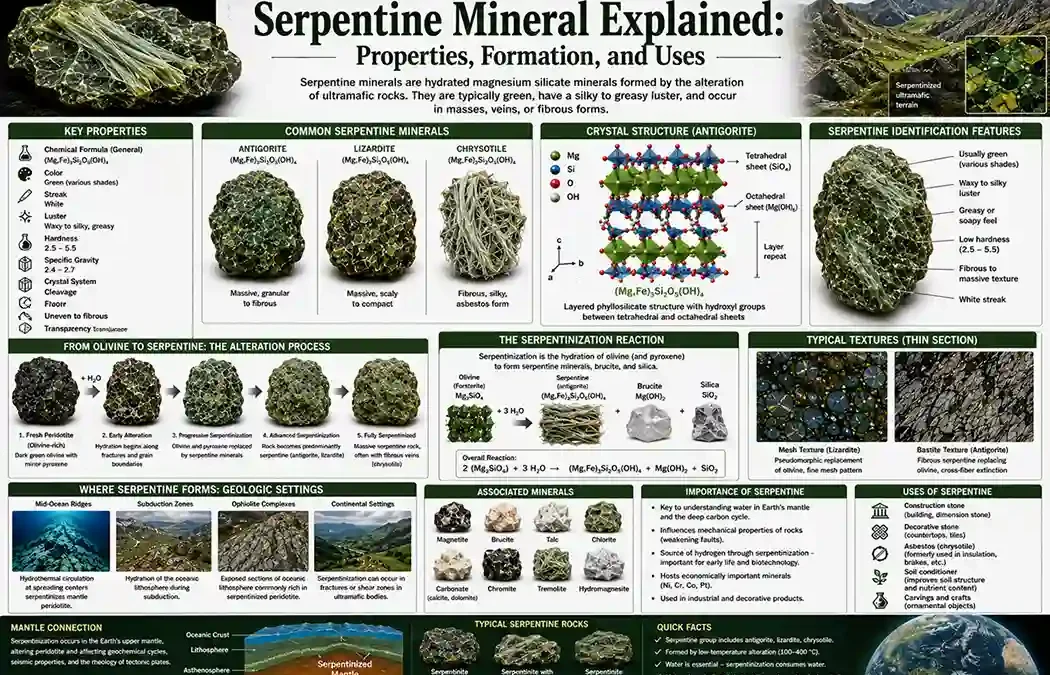
Serpentine is a group of green hydrated magnesium silicate minerals commonly formed by the alteration of ultramafic rocks such as peridotite and dunite. These minerals are important indicators of hydrothermal activity and play a major role in the transformation of Earth's mantle rocks.
Serpentine minerals are widely distributed and are known for their:
- green coloration
- waxy appearance
- low hardness
- association with ultramafic rocks
The name "serpentine" comes from its resemblance to snake skin, often displaying mottled green patterns.
Learn more → olivine-mineral-explained
What Is Serpentine?
Serpentine is a group of hydrated magnesium silicate minerals. A common serpentine formula is:
Serpentine minerals contain:
- magnesium
- silicon
- oxygen
- hydroxyl groups
They belong to the phyllosilicate (sheet silicate) group
Basic Properties of Serpentine
| Property | Value |
|---|---|
| Chemical Formula | Mg₃Si₂O₅(OH)₄ |
| Mineral Group | Serpentine |
| Crystal System | Monoclinic / Orthorhombic |
| Hardness | 2.5–5.5 |
| Streak | White |
| Luster | Waxy to Greasy |
Major Minerals in the Serpentine Group
The serpentine group consists primarily of:
Antigorite
Common metamorphic serpentine mineral.
Lizardite
Often found in altered ultramafic rocks.
Chrysotile
Fibrous variety commonly known as white asbestos.
Common Serpentine Minerals
| Mineral | Habit |
|---|---|
| Antigorite | Platy |
| Lizardite | Massive |
| Chrysotile | Fibrous |
Why Is Serpentine Green?
The characteristic green color comes mainly from Iron and Magnesium
These elements produce colors ranging from:
- pale green
- yellowish green
- olive green
- dark green
Color intensity depends on mineral composition and impurities.
Crystal Structure of Serpentine
Serpentine has a layered structure composed of:
- silica sheets
- magnesium hydroxide sheets
Its crystal structure contributes to:
- softness
- flexibility in some varieties
- waxy appearance
Learn more → crystal-structure-in-minerals
Crystal Systems of Serpentine
Different serpentine minerals belong to different crystal systems.
Antigorite
Monoclinic
Chrysotile
Monoclinic
Lizardite
Often Orthorhombic or Trigonal depending on structure
Because serpentine is usually massive, crystal forms are rarely obvious in hand specimens.
Learn more → crystal-systems-explained
Physical Properties of Serpentine
| Property | Description |
|---|---|
| Color | Green, yellow-green, olive-green |
| Streak | White |
| Luster | Waxy to greasy |
| Hardness | 2.5–5.5 |
| Cleavage | Poor to perfect |
| Transparency | Opaque to translucent |
| Specific Gravity | 2.4–2.7 |
How Serpentine Forms
Serpentine forms primarily through serpentinization. This process occurs when ultramafic rocks react with water.
Common parent minerals include:
- olivine
- pyroxene
- peridotite
A simplified reaction is Olivine+Water→Serpentine+Magnetite. This reaction is important in oceanic crust and mantle environments.
Serpentine and Ultramafic Rocks
Serpentine is strongly associated with:
Peridotite
Mantle-derived rock rich in olivine.
Dunite
Rock composed mostly of olivine.
Harzburgite
Common mantle rock altered to serpentine.
Large serpentine bodies often represent altered mantle rocks exposed at Earth's surface.
Learn more → olivine-mineral-explained
Geological Importance of Serpentinization
A Major Earth Process Serpentinization influences:
- plate tectonics
- hydrothermal systems
- ocean floor geology
- hydrogen production
- deep Earth water cycling
Scientists study serpentinization to understand Earth's mantle and early life environments.
Serpentine and Asbestos
One serpentine mineral, chrysotile, is known as white asbestos
Historically used in:
- insulation
- roofing materials
- fireproof products
Today, health concerns limit its use because inhaled fibers can cause serious respiratory diseases.
Industrial Uses of Serpentine
Serpentine has several commercial applications.
Decorative Stone
Used in carvings and architecture.
Gem Materials
Some varieties are cut into cabochons.
Construction Stone
Used as ornamental building material.
Geological Research
Important for studying mantle alteration.
Major Uses of Serpentine
| Industry | Application |
|---|---|
| Architecture | Decorative stone |
| Art | Carvings |
| Jewelry | Gem material |
| Geology | Scientific research |
Serpentine in Mineral Identification
Geologists identify serpentine using:
- green color
- waxy luster
- soft hardness
- association with ultramafic rocks
- smooth, polished surfaces
Its waxy feel is often one of the easiest diagnostic features.
Learn more → mineral-identification-guide
Serpentine Identification Summary
| Property | Serpentine |
|---|---|
| Hardness | 2.5–5.5 |
| Color | Green |
| Streak | White |
| Luster | Waxy |
| Structure | Sheet Silicate |
| Mineral Group | Serpentine |
Serpentine is a group of hydrated magnesium silicate minerals formed through alteration of ultramafic rocks.
Its green color comes primarily from magnesium and iron within the mineral structure.
Serpentinization is the process where ultramafic rocks react with water to form serpentine minerals.
Yes. Chrysotile, a member of the serpentine group, is the most common type of asbestos.
Serpentine occurs in altered mantle rocks, oceanic crust, metamorphic belts, and ultramafic rock complexes.
Final Thoughts
Serpentine is one of the most important alteration minerals in geology, linking water, mantle rocks, and tectonic processes. Its formation through serpentinization helps scientists understand oceanic crust evolution, hydrothermal systems, and the chemical cycling of Earth's interior.
From decorative stone and gemstones to major geological processes beneath the oceans, serpentine demonstrates the remarkable transformation of minerals through water-rock interaction.