
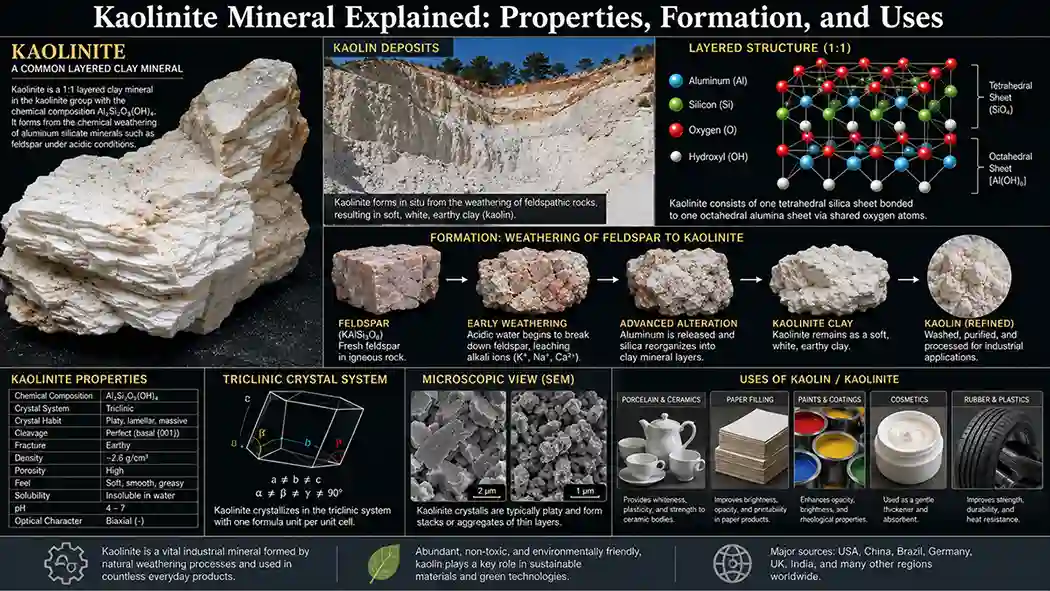
Kaolinite is one of the most important clay minerals on Earth. It forms through the weathering of feldspar-rich rocks and is a major component of many soils, sedimentary deposits, and industrial clay resources.
The mineral is best known as the primary component of:
- kaolin clay
- porcelain
- ceramics
- paper coatings
Kaolinite plays a critical role in geology because it records chemical weathering processes and helps scientists understand how rocks break down at Earth's surface.
Learn more → chemical properties of minerals
What Is Kaolinite?
Kaolinite is a hydrated aluminum silicate clay mineral. Its chemical formula is: . Kaolinite belongs to the phyllosilicate (clay mineral) group. It is one of the most common minerals produced by chemical weathering.
Basic Properties of Kaolinite
| Property | Value |
|---|---|
| Chemical Formula | Al₂Si₂O₅(OH)₄ |
| Mineral Group | Phyllosilicate |
| Crystal System | Triclinic |
| Hardness | 2–2.5 |
| Streak | White |
| Luster | Earthy to Pearly |
How Kaolinite Forms
Kaolinite forms primarily through:
Chemical Weathering
Feldspar minerals react with water and acidic solutions.
Hydrothermal Alteration
Hot fluids alter aluminum-rich rocks.
Tropical Weathering
Warm, humid climates accelerate kaolinite formation.
Soil Development
Kaolinite commonly accumulates in mature soils.
Kaolinite from Feldspar Weathering
One of the most common formation pathways is: Feldspar → Kaolinite Transformation
Simplified weathering reaction:
2KAlSi3O8+2H++9H2O→Al2Si2O5(OH)4+4H4SiO4+2K+ This process explains why kaolinite is abundant in weathered granite and feldspar-rich rocks.
Learn more → feldspar mineral explained
Crystal Structure of Kaolinite
Kaolinite has a layered structure composed of:
- silica sheets
- aluminum hydroxide sheets
These layers stack together to form:
- fine clay particles
- soft textures
- low swelling behavior
Its crystal structure controls many of its engineering and industrial properties.
Learn more → crystal structure in minerals
Crystal System of Kaolinite
Kaolinite belongs to the triclinic crystal system. Its crystallographic relationship is: . However, individual crystals are usually microscopic and rarely visible without specialized instruments.
Learn more → triclinic crystal system
Physical Properties of Kaolinite
| Property | Description |
|---|---|
| Color | White to cream |
| Streak | White |
| Luster | Earthy, dull, pearly |
| Hardness | 2–2.5 |
| Cleavage | Perfect microscopic cleavage |
| Transparency | Opaque |
| Specific Gravity | 2.6 |
Kaolin and Kaolinite
Kaolin is a clay-rich rock composed mainly of kaolinite.
Kaolin deposits are mined for:
- ceramics
- paper manufacturing
- cosmetics
- industrial fillers
Not all kaolin is pure kaolinite, but kaolinite is usually the dominant mineral.
Kaolinite in Soils
Kaolinite is common in:
- tropical soils
- subtropical soils
- highly weathered landscapes
Its presence indicates:
- intense chemical weathering
- long-term soil development
- humid climatic conditions
Industrial Uses of Kaolinite
Kaolinite is one of the most important industrial clay minerals.
Ceramics
Used in porcelain and fine pottery.
Paper Industry
Provides smooth coatings and brightness.
Paints
Acts as a filler and extender.
Cosmetics
Used in powders and skincare products.
Pharmaceuticals
Found in certain medicinal products.
Major Uses of Kaolinite
| Industry | Application |
|---|---|
| Ceramics | Porcelain and pottery |
| Paper | Surface coatings |
| Paint | Fillers |
| Cosmetics | Face powders |
| Pharmaceuticals | Medicinal products |
Kaolinite vs Other Clay Minerals
| Property | Kaolinite | Smectite |
|---|---|---|
| Swelling | Low | High |
| Water Absorption | Moderate | Very High |
| Layer Structure | Simple | Expandable |
| Engineering Stability | Better | Lower |
This difference is important in soil science and engineering geology.
Kaolinite in Mineral Identification
Geologists identify kaolinite using:
- white color
- soft texture
- earthy appearance
- association with weathered feldspar
- clay-rich deposits
Laboratory techniques such as X-ray diffraction are often needed for precise identification.
Learn more → mineral identification guide
Kaolinite Identification Summary
| Property | Kaolinite |
|---|---|
| Formula | Al₂Si₂O₅(OH)₄ |
| Hardness | 2–2.5 |
| Crystal System | Triclinic |
| Color | White |
| Streak | White |
| Mineral Group | Clay Mineral |
Kaolinite is a hydrated aluminum silicate mineral with the formula Al₂Si₂O₅(OH)₄.
It forms mainly through the chemical weathering of feldspar-rich rocks.
Kaolin is a clay-rich material composed primarily of kaolinite.
Kaolinite is used in ceramics, paper, paint, cosmetics, and pharmaceuticals.
Kaolinite belongs to the triclinic crystal system.
Final Thoughts
Kaolinite is one of the world's most important clay minerals and a key product of chemical weathering. Its role in soil formation, sedimentary processes, and industrial applications makes it highly significant in both geology and modern manufacturing.
From weathered granite landscapes to porcelain production and paper coatings, kaolinite demonstrates how clay minerals connect Earth's surface processes with everyday human activities.