
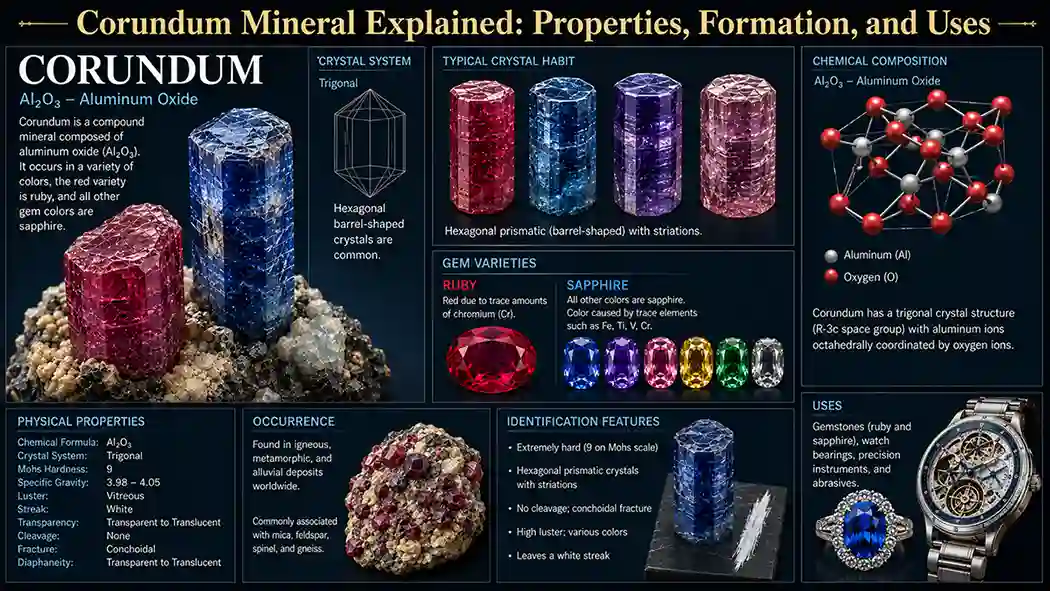
Corundum is one of the most valuable and scientifically important minerals on Earth. It is best known as the mineral that forms the gemstones ruby and sapphire, two of the most prized gems in the world.
Composed of aluminum oxide, corundum is exceptionally hard and ranks just below diamond on the Mohs Hardness Scale. Its durability, beauty, and resistance to weathering make it important in both gemology and industry.
Corundum occurs in:
- metamorphic rocks
- igneous rocks
- placer deposits
- pegmatites
It is one of the most important gemstone minerals and industrial abrasives.
Learn more → what is a mineral
What Is Corundum?
Corundum is an aluminum oxide mineral. Its chemical formula is:
Corundum consists primarily of:
- aluminum (Al)
- oxygen (O)
It belongs to the Oxide Mineral Group and is one of the hardest naturally occurring minerals.
Basic Properties of Corundum
| Property | Value |
|---|---|
| Chemical Formula | Al₂O₃ |
| Mineral Group | Oxide |
| Crystal System | Trigonal |
| Hardness | 9 |
| Streak | White |
| Luster | Adamantine to Vitreous |
Why Is Corundum So Hard?
Corundum's hardness comes from strong aluminum-oxygen bonds
Its tightly packed crystal structure creates:
- exceptional hardness
- resistance to abrasion
- outstanding durability
Corundum ranks 9 on the Mohs Hardness Scale, making it second only to diamond among common natural minerals.
Learn more → mohs hardness scale
Crystal Structure of Corundum
Corundum contains:
- oxygen atoms arranged in a dense structure
- aluminum atoms occupying specific positions
- strong ionic bonding
This structure produces:
- hardness
- durability
- gemstone quality transparency
Learn more → crystal structure in minerals
Crystal System of Corundum
Corundum belongs to the trigonal crystal system. Its symmetry can be represented by:
Common crystal forms include:
- barrel-shaped crystals
- hexagonal prisms
- bipyramids
Learn more → trigonal crystal system
Physical Properties of Corundum
| Property | Description |
|---|---|
| Color | Colorless, red, blue, yellow, green |
| Streak | White |
| Luster | Vitreous to Adamantine |
| Hardness | 9 |
| Cleavage | None |
| Fracture | Conchoidal to uneven |
| Specific Gravity | 3.9–4.1 |
Ruby: The Red Variety
Ruby is the red gemstone variety of corundum. Its color is caused by trace amounts of chromium. Ruby is one of the most valuable gemstones in the world.
Characteristics:
- deep red color
- exceptional hardness
- strong brilliance
Sapphire: The Blue Variety
Sapphire is any gem-quality corundum that is not ruby. Blue sapphire obtains its color from iron and titanium impurities.
Sapphires may also occur in:
- yellow
- pink
- green
- purple
- colorless
Ruby vs Sapphire
| Property | Ruby | Sapphire |
|---|---|---|
| Mineral | Corundum | Corundum |
| Color Cause | Chromium | Iron & Titanium |
| Typical Color | Red | Blue |
| Hardness | 9 | 9 |
How Corundum Forms
Corundum forms in:
Metamorphic Rocks
High-temperature metamorphism produces corundum.
Igneous Rocks
Some corundum crystallizes from aluminum-rich magmas.
Pegmatites
Rare occurrences in coarse-grained igneous rocks.
Placer Deposits
Weathering concentrates corundum gemstones.
Corundum in Gemstone Deposits
Major gemstone-producing regions include:
- Myanmar
- Sri Lanka
- Madagascar
- Thailand
- Tanzania
- Australia
These areas are famous for high-quality rubies and sapphires.
Industrial Uses of Corundum
Corundum is widely used because of its hardness.
Abrasives
Used in sandpaper and grinding wheels.
Cutting Tools
Industrial polishing applications.
Gemstones
Ruby and sapphire jewelry.
Precision Instruments
Used in watches and scientific equipment.
Major Uses of Corundum
| Industry | Application |
|---|---|
| Jewelry | Ruby and sapphire |
| Abrasives | Grinding and polishing |
| Manufacturing | Cutting tools |
| Technology | Precision components |
Corundum in Mineral Identification
Geologists identify corundum using:
- hardness of 9
- white streak
- trigonal crystal forms
- lack of cleavage
- high density
Its exceptional hardness is the most important diagnostic feature.
Learn more → mineral identification guide
Corundum Identification Summary
| Property | Corundum |
|---|---|
| Formula | Al₂O₃ |
| Hardness | 9 |
| Crystal System | Trigonal |
| Cleavage | None |
| Streak | White |
| Mineral Group | Oxide |
Corundum is composed of aluminum oxide (Al₂O₃).
Yes. Ruby is the red gemstone variety of corundum.
Yes. Sapphire is gem-quality corundum that is not red.
Corundum has a hardness of 9 on the Mohs Hardness Scale.
Corundum belongs to the trigonal crystal system.
Final Thoughts
Corundum is one of the most remarkable minerals in geology and gemology. Its exceptional hardness, beautiful crystal forms, and gemstone varieties ruby and sapphire make it one of the most valuable minerals on Earth.
From jewelry and industrial abrasives to scientific applications, corundum demonstrates how mineral properties can create both economic value and geological significance.